
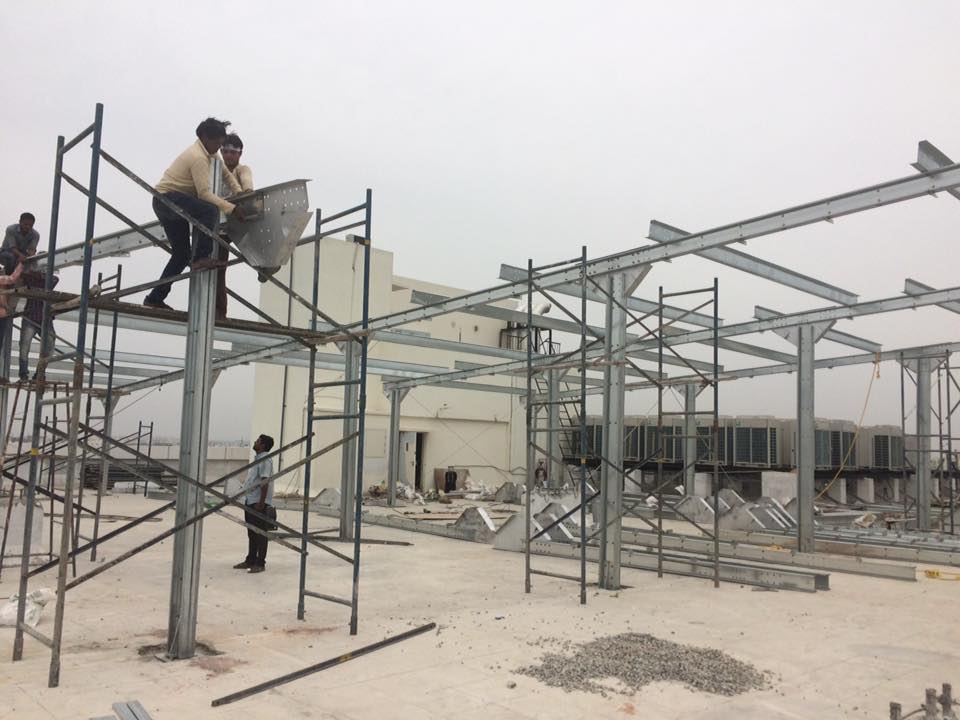
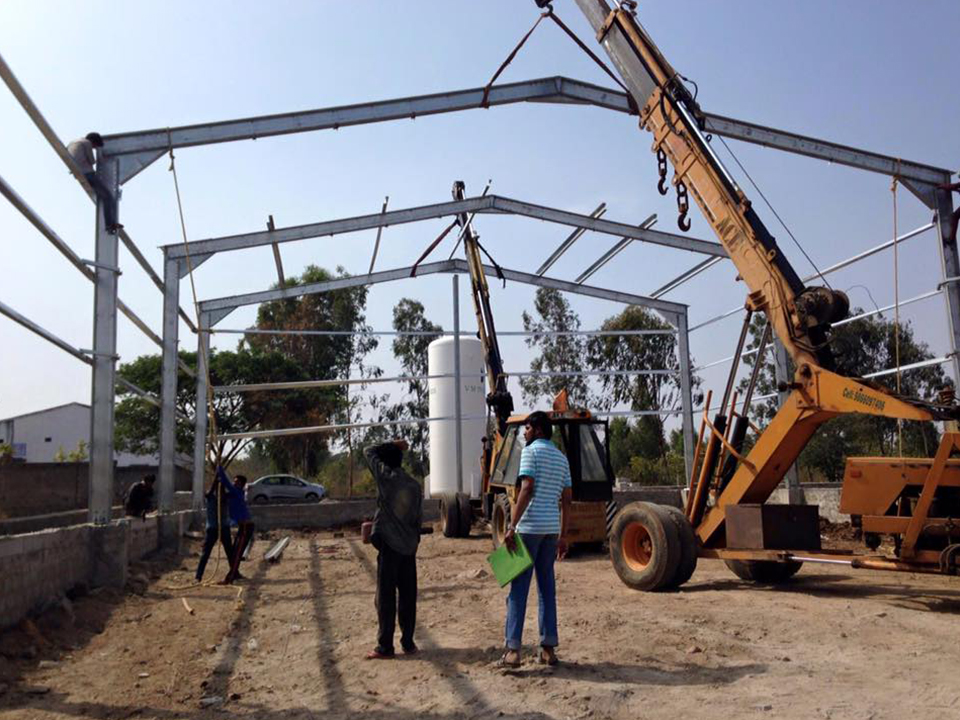
Quick Answer: Cold roll formed steel construction uses thin steel strip roll-formed into structural sections at room temperature. The process work-hardens the steel, giving a high strength-to-weight ratio with tight, repeatable dimensions. In a pre-engineered building it produces the purlins and girts; as a complete system it forms light gauge framing for low-rise buildings, partitions, mezzanine framing and modular structures. Its advantages are low weight (which reduces foundation cost), dimensional accuracy and fast assembly. Its limit is span and load — heavy crane duty and wide clear spans still need hot-rolled or built-up sections.
Benefits of Cold Roll Formed Buildings
Adaptability and Flexibility: Cold-formed steel offers remarkable flexibility in building design due to its lightweight nature and ease of handling. This allows for a wide range of design choices that are not economically feasible with traditional framing materials.
Consistent Quality: Cold-formed steel is dimensionally precise and manufactured to strict tolerances, ensuring high-quality construction without the issues of knots, warps, or twists typically found in other materials.
Light Weight: Cold-formed steel members are up to 40% lighter than conventional lumber, reducing overall building and seismic loads.
Applications of Cold Roll Formed Buildings
Cold Roll Formed Buildings are versatile and can be used in various applications, including:
- Health Care Centers
- Community Centers
- Site Offices
- Mass Housing
- Pent Houses (Terrace Structures)
- Relief Camps
- Labour Camps
- Schools
- Solar Roof Tops
- Canteens
Special Features of Cold Roll Formed Buildings
Our Cold Roll Formed Buildings come with several special features that enhance their functionality and performance:
- Spans up to 15 meters
- Clear height up to 6 meters
- Variety of Sheeting: Galvanized, Galvalume
- Wall Options: Sheeted, Block works
- Covered Ceilings: Roof liners
- Insulation for Roof and Walls
- Partition Walls
- Custom-Designed
- Defence Shelters
- Special Accessories: Doors, windows, ventilators, etc.
Why Choose Kishore Industries for Cold Roll Formed Buildings?
Kishore Industries is committed to delivering high-quality cold roll-formed steel structures that meet the highest industry standards. Our innovative approach ensures that each project is completed with precision, efficiency, and cost-effectiveness. Trust Kishore Industries for all your cold roll-formed building needs and experience superior quality and performance.
Get a Free PEB Design & Indicative Estimate.
Share your plot location and requirement — our engineers call you back within 24 hours with a PEB factory or warehouse design and transparent costing.
- Clear-span PEB buildings engineered per IS 800
- Wind & seismic design per IS 875 Part 3 / IS 1893
- In-house fabrication at Jeedimetla, Hyderabad
- Faster erection than RCC — months, not years
- 45+ years steel fabrication, 700+ projects delivered
Prefer to speak directly? Call 9440407852
Our PEB engineers will call you back shortly with your free PEB proposal and quotation.
Want a faster response?
📱 Chat with us on WhatsAppFrequently Asked Questions About Cold Roll Formed Buildings
What is cold roll formed steel?
Cold roll forming shapes steel coil into a structural section at room temperature, by passing it through a series of rollers rather than by heating and rolling it. The process work-hardens the steel, so a thin section achieves a useful strength-to-weight ratio. C and Z purlins, girts and light framing members are made this way.
How does a cold formed building differ from a hot-rolled steel building?
Cold formed sections are thinner and lighter, which suits light to medium loads and shorter spans, and makes the structure cheaper to transport and erect. Hot-rolled sections carry heavier loads over longer spans. The design considerations also differ: cold formed members are governed by local buckling of thin elements, so section shape matters as much as thickness.
What are cold roll formed buildings used for?
Light industrial sheds and workshops, warehousing with moderate loading, agricultural and poultry buildings, godowns, canopies and covered storage, and secondary framing inside larger structures. They suit buildings where the loads are modest and speed and cost matter more than heavy load capacity.
What are the benefits of cold roll formed construction?
Low structural weight, which reduces both foundation cost and erection plant; dimensional consistency, because sections are rolled to a precise profile; fast erection, since members are light enough to handle without heavy cranage; and efficient material use, as the profile is rolled to the length required with little waste.
What thickness range is used?
Typically 0.8 mm to around 3 mm for cold formed structural members, with industrial roof purlins commonly between 1.6 mm and 2.5 mm. The right thickness follows from span, spacing and loading. A deeper section in the same thickness carries considerably more, which is why specifying by thickness alone is a mistake.
Do you roll sections to project requirement?
Yes. The in-house Z and C purlin mill rolls sections to the project’s requirement rather than to stock sizes, so purlin depth, thickness and spacing can be optimised against the actual roof loading. On a large roof that is a meaningful saving, because secondary steel is a substantial share of total tonnage.
Are cold formed buildings durable?
Yes, provided the coating specification matches the exposure. Because the sections are thin, corrosion protection matters proportionally more than it does on heavy steel — the same rate of loss removes a larger share of the section. Galvanised coil and appropriate coatings, with sealed laps and correctly specified fasteners, are what deliver the design life.
Can a cold formed building take an overhead crane?
Light crane provision can be accommodated where it is designed in from the start, but heavier cranes call for a hot-rolled or built-up primary frame, with cold formed members used for secondary framing. As always, the crane capacity, hook height and duty class must be fixed before engineering begins.
How quickly can a cold formed building be erected?
Faster than an equivalent heavy steel building, because members are light enough to handle without major lifting plant and connections are bolted. For a standard building, fabrication and erection typically run to a few weeks once the design is approved and foundations are ready. Design approval, not erection, usually sets the completion date.
What does a cold roll formed building cost?
For light industrial and storage buildings, costs sit at the lower end of the general PEB range, an indicative ₹1,400–1,800 per sq ft depending on span, height and envelope specification. These are indicative planning estimates rather than quotations. Clear height and span remain the dominant cost levers.