
Silos and Storage Solutions by Kishore Infratech Private Limited
Quick Answer: Silos and grain bins store bulk material in a sealed vessel rather than in bags, cutting handling losses, pest damage and moisture spoilage while making loading and discharge mechanical. The design parameters are capacity and the bulk density of the stored commodity (which changes the structural loading), aeration and moisture management to prevent hot spots, the discharge arrangement, and a foundation designed for a heavy concentrated load. A silo is normally part of a wider system — intake, cleaning, conveying and outloading — so plan the site layout alongside the vessel.
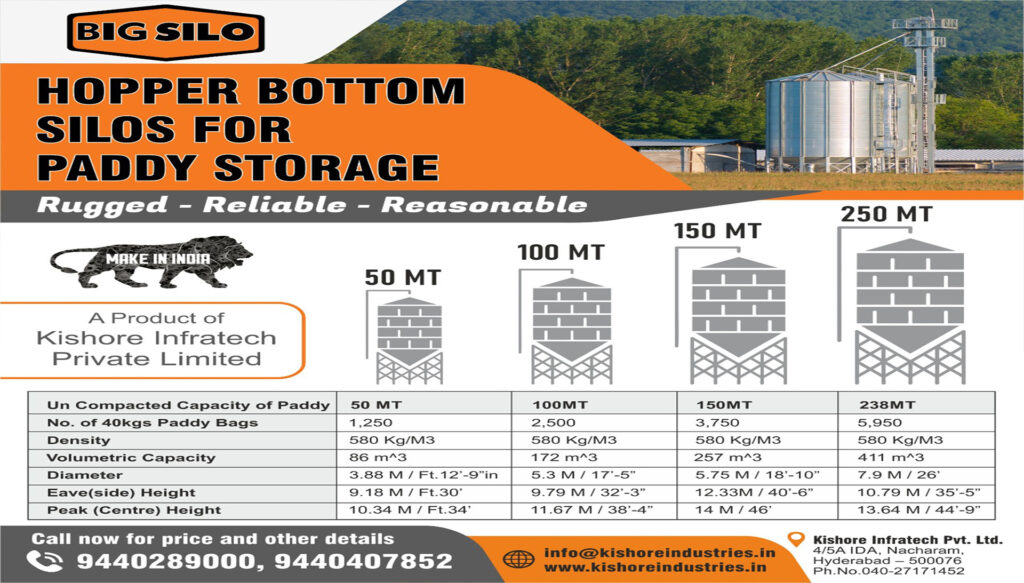
Grain Storage Systems
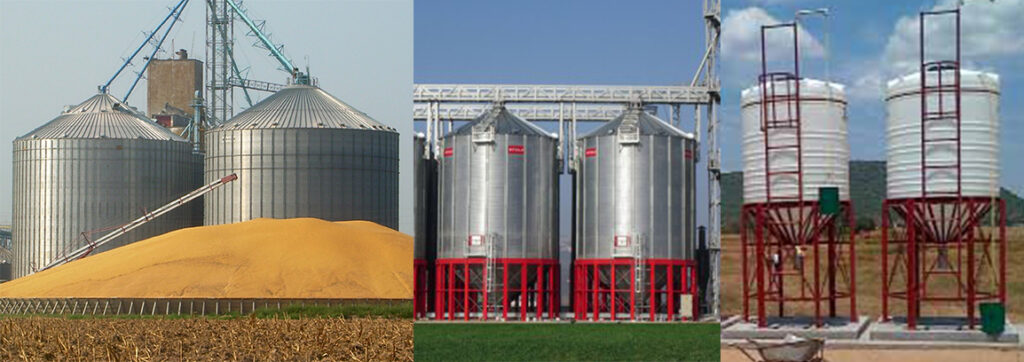
KIPL offers advanced Grain Storage Systems that include:
- Grain Storage Silos: Designed for long-term durability and efficiency.
- Material Handling Equipment: Ensures seamless movement and storage of grains.
- Monitoring Systems: Facilitates real-time tracking and management.
- Aeration Systems: Maintains optimal storage conditions.
- Automation Systems: Enhances operational efficiency and reduces manual intervention.
Our grain bins are meticulously designed and manufactured to provide hassle-free service for an extended period.
Engineering and Design Standards
KIPL silos are engineered to meet rigorous specifications and standards:
- Dynamic Analysis: Conducted based on seismic and soil conditions of the installation site.
- Snow Load Calculation: Tailored to the specific environmental conditions of the installation area.
- Wind Load Calculation: Adjusted according to the silo’s height, particularly for empty silos.
Expertise in Liquid Storage Silos
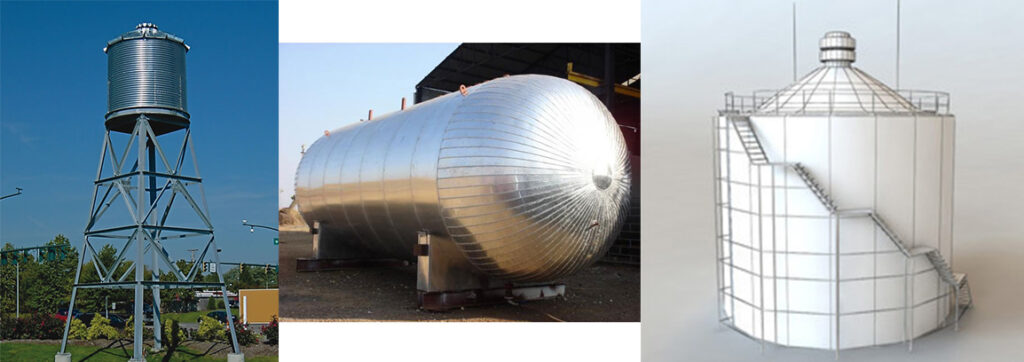
Kishore Infratech has built a solid reputation for providing expert commercial services, including the design, manufacturing, supply, installation, erection, and completion of various types of liquid storage silos. Our services cater to diverse applications and industries, ensuring comprehensive solutions.
Additional Services and Infrastructure Solutions
KIPL extends its expertise beyond storage silos to offer:
- Water Infrastructure: Comprehensive solutions for water storage and management.
- Solid Waste Management: Effective systems for handling and processing waste.
- Agricultural Infrastructure: Advanced solutions for agricultural storage and operations.
- Stainless Steel Water Storage Tanks: Durable and efficient tanks for various water storage needs.
Industrial Liquid Storage Solutions
We provide industrial liquid storage solutions from concept to commissioning, including:
- Overhead Water Tanks
- Elevated Tanks
- Underground Tanks
- On-the-Ground Tanks
KIPL also supports clients with optimization services for new or rehabilitated water plants, catering to both private and government water schemes. Our commitment extends to the Operations & Maintenance phase, ensuring long-term performance and reliability.
Why Choose KIPL for Your Storage Needs?
Kishore Infratech is dedicated to delivering top-tier storage solutions with unmatched expertise and customer support. Our comprehensive approach ensures that every project meets the highest standards of quality and efficiency.
Get a Free Design Review & Indicative Estimate.
Share your plot location and requirement — our engineers call you back within 24 hours with a PEB factory or warehouse design and transparent costing.
- Clear-span PEB buildings engineered per IS 800
- Wind & seismic design per IS 875 Part 3 / IS 1893
- In-house fabrication at Jeedimetla, Hyderabad
- Faster erection than RCC — months, not years
- 45+ years steel fabrication, 700+ projects delivered
Prefer to speak directly? Call 9440407852
Our PEB engineers will call you back shortly with your free PEB proposal and quotation.
Want a faster response?
📱 Chat with us on WhatsAppFrequently Asked Questions About Silos and Storage
What types of silos do you manufacture?
Grain storage silos for paddy, rice, wheat, maize and pulses, and liquid storage silos and tanks for industrial use. Both are engineered structures rather than containers — the design follows the stored material’s density, flow behaviour and discharge method. A silo sized for grain cannot simply be reused for a different material.
Why store grain in a silo rather than in bags in a godown?
Bulk storage removes the handling, bag cost and labour of a bagged operation, and gives far better control over moisture, pests and stock rotation. It suits operations handling continuous volume, such as rice mills and processing plants. Bagged godown storage remains appropriate where throughput is intermittent or the product is already packed.
What determines the structural design of a grain silo?
The bulk density of the stored material, the wall pressures it exerts both at rest and during discharge, the hopper angle needed for reliable flow, and the wind and seismic loading at the site. Discharge pressures are higher than filling pressures, which is the point most often underestimated. Foundation design follows from the total stored mass, which is substantial.
How is silo capacity specified?
By the mass of material stored, not by volume alone, because bulk density varies between commodities — the same silo holds different tonnages of paddy, wheat and maize. Capacity should be sized against peak procurement intake and the intended turnover cycle rather than annual throughput. Oversizing costs capital; undersizing forces bagged overflow storage anyway.
What hopper angle does a silo need?
It depends on the flow properties of the stored material, and it must exceed the angle at which that material will reliably slide rather than arch across the outlet. Too shallow a hopper causes bridging and rat-holing, which then needs manual intervention to clear. This is a design input, not a detail to settle on site.
How is moisture and pest control managed in bulk storage?
Through a sealed structure, aeration to control the temperature and moisture of the grain mass, and the ability to close the silo for fumigation where required. Grain going in above safe moisture content will not be rescued by the structure, so intake drying and moisture measurement are part of the system. Temperature monitoring is what gives early warning of a developing problem.
What liquid storage solutions do you supply?
Industrial liquid storage silos and tanks, designed for the specific liquid’s density, temperature and corrosivity. The material specification and internal lining follow from what is being stored; a tank suited to one liquid may be unsuitable for another. Foundation and anchorage design matter particularly, because an empty tank is vulnerable to wind uplift.
Can a silo be integrated with an existing mill or plant?
Yes, and it is often the most economical way to expand storage, because it moves storage out of the covered building. Integrating external silos with a rice mill typically frees 2,000–3,000 sq ft of building footprint. The connection points — conveying in, discharge out and the electrical supply — should be designed with the silo, not after it.
What foundation does a silo require?
A foundation designed for the full stored mass plus wind and seismic loads, on the basis of a site soil investigation. Silo foundations carry a concentrated load over a small footprint, which makes them more sensitive to bearing capacity and differential settlement than a shed foundation. A soil report is not optional for this structure type.
What design standards do you work to?
Silos are engineered to the applicable Indian standards for structural design, wind and seismic loading, together with the accepted design practice for bulk material pressures. Kishore Infratech Private Limited is ISO 9001:2015 certified and supplies design calculations and drawings with the structure.