
The PEB erection process is the most critical phase in any pre-engineered building project — it transforms factory-manufactured steel components into a fully standing structure on your site. Whether you’re building a warehouse, factory shed, or industrial facility, understanding the step-by-step PEB installation process helps you plan timelines, ensure safety compliance, and avoid costly mistakes during construction.
Quick Answer: The PEB erection process involves 8 key steps — site preparation, anchor bolt installation, column erection, rafter assembly, purlin and girt fixing, roof sheeting, wall cladding, and finishing work. A standard 10,000 sq ft PEB structure takes 15–25 days for erection, while larger projects (50,000+ sq ft) require 45–75 days. Proper foundation curing (14–21 days before erection) and crane planning are the two most common factors that affect PEB installation timelines.
Disclaimer: Timelines and processes described are based on standard PEB erection practices. Actual erection duration varies by project size, site conditions, weather, crane availability, and structural complexity. Always follow your PEB manufacturer’s erection manual and safety guidelines.
What Is PEB Erection?
PEB erection is the on-site assembly and installation of pre-engineered building components that have been designed, fabricated, and shipped from a manufacturing facility. Unlike conventional steel construction where members are cut and welded on-site, PEB erection involves bolting together pre-fabricated primary frames (columns and rafters), secondary members (purlins, girts, eave struts), and cladding (roof and wall sheets) using high-strength bolts. This bolt-up approach makes PEB installation significantly faster — typically 40–50% quicker than conventional steel erection.
Pre-Erection Requirements: Before the PEB Installation Begins
Before a single column goes up, several preparatory activities must be completed. Skipping or rushing pre-erection work is the most common reason for delays during PEB structure installation.
Key takeaway: Foundation work and anchor bolt accuracy are the two make-or-break factors before PEB erection. Anchor bolts must be placed within ±3mm tolerance — even a 5mm deviation can cause column misalignment that cascades through the entire structure.
| Pre-Erection Activity | Details | Timeline |
|---|---|---|
| Foundation completion | RCC isolated/combined footings as per PEB design drawings | 15–25 days |
| Foundation curing | Minimum 14 days curing; 21 days recommended before loading | 14–21 days |
| Anchor bolt verification | Check bolt location, projection, level using survey instruments | 1–2 days |
| Material receipt & inspection | Unload, inspect for transport damage, verify against packing list | 1–3 days |
| Material sorting & staging | Organize components by erection sequence near installation zones | 1–2 days |
| Crane & equipment mobilization | Position cranes, boom lifts, and safety equipment on site | 1 day |
| Erection crew briefing | Review erection drawings, safety plan, bolt torque specs | Half day |
PEB Erection Process: Complete Step-by-Step Guide
The PEB erection process follows a specific sequence that ensures structural stability at every stage. Here is the complete step-by-step breakdown of how a pre-engineered building is erected on site.
Step 1: Site Preparation and Layout Marking
The first step in PEB installation is verifying the site layout against engineering drawings. Survey teams mark column grid lines, check foundation levels, and confirm that anchor bolt positions match the PEB manufacturer’s anchor bolt plan. Any deviation beyond ±3mm must be corrected before proceeding — shimming or grouting can fix minor level differences, but bolt location errors often require chipping and re-setting.
- Verify column centre-to-centre dimensions against erection drawings
- Check anchor bolt projection height (typically 50–100mm above pedestal)
- Confirm foundation top level using auto-level or total station
- Mark crane positioning zones and material staging areas
- Ensure clear access roads for crane movement between bays
Step 2: Column Erection
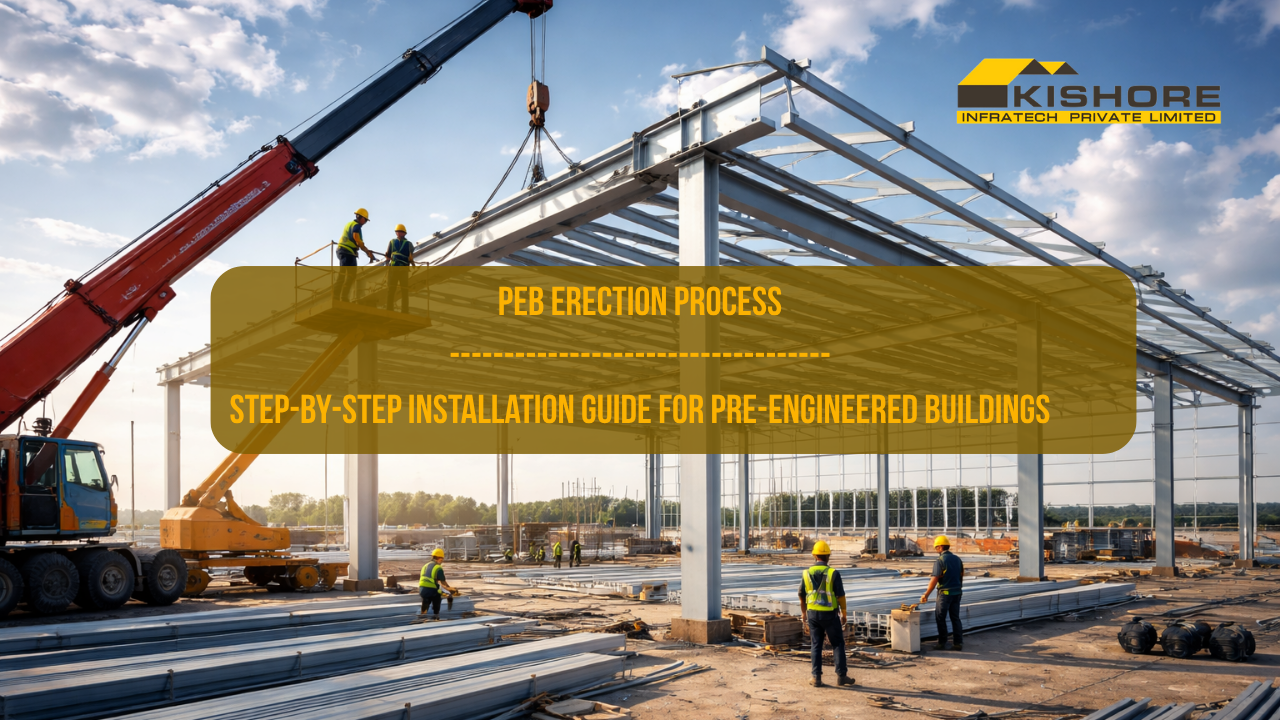
Column erection is the first major structural activity in the PEB erection process. Columns are lifted using a crane, placed over anchor bolts, and temporarily secured with levelling nuts before final tightening. Each column must be plumbed (checked for vertical alignment) in both directions using a plumb bob or digital inclinometer.
Key takeaway: Columns are erected in pairs (one on each side of a frame) to allow immediate rafter connection. A typical erection crew installs 4–6 column pairs per day for standard heights (8–12m). For buildings taller than 15m, columns may arrive in two spliced sections that are bolted together on the ground before lifting.
- Lift column with crane using pre-attached lifting lugs
- Guide column onto anchor bolts — use tag lines to control swing
- Hand-tighten levelling nuts and check plumb in both axes
- Install temporary guy wires or bracing for stability
- Do NOT release crane until temporary bracing is secured
Step 3: Rafter and Ridge Assembly
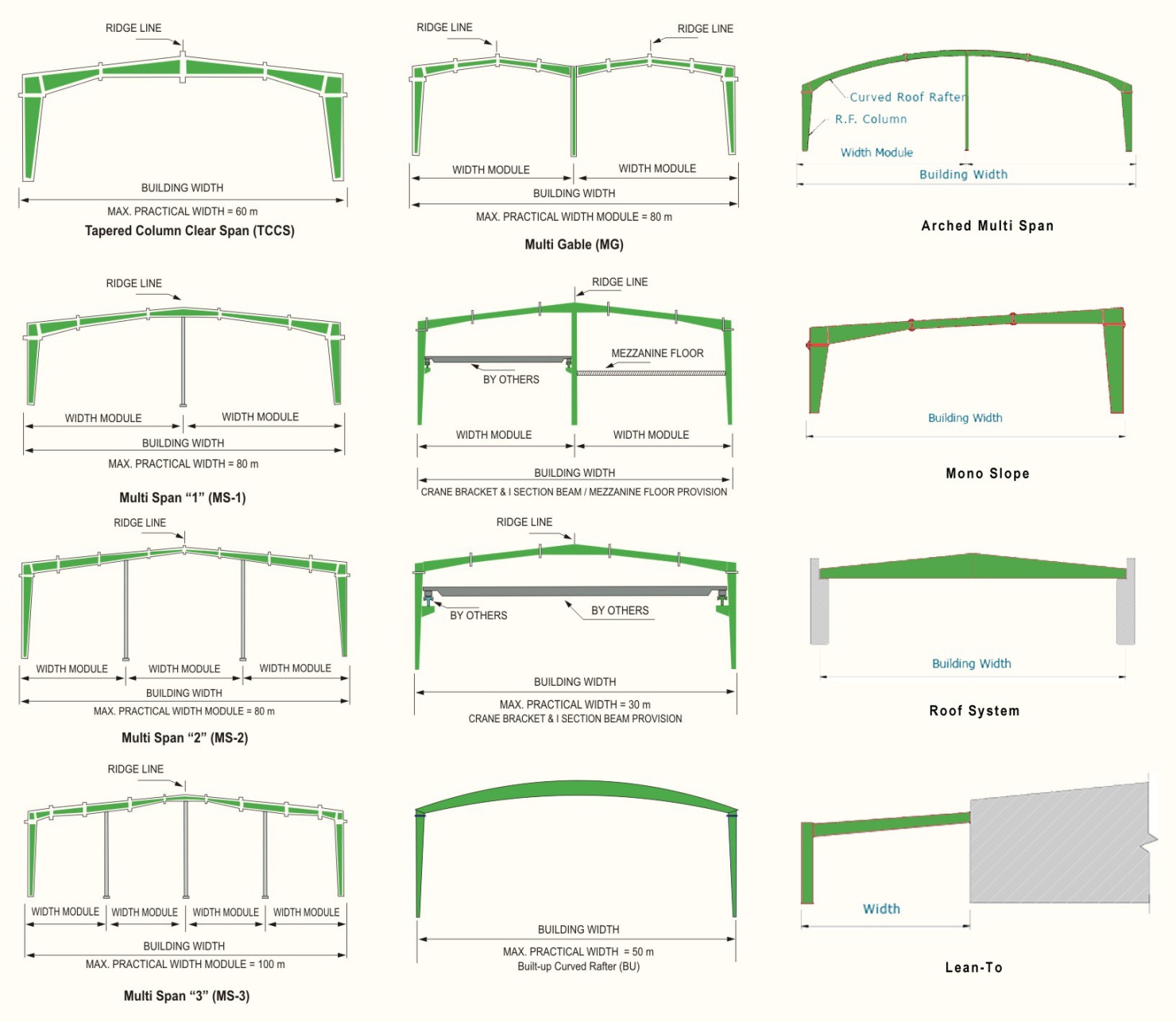
Rafters (roof beams) are the primary horizontal members that connect column pairs and form the roof slope. In most PEB designs, each rafter comes in two halves that are bolted at the ridge (apex) and at the column-rafter connection (knee joint). For spans above 30m, rafters may have additional splice points.
The rafter assembly can be done in two ways depending on crane capacity and site conditions:
- Ground assembly method: Both rafter halves are bolted together on the ground, then lifted as a complete frame using two cranes. Faster but requires larger cranes
- Piece-by-piece method: Each rafter half is lifted individually and bolted to the column first, then connected at the ridge. Needs only one crane but takes longer
After the first rigid frame (column pair + rafter) is erected and braced, subsequent frames are installed bay by bay. Temporary cable bracing is essential until permanent bracing is connected.
Step 4: Bracing Installation
Bracing is the structural backbone that provides lateral stability to the PEB structure against wind and seismic loads. There are three types of bracing installed during PEB erection:
- Sidewall cross bracing: X-pattern rod or cable bracing between columns in the end bays and every 4th–5th bay. Resists longitudinal wind loads
- Roof bracing: Horizontal bracing in the roof plane, installed between purlins. Transfers lateral loads to the sidewall bracing
- Portal/wind bracing: In buildings with large openings (rolling shutters), portal frames replace cross bracing where door openings prevent X-bracing
Key takeaway: Bracing must be installed as early as possible during PEB erection — ideally within the same day as rafter installation for each bay. An unbraced frame is vulnerable to collapse from even moderate wind. Many erection accidents occur because bracing installation was delayed.
Step 5: Purlin and Girt Installation
Purlins (roof secondary members) and girts (wall secondary members) are cold-formed Z or C-section steel members that span between primary frames. They serve two purposes: they support roof sheets and wall cladding, and they provide lateral restraint to the primary frame flanges.
Key takeaway: Purlins are typically spaced at 1.2m–1.8m centres for metal roofing, and girts at 1.5m–2.0m centres for wall sheeting. Closer spacing is used in high wind zones or where heavy loads (solar panels, sprinklers) are expected on the roof.
- Install eave struts first — they connect column tops and provide a working platform reference
- Fix purlins from eave to ridge, maintaining consistent spacing per drawings
- Install sag rods between purlins to prevent rotation under load
- Fix wall girts starting from the base girt (typically 200–300mm above floor level)
- All purlin and girt connections use self-drilling bolts or standard bolts as specified
Step 6: Roof Sheeting Installation
Roof sheeting is the first cladding activity in the PEB erection process. Roofing is always installed before wall cladding because it provides weather protection for ongoing work below. PEB roofing typically uses pre-painted galvalume sheets in 0.5mm–0.6mm thickness (commonly Tata Durashine, JSW Colouron+, or equivalent).
- Lay roof sheets from the downwind side to ensure overlaps face away from prevailing wind
- Maintain one-corrugation side overlap and 150mm end overlap
- Fix sheets to purlins using self-drilling screws with EPDM washers (5–6 screws per sheet per purlin)
- Install ridge cap, gutter, and downspout systems
- Apply butyl sealant tape at all overlaps for weather-tightness
- For insulated roofs: install insulation blanket (50mm–100mm) with wire mesh before top sheeting
Step 7: Wall Cladding and Accessories
Wall sheeting follows roof completion. Wall cladding uses similar pre-painted galvalume or galvanized sheets, though sandwich panels (PUF/PIR insulated) are increasingly used for temperature-controlled buildings like cold storage and food processing plants.
- Install wall sheets from one corner, working in one direction for consistent overlaps
- Leave openings for doors, windows, ventilators, and louvers as per architectural drawings
- Fix flashing at wall-to-roof junction, corners, and around openings
- Install rolling shutters, personnel doors, and ventilation systems
- Apply corner trims, base trims, and J-trims for a clean finish
Step 8: Final Bolt Tightening, Touch-Up, and Handover
The final step in PEB erection is a comprehensive inspection and snag-fixing round. Every bolted connection in the structure must be checked and tightened to the specified torque value. This step is often underestimated but is critical for long-term structural performance.
- Final torque tightening of all primary frame bolts (column base, knee, ridge, splice connections)
- Verify plumb and alignment of all columns — re-adjust if needed before final tightening
- Touch-up paint on all field connections, bolt heads, and any scratched surfaces
- Grout column base plates (non-shrink grout filling the gap between base plate and pedestal top)
- Sealant application at all joints, flashings, and penetrations
- Final inspection walkthrough with client and handover documentation
PEB Erection Timeline: How Long Does PEB Installation Take?
Key takeaway: A 10,000 sq ft PEB warehouse takes approximately 15–25 days for erection (excluding foundation time), while a 50,000 sq ft industrial facility requires 45–75 days. The erection rate for an experienced crew averages 200–400 sq ft per day per crew, depending on building complexity and height.
| Building Size | Erection Duration | Crew Size | Crane Requirement |
|---|---|---|---|
| 5,000 sq ft | 10–15 days | 8–10 workers | 1 × 20T crane |
| 10,000 sq ft | 15–25 days | 10–15 workers | 1 × 25T crane |
| 25,000 sq ft | 30–45 days | 15–20 workers | 1 × 30T crane |
| 50,000 sq ft | 45–75 days | 20–30 workers | 1 × 50T + 1 × 20T crane |
| 1,00,000 sq ft | 75–120 days | 30–50 workers | 2 × 50T cranes |
Equipment and Tools Required for PEB Erection
Proper equipment planning prevents erection delays. Here is the essential equipment list for a standard PEB installation project.
| Category | Equipment | Purpose |
|---|---|---|
| Heavy lifting | Hydraulic crane (20T–50T) | Lifting columns, rafters, and heavy assemblies |
| Access equipment | Boom lift / scissor lift | Working at height for bolting and sheeting |
| Bolting tools | Torque wrench, impact wrench, spud wrench | Tightening high-strength bolts to specified torque |
| Alignment tools | Plumb bob, spirit level, total station | Checking vertical and horizontal alignment |
| Sheeting tools | Screw gun, nibbler, pop rivet gun | Fixing roof/wall sheets and flashings |
| Safety equipment | Full-body harness, lifeline, safety nets | Fall protection for workers at height |
| Welding (limited) | Welding machine, grinder | Minor field corrections and attachment welding |
Common PEB Erection Mistakes to Avoid
Based on our experience erecting 700+ PEB structures across India, these are the most frequent mistakes that cause delays, rework, or safety incidents during PEB installation:
| No. | Mistake | Consequence | Prevention |
|---|---|---|---|
| 1 | Anchor bolt misalignment | Columns don’t fit, requires chipping and re-setting | Use anchor bolt templates during concreting |
| 2 | Starting erection before foundation curing | Foundation cracking under crane and structural loads | Wait minimum 14–21 days after casting |
| 3 | Delaying bracing installation | Unbraced frames can collapse in wind | Install bracing same day as rafter erection |
| 4 | Undersized crane for the job | Erection stops, crane mobilization delays | Calculate lift weights and radii before ordering crane |
| 5 | Skipping bolt torque verification | Loose connections, long-term structural issues | Use calibrated torque wrench for all primary connections |
| 6 | Poor material staging | Crane idle time searching for components | Sort and tag all members before erection starts |
| 7 | No safety harness at height | Fatal falls — #1 cause of PEB erection accidents | Mandatory harness + lifeline above 2m height |
Safety Guidelines During PEB Erection
Safety during PEB erection is non-negotiable. Steel erection at height is classified as high-risk work under Indian construction safety regulations. Every PEB erection site must follow these mandatory safety practices:
- Fall protection: Full-body harness with double lanyard for all workers above 2m height. Lifelines must be anchored to structural members, never to purlins or sheeting
- Crane safety: Certified operator, daily inspection log, load chart compliance. Never lift in wind speeds above 40 km/h
- PPE requirements: Hard hat, safety shoes with steel toe, high-visibility vest, safety goggles, and gloves for all site personnel
- Exclusion zones: Barricade the area below active lifting. No personnel under suspended loads
- Weather monitoring: Stop all erection work during thunderstorms, heavy rain, or wind speeds exceeding 50 km/h
- Toolbox talks: Daily 10-minute safety briefings before work starts — cover the day’s specific hazards
- First aid: Trained first-aider and stocked first-aid kit on site at all times
PEB Erection vs Conventional Steel Erection: Key Differences
Key takeaway: PEB erection is 40–50% faster than conventional steel erection because components arrive pre-fabricated and pre-drilled — all connections are bolted, not welded. A 10,000 sq ft PEB building takes 15–25 days to erect versus 35–50 days for conventional steel construction of the same size.
| Parameter | PEB Erection | Conventional Steel Erection |
|---|---|---|
| Connection method | Bolted (pre-drilled holes) | Welded + bolted on site |
| Erection speed | 200–400 sq ft/day/crew | 100–200 sq ft/day/crew |
| On-site labour | Semi-skilled fitters + crane operator | Skilled welders + fitters + crane operator |
| Quality control | Factory-controlled; site checks limited to alignment and torque | Extensive site welding QC (NDT, visual inspection) |
| Weather dependency | Moderate — bolting can resume quickly after rain | High — welding cannot be done in rain or high humidity |
| Waste on site | Minimal (2–5%) | Significant (10–15% cutting waste) |
| Disassembly/relocation | Possible — bolted joints can be dismantled | Difficult — welded joints require cutting |
Why Choose Kishore Infratech for PEB Erection?
Kishore Infratech Private Limited (KIPL), an ISO 9001:2015 certified PEB manufacturer headquartered in Hyderabad, Telangana, with 45+ years of steel fabrication experience and 700+ completed projects, provides end-to-end PEB solutions from design and manufacturing to erection and handover. Our in-house erection teams ensure quality control throughout the installation process.
- In-house erection teams: Trained, experienced crews — not outsourced labour. This ensures consistent quality and adherence to our erection manual
- Erection supervision: Dedicated site engineers for every project to oversee alignment, bolting, and safety compliance
- End-to-end accountability: As the manufacturer and erector, we take full responsibility — no finger-pointing between fabricator and erection contractor
- Pan-India execution: We’ve erected PEB structures across Telangana, Andhra Pradesh, Karnataka, Maharashtra, Tamil Nadu, and other states
- Safety-first approach: Mandatory harness policy, daily toolbox talks, and zero-tolerance for unsafe practices
- On-time delivery: Integrated manufacturing + erection scheduling ensures your building is ready when promised
- 45 lakh+ sq ft constructed: Warehouses, factories, poultry EC sheds, cold storage, multi-storey PEB — we’ve done it all
Frequently Asked Questions About PEB Erection
How long does PEB erection take?
PEB erection typically takes 15–25 days for a 10,000 sq ft building and 45–75 days for a 50,000 sq ft structure. This excludes foundation work (which adds another 3–4 weeks including curing). Actual timelines depend on building height, complexity, weather, and crane availability.
What is the cost of PEB erection per sq ft?
PEB erection cost typically ranges from ₹80–₹150 per sq ft depending on building size, height, location, and complexity. This includes labour, crane hire, consumables, and site supervision. For buildings above 15m height or with crane beam installations, erection costs can go up to ₹180–₹200 per sq ft.
What size crane is needed for PEB erection?
A 20–25 ton crane is sufficient for most standard PEB buildings up to 12m eave height. Buildings with 15m+ height or heavy crane beams may require 30–50 ton cranes. For very large projects, two cranes are used simultaneously — one for primary frames and one for secondary members and sheeting.
How long should foundations cure before PEB erection starts?
PEB foundations should cure for a minimum of 14 days, with 21 days recommended before starting erection. Starting erection on uncured foundations can cause cracking under crane loads and structural weight. The curing period allows concrete to reach approximately 65–70% of its design strength.
Can PEB erection be done during rainy season?
PEB erection can continue during light rain since all connections are bolted, not welded. However, work must stop during heavy rain, thunderstorms, or when wind speed exceeds 50 km/h. Roof sheeting work is particularly affected by rain as wet surfaces become slippery and dangerous. Planning major erection activities outside peak monsoon months (July–August) is recommended.
How many workers are needed for PEB erection?
A standard PEB erection crew consists of 10–15 workers for buildings up to 15,000 sq ft, including fitters, helpers, a crane operator, and a site supervisor. Larger projects (50,000+ sq ft) require 20–30 workers with multiple teams working on different bays simultaneously.
What happens if anchor bolts are misaligned during PEB erection?
Misaligned anchor bolts are one of the most common erection problems. Minor misalignment (3–5mm) can be corrected by reaming bolt holes in the base plate. Larger deviations require chipping the foundation, re-setting bolts with chemical anchors, and re-grouting — this can delay erection by 3–5 days per affected column.
Is professional supervision necessary during PEB erection?
Yes, professional supervision by experienced PEB engineers is essential during erection. An erection supervisor ensures correct bolt torque, column alignment, bracing sequence, and safety compliance. Unsupervised erection by general civil contractors often results in misaligned frames, under-torqued bolts, and safety violations that compromise the building’s structural integrity.
Can a PEB building be dismantled and relocated?
Yes, PEB buildings can be dismantled and relocated since all primary connections are bolted. Dismantling takes approximately 60–70% of the original erection time. However, some components like sheeting, sealants, and fasteners may need replacement. Relocation is a significant advantage of PEB over conventional steel construction.
How is PEB erection different from conventional steel building erection?
PEB erection is 40–50% faster than conventional steel erection because all components arrive pre-fabricated with pre-drilled bolt holes — no cutting, drilling, or welding is needed on site. PEB erection uses semi-skilled fitters whereas conventional erection requires skilled welders. PEB also generates 2–5% site waste compared to 10–15% for conventional construction.
What safety measures are mandatory during PEB erection?
Mandatory safety measures include full-body harness with double lanyard for all work above 2m height, certified crane operators with daily load tests, barricaded exclusion zones under active lifts, mandatory PPE (hard hat, safety shoes, high-vis vest, goggles), daily toolbox talks, and weather monitoring to stop work during storms or high wind conditions.
What type of foundation is used for PEB buildings?
PEB buildings typically use isolated RCC footings with anchor bolts — one footing per column. The footing size depends on building load, soil bearing capacity, and wind/seismic zone. Common footing sizes range from 1.2m × 1.2m for light buildings to 2.5m × 2.5m for heavy industrial structures. Pedestal columns extend 300–600mm above ground level.
Data methodology: Erection timelines and crew sizes based on Kishore Infratech Private Limited’s project data from 700+ PEB structures across Telangana, Andhra Pradesh, Karnataka, Maharashtra, and Tamil Nadu (2015–2026). Equipment specifications follow standard Indian PEB industry practices. All figures are indicative — actual erection timelines vary by project size, site conditions, weather, and structural complexity.
Conclusion
The PEB erection process is a systematic, step-by-step procedure that transforms pre-fabricated steel components into a complete building structure in a fraction of the time conventional construction takes. From site preparation and anchor bolt verification to column erection, rafter assembly, purlin fixing, sheeting, and final bolt tightening — each step must be executed in the correct sequence with proper safety measures.
The key to a successful PEB installation lies in three factors: accurate foundation work with precisely placed anchor bolts, experienced erection crews who follow the manufacturer’s erection manual, and strict safety compliance throughout the process. Cutting corners on any of these leads to delays, rework, and safety incidents that cost far more than doing it right the first time.
If you’re planning a PEB project — whether it’s a warehouse, factory, industrial shed, cold storage, or any other steel building — partner with a manufacturer who handles erection in-house. Contact Kishore Infratech Private Limited at 9440407852 or visit kishoreindustries.in for end-to-end PEB solutions from design to erection.