
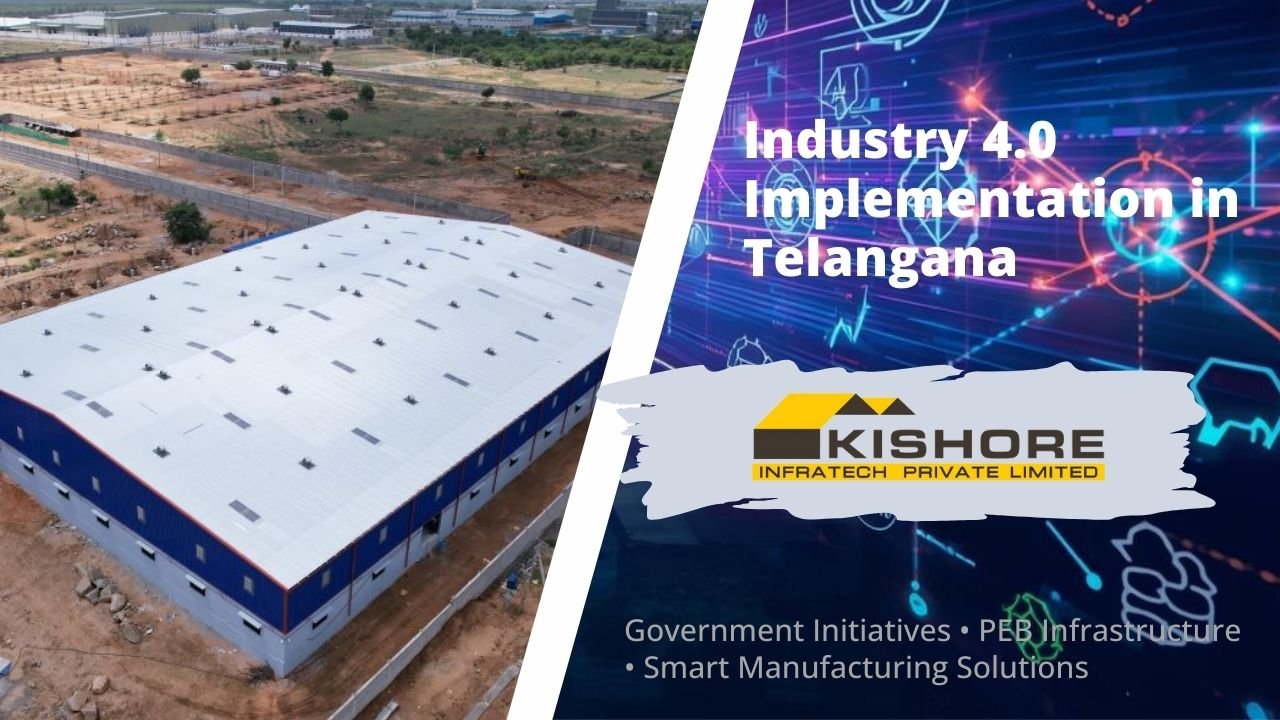
How Pre-Engineered Buildings (PEB) Are Enabling Telangana’s Smart Manufacturing Revolution
Telangana’s Ambitious Journey Toward Manufacturing 5.0
Telangana stands at a pivotal moment in India’s industrial transformation. As the state transitions from Industry 4.0 to the cutting-edge Manufacturing 5.0 paradigm, it’s creating unprecedented opportunities for forward-thinking manufacturers who understand that digital transformation begins with the right physical infrastructure.
With a remarkable GDP growth of 196.7% over the past decade, Telangana has positioned itself as India’s most progressive state for industrial innovation. The state’s comprehensive Industry 4.0 framework—backed by initiatives like TS-iPASS, T-Hub 2.0 (the world’s largest startup incubator), and the newly launched Telangana AI Innovation Hub—is attracting global investments that total over $9.8 billion in recent years.
But here’s the critical insight often overlooked: Smart factories require smart infrastructure. The sophisticated automation systems, IoT sensors, collaborative robots (cobots), and AI-driven manufacturing execution systems that define Industry 4.0 cannot function optimally in traditional brick-and-mortar buildings designed for 20th-century manufacturing.
This guide sets out what an Industry 4.0 facility actually demands from its building—floor, height, grid, loading and services routing—and how each requirement translates into a pre-engineered building specification you can put out to tender.
Quick Answer: An Industry 4.0 factory fails or succeeds on physical parameters that must be fixed before the frame is fabricated. The five that matter most: floor flatness (AGVs and AMRs need a defined flatness class; VNA racking needs tighter still), clear height (10–12 m for conventional racking, 12–30 m for automated storage and retrieval), clear span and column grid (24–30 m typical, so robot routes and racking modules are not designed around columns), floor loading (5–10 t/m² for ASRS and heavy automation), and services routing (fibre, industrial Ethernet and power raceways designed into the roof and walls, not surface-clipped afterwards). A pre-engineered structure suits this because spans are column-free and the frame can be engineered for crane loads, mezzanines, solar dead load and future expansion from day one. Indicative build cost for a smart manufacturing facility runs ₹1,900–2,900 per sq ft all-in, excluding land and process equipment.
This guide covers what an Industry 4.0 manufacturing facility actually demands from its building — the floor, the height, the grid, the loading and the services routing — and how those requirements translate into a pre-engineered building specification you can put out to tender. It is written for projects at commercial scale, typically 20,000 sq ft and above.
Understanding Industry 4.0: Beyond the Buzzwords
What is Industry 4.0?
Industry 4.0, often called the Fourth Industrial Revolution, represents the convergence of physical manufacturing systems with digital technologies. It’s characterized by:
- Cyber-Physical Systems: Integration of computation, networking, and physical processes
- Internet of Things (IoT): Connected machines and sensors throughout the production floor
- Big Data & Analytics: Real-time data collection and analysis for decision-making
- Artificial Intelligence & Machine Learning: Predictive maintenance, quality control, demand forecasting
- Cloud Computing: Accessible data storage and processing power
- Collaborative Robots (Cobots): Human-machine collaboration on production lines
- Additive Manufacturing: 3D printing and advanced prototyping
- Augmented Reality (AR): Enhanced training, maintenance, and quality inspection
Telangana’s Vision: Leapfrogging to Manufacturing 5.0
Telangana isn’t merely adopting Industry 4.0—it’s positioning itself to lead India’s transition to Manufacturing 5.0, which emphasizes:
- Human-Centric Innovation: Technology that augments human capabilities rather than replacing them
- Sustainability: Circular economy principles, renewable energy, reduced carbon footprints
- Resilience: Adaptive supply chains capable of responding to disruptions
- Mass Personalization: Customized production at scale
According to EY’s Manufacturing 5.0 study, Telangana’s pharmaceutical, automotive, and electronics sectors have already begun deploying cutting-edge technologies. The state aims to train 5 million students and professionals in AI capabilities, support over 250 startups in three years, and mobilize over $100 million in private investment for AI-driven manufacturing.
What an Industry 4.0 Facility Actually Demands From Its Building
Most smart factory projects are planned as a technology purchase — robots, sensors, an MES platform — and the building is treated as a shed to put them in. That order of thinking is what causes the expensive problems. Automation is unforgiving about the physical envelope: an AGV fleet will not run reliably on a floor that was poured to ordinary warehouse tolerance, and an ASRS cannot be installed in a building whose clear height was fixed without reference to the rack design.
The parameters below have one thing in common — they are cheap to specify before fabrication and expensive or impossible to change afterwards. Raising eaves height after erection means replacing columns. Correcting floor flatness under installed racking means taking the racking out.
Key takeaway: Fix five things before the frame is engineered: floor flatness class, clear height (driven by the rack or crane design, not by habit), clear span and column grid, floor loading in tonnes per square metre, and the routes services will take through the structure. Everything else in an Industry 4.0 fit-out can be adapted later. These five cannot.
| Industry 4.0 System | What It Demands From the Building | Design Parameter to Fix Before Fabrication |
|---|---|---|
| AGVs and autonomous mobile robots (AMRs) | A continuously flat, level floor with no steps at joints; unobstructed travel routes | Floor flatness class and joint detail; column grid set to keep robot routes straight |
| Automated storage & retrieval systems (ASRS) | Very tight floor flatness and high clear height; heavy concentrated point loads at rack legs | Clear height 12–30 m; floor loading 5–10 t/m²; slab designed for rack leg point loads |
| Very-narrow-aisle (VNA) racking | Tighter floor flatness than standard warehousing, measured along defined aisle lines | Aisle-specific flatness tolerance agreed with the racking vendor before slab pour |
| Collaborative robots (cobots) and robot cells | Stable, vibration-controlled floor; local power and data at each cell | Slab thickness and reinforcement for cell anchoring; raceway grid at cell spacing |
| IoT sensor networks and industrial Ethernet | Structured cable routes at high level, accessible for expansion | Cable trays and conduit routes designed into the roof structure and purlin layout |
| Edge computing and MES server rooms | Conditioned, dust-controlled space with redundant power and cooling | Server room location, HVAC provision and UPS room sized at design stage |
| Machine vision and quality inspection | Consistent, controlled lighting with minimal glare and shadow | Translucent sheeting percentage, skylight placement and LED layout |
| Metrology and precision measurement | Isolation from machine and traffic vibration; stable temperature | Separate foundation or isolation slab for metrology areas; thermal zoning |
| Electronics and semiconductor assembly | Contamination control, ESD-compatible flooring, tight humidity control | Envelope sealing, floor finish specification and HVAC zoning |
| Rooftop solar and net-zero targets | Roof able to carry panel dead load plus maintenance access | Solar dead load allowance in the roof design and mounting rail provision |
| Future line reconfiguration and expansion | Ability to change layout or extend without structural rework | Column-free spans, expandable end bay, and crane capacity headroom designed in |
Floor: The Parameter Most Projects Get Wrong
The floor slab is the single most common failure point in Indian smart factory projects. A standard industrial floor is poured to a tolerance that is perfectly adequate for forklifts and entirely inadequate for automated guided vehicles, very-narrow-aisle trucks or an ASRS. The consequences show up months later as navigation errors, premature wheel wear and racking that cannot be aligned within tolerance.
- Agree the flatness class with the automation and racking vendors before the slab is poured — not after the building is handed over. Different systems measure flatness differently, and defined-movement areas such as VNA aisles are assessed along the aisle line rather than across the floor as a whole.
- Design the joint layout around the traffic routes. Every joint an AGV crosses is a small shock; joint position, load transfer and edge protection matter more than the concrete grade.
- Specify abrasion resistance for the actual traffic, and confirm any chemical resistance the process needs.
- Confirm point loads, not just uniform loads. Rack legs concentrate load into small baseplates; a slab designed only for a uniformly distributed load can still fail under them.
Clear Height and Span: Driven by the Equipment, Not the Habit
Clear height should be derived from the storage or handling system, never assumed. Conventional racking typically wants 10–12 m clear; automated storage and retrieval can run from 12 m to 30 m and above. Crane-served bays are dimensioned from the under-hook requirement upwards, which usually puts eaves height 2.5–3 m above the under-hook level once you allow for the crane, the gantry and the roof structure.
Span matters for a different reason. In a column-free building the production layout is designed around the process; in a columned building the process is designed around the columns, and every future reconfiguration inherits that constraint. A 24–30 m clear span covers most manufacturing requirements, and pre-engineered frames can go considerably wider where the layout justifies it.
Services: Design the Routes, Not Just the Loads
An Industry 4.0 facility carries far more cabling than a conventional factory — power to every cell, fibre and industrial Ethernet to every machine, sensor drops throughout. The difference between a clean installation and an expensive mess is whether the routes were designed into the structure. Cable trays and conduit runs coordinated with the purlin layout cost very little at design stage; retrofitting them means drilling structural members and clipping trays to whatever is convenient, which then obstructs the next change.
The Approval Layer
Telangana routes industrial applications through the TG-iPASS (formerly TS-iPASS) single-window system, established under the TS-iPASS Act 2014. It is a process mechanism, not a building standard: the window routes the application, while the building plan itself is sanctioned by HMDA, the municipality or DTCP, or the TGIIC industrial area local authority depending on where the plot sits, with a separate factory building plan approval from the Factories Department.
| Aspect | Position Before Single-Window | Position Under TG-iPASS |
|---|---|---|
| Clearance time | 12–18 months typical | 15-day statutory timeline for eligible projects |
| Departments | Multiple separate submissions | Integrated across departments on one platform |
| Application process | Manual, physical documents | Online, with self-certification |
| Accountability | Limited tracking | Defined timelines with officer accountability |
| Document submission | Repeated for each department | Common Application Form |
A note on scope: Kishore Infratech prepares the structural drawings, GA drawings and design calculations your architect or licensed consultant submits, and builds to the sanctioned plan. We do not file applications, liaise with departments or act as an approval agency — statutory filing, fire NOC and environmental clearance remain with you or your consultant. Our guide to TG-iPASS industrial building permission sets out the norms your drawings have to satisfy.
Why Infrastructure Matters: The PEB Advantage for Industry 4.0
The Hidden Challenge of Digital Transformation
Here’s what many manufacturers discover too late: You cannot retrofit Industry 4.0 capabilities into buildings designed for Industry 2.0 workflows.
Traditional RCC (Reinforced Cement Concrete) buildings present numerous obstacles for smart manufacturing:
- Columns interrupting production flow and sensor networks
- Limited ceiling height restricting automated material handling systems
- Inadequate power infrastructure for data centers and charging stations
- Poor cable management for IoT devices and networking
- Inflexible layouts that can’t adapt to changing production lines
- Insufficient floor loading capacity for heavy automation equipment
- Long construction timelines delaying time-to-market for new products
Pre-Engineered Buildings: Purpose-Built for Smart Manufacturing
PEB construction addresses every infrastructure challenge that Industry 4.0 manufacturers face:
Key takeaway: The structural case for pre-engineered construction in a smart factory is not speed alone. It is that column-free spans let the process drive the layout, the frame can be engineered for crane, mezzanine and solar loads at the outset, and services can be routed through the structure rather than clipped onto it.
| Industry 4.0 Requirement | How a Pre-Engineered Building Answers It | Practical Impact |
|---|---|---|
| Unobstructed production flow for AGVs and AMRs | Wide clear spans with no intermediate columns | Robot routes follow the process, not the structural grid; better sensor coverage |
| Heavy automation — cobots, ASRS, conveyors | Frame engineered for the specified crane capacity and floor loading | Automation installed without structural rework or load restrictions |
| Extensive IoT sensor networks | Cable trays and conduit routes coordinated with the purlin layout | Clean installation; sensors can be added later without drilling structure |
| High-density computing — edge servers, MES | Server and UPS rooms positioned and serviced at design stage | Conditioned, dust-controlled space with power redundancy built in |
| Natural lighting for inspection and quality control | Translucent roof sheeting and skylights set out with the LED layout | Lower lighting energy use and more consistent inspection conditions |
| Rapid production line changes | Column-free floor; utilities in accessible raceways | Layout can be reconfigured without touching the structure |
| Rooftop solar and net-zero commitments | Solar dead load allowed for in the roof design; mounting rails integrated | Solar added when you choose, without strengthening the roof first |
| Compressed project programme | Fabrication runs in parallel with foundation work | Typically 30–50% faster to handover than conventional construction |
Industry 4.0 Sectors in Telangana and What Each One Needs From Its Building
The automation may be similar across sectors, but the building specification is not. These are the requirements that actually change the structural design, sector by sector.
1. Pharmaceutical Manufacturing
Telangana accounts for a substantial share of India’s bulk drug production, and pharma is where smart manufacturing adoption in the state is furthest along — flow chemistry, continuous manufacturing and automated batch records.
What the building has to deliver: cleanroom integration with the structure (ceiling grid support, airtight envelope penetrations), precise temperature and humidity control, washable and non-shedding surfaces, segregated material and personnel flows designed into the layout, and the ability to expand or re-validate a zone without disturbing adjacent production. Roof and wall penetrations for HVAC have to be coordinated with the frame at design stage, because a cleanroom envelope cannot tolerate improvised openings.
Further reading: PEB for the pharmaceutical industry in Hyderabad.
2. Automotive and Electric Vehicle Manufacturing
Telangana is building out significant EV and battery manufacturing capacity, and these plants are automation-heavy from the outset.
What the building has to deliver: long clear spans for continuous assembly lines, heavy crane provision for body shop and press operations, floor loading for automated conveyors and robot cells, paint booth integration with its own fire and ventilation requirements, and battery assembly areas with controlled humidity. Crane capacity should be specified with headroom for a future upgrade — columns pre-designed for a higher crane load cost far less now than a structural retrofit later.
3. Electronics and Semiconductor Assembly
Packaging, testing and assembly operations place the tightest environmental demands of any sector on this list.
What the building has to deliver: vibration isolation for precision equipment (often a separate foundation for metrology and inspection areas), ESD-compatible floor finishes, contamination control through a sealed envelope, and tight humidity control. The envelope detailing matters more here than anywhere else — every joint, penetration and door seal is a potential contamination path.
4. Data Centres and AI Infrastructure
Hyderabad’s data centre capacity continues to expand, driven by AI workloads and 5G.
What the building has to deliver: very high floor loading for server racks, redundant power distribution with generator and UPS provision, cooling capacity that may exceed the IT load itself, layered physical security, and rapid deployment — data centre capacity is usually committed before the building exists. Pre-engineered construction suits this because fabrication runs in parallel with foundation work, compressing the programme substantially.
See our data centre construction cost analysis.
5. Food Processing and Cold Chain
Automation in food processing is increasingly about traceability and hygiene compliance as much as throughput.
What the building has to deliver: insulated panels with a properly detailed vapour barrier, coved or sealed floor-to-wall junctions, drainage designed for washdown, hygienic non-shedding surfaces, bird- and pest-proof openings, and the ability to scale for seasonal peaks. If chilled or frozen storage is in scope, the insulated envelope must be designed in from the start — it is not a finish applied to a completed shed.
Get a Free Design Review & Indicative Estimate.
Share your plot location and requirement — our engineers call you back within 24 hours with a PEB factory or warehouse design and transparent costing.
- Clear-span PEB buildings engineered per IS 800
- Wind & seismic design per IS 875 Part 3 / IS 1893
- In-house fabrication at Jeedimetla, Hyderabad
- Faster erection than RCC — months, not years
- 45+ years steel fabrication, 700+ projects delivered
Prefer to speak directly? Call 9440407852
Our PEB engineers will call you back shortly with your free PEB proposal and quotation.
Want a faster response?
📱 Chat with us on WhatsAppBuilding Your Industry 4.0 Manufacturing Facility: A Practical Roadmap
Phase 1: Strategic Planning & Digital Infrastructure Design (Months 1-2)
Key Decisions:
- Location Selection:
- Proximity to Hyderabad’s talent pool and international airport
- Industrial corridor access (Hyderabad-Warangal priority)
- Power and water availability assessment
- Digital connectivity (fiber optic availability for IoT backbone)
- Industry 4.0 Technology Stack Definition:
- Production automation level (lights-out vs human-machine collaboration)
- IoT sensor density requirements
- Edge computing vs cloud computing balance
- MES (Manufacturing Execution System) integration points
- Digital twin capabilities needed
- Building Requirements Translation:
- Clear span needs based on production flow simulation
- Ceiling height for automated storage/retrieval systems
- Power capacity (often 3-5x traditional manufacturing for servers, charging, automation)
- HVAC zoning for equipment vs human comfort areas
- Floor loading specifications for heavy machinery
Phase 2: Statutory Application & PEB Design (Months 2-3)
Parallel Track Approach:
Track A: Regulatory Approvals
- Register on TS-iPASS portal (https://ipass.telangana.gov.in)
- Submit Combined Application Form (CAF) with self-certifications
- Upload required documents: land documents, project report, pollution category assessment
- Track real-time approval status through entrepreneur dashboard
- Expect approvals within 15-day statutory timeline
Track B: PEB Engineering
- Engage PEB manufacturer with Industry 4.0 experience (like Kishore Infratech)
- Detailed engineering using STAAD Pro, Tekla Structures (American AISC/MBMA standards)
- Coordination between structural engineers and automation vendors
- BIM (Building Information Modeling) for clash detection
- Value engineering for optimal span-to-cost ratio
Phase 3: Foundation & Simultaneous Component Fabrication (Months 3-4)
The PEB advantage becomes evident here—while civil work progresses on-site, steel components are being manufactured simultaneously in the factory:
- On-Site: Foundation work, anchor bolt installation, utility trenching
- Factory: Primary frame fabrication, secondary members (purlins, girts), roof/wall panel production
- Digital Coordination: IoT integration points mapped, cable tray systems designed
Phase 4: Rapid Structural Erection (Months 5-6)
PEB structures erect in weeks, not months:
- Primary frame erection (columns and rafters): 2-3 weeks
- Secondary framing and roof/wall panels: 2-3 weeks
- Crane runway beam installation: 1 week
- Weather-tight enclosure achieved in 6-8 weeks total
Phase 5: Systems Integration for Smart Factory (Months 6-9)
With the building envelope complete, sophisticated system installation begins:
| System Category | Components | Indicative Timeline |
|---|---|---|
| Electrical infrastructure | HT/LT panels, UPS systems, power distribution, backup generation, solar integration | 4–6 weeks |
| HVAC and cleanrooms | Precision air handling units, filtration, humidity control, zoning | 6–8 weeks |
| Networking and IoT | Fibre backbone, industrial Ethernet, WiFi 6, 5G readiness, sensor networks | 3–4 weeks |
| Automation hardware | Conveyors, AGV guidance, cobot workstations, ASRS | 8–10 weeks |
| Safety and security | Fire suppression, gas detection, access control, CCTV with analytics | 4–5 weeks |
Phase 6: Equipment Installation & Software Integration (Months 9-11)
Production equipment installation occurs parallel to MES and ERP system configuration:
- Production machinery installation and commissioning
- Sensor calibration and IoT device connectivity testing
- MES software configuration and integration with equipment PLCs
- ERP system deployment and integration with MES
- Digital twin environment setup and validation
- Cybersecurity implementation (OT/IT convergence)
Phase 7: Commissioning & Validation (Month 12)
- Integrated system testing (equipment + software + connectivity)
- Production trial runs with quality validation
- Operator training on Industry 4.0 interfaces
- Safety system verification and regulatory inspections
- Performance baseline establishment for continuous improvement
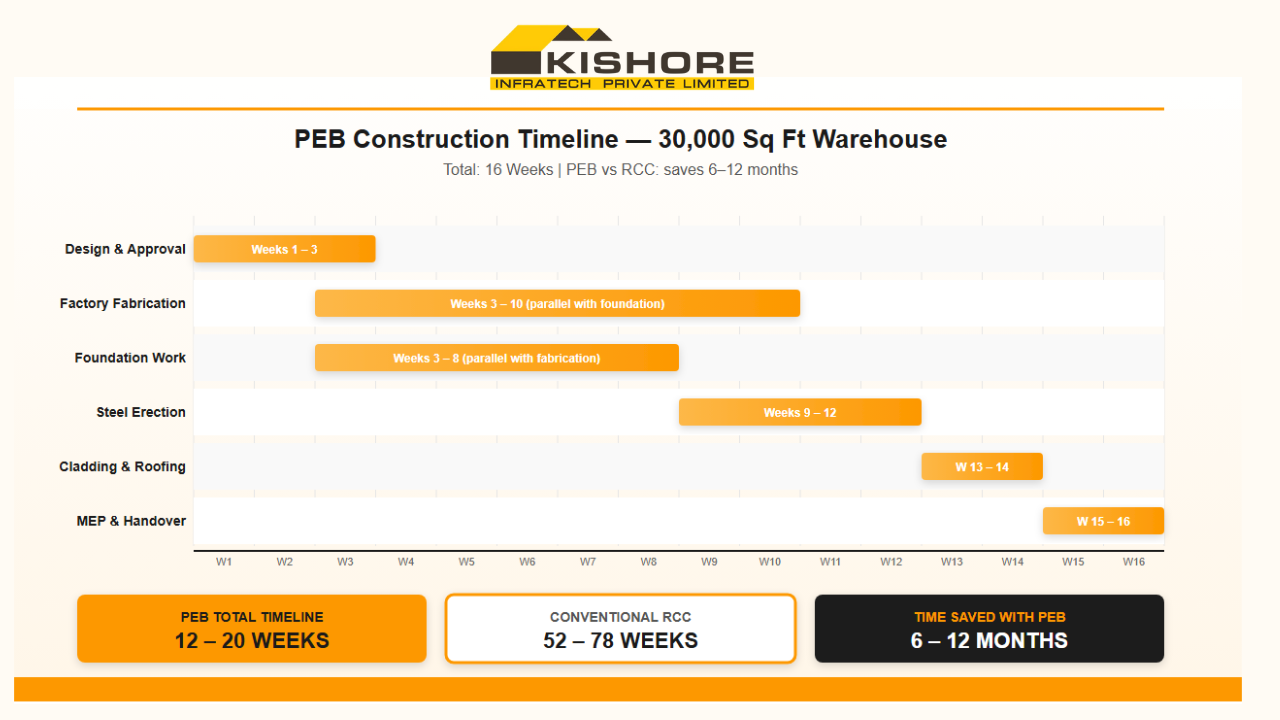
Total Timeline: 11-12 months from concept to production (vs 20-24 months with traditional construction)
Future-Proofing Your Investment: Scalability & Adaptability
Why PEB Structures Excel at Evolution
Industry 4.0 is not a destination—it’s a continuous journey. Manufacturing technologies evolve rapidly:
- New automation equipment emerges every 3-5 years
- Production volumes fluctuate requiring space adjustments
- Product lines change demanding layout reconfigurations
- Sustainability mandates evolve (solar, rainwater harvesting, EV charging)
PEB Flexibility Advantages:
| Expansion Type | How It Works in a Pre-Engineered Building | Indicative Execution Time |
|---|---|---|
| Horizontal expansion | Bays added along the length; end wall designed to be removable from the outset | 3–4 months |
| Vertical expansion | Mezzanine floors for offices, laboratories or light storage | 2–3 months |
| Crane capacity upgrade | Columns pre-designed for a higher future crane load | 2–4 weeks |
| Rooftop solar addition | Roof designed with solar dead load allowance; mounting rails integrated | 1–2 months |
| Production line reconfiguration | No columns to work around; utilities in accessible raceways | Days to weeks |
What a Smart Manufacturing Facility Costs to Build in Telangana
Automation budgets are usually well understood by the time a project starts; the building budget often is not. The figures below are indicative planning estimates for the facility — structure, civil work and building services — and exclude land and process equipment.
Key takeaway: A general-purpose pre-engineered facility runs an estimated ₹1,600–2,200 per sq ft all-in. Industry 4.0 requirements — tighter floor tolerance, higher clear height, heavier floor loading, structured services routing and controlled environments — typically add ₹300–700 per sq ft, putting a smart manufacturing facility at roughly ₹1,900–2,900 per sq ft. On a 50,000 sq ft build that is an estimated ₹9.5–14.5 crore.
| Facility Type | Typical Size | Indicative All-In (₹/sq ft) | Indicative Project Estimate | Main Cost Drivers |
|---|---|---|---|---|
| General automated manufacturing | 30,000–80,000 sq ft | ₹1,900–2,400 | ₹5.7–19.2 Cr | Floor tolerance, services routing, clear height |
| Pharma with cleanroom zones | 20,000–60,000 sq ft | ₹2,400–3,200 | ₹4.8–19.2 Cr | Cleanroom envelope, HVAC, validation requirements |
| Automated warehouse / ASRS | 50,000–2,00,000 sq ft | ₹1,700–2,300 | ₹8.5–46 Cr | Clear height, floor flatness, rack point loading |
| Electronics / precision assembly | 20,000–50,000 sq ft | ₹2,300–3,000 | ₹4.6–15 Cr | Vibration isolation, ESD flooring, humidity control |
| Data centre shell | 20,000–60,000 sq ft | ₹2,500–3,500 | ₹5–21 Cr | Floor loading, power redundancy, cooling provision |
All figures are indicative estimates for budgeting and planning, not quotations. Actual cost depends on span, eaves height, crane capacity, floor specification, soil conditions, the extent of controlled-environment areas and the steel rate at the time of order.
Kishore Infratech Private Limited: Your Partner in Industry 4.0 Infrastructure
Why Kishore Infratech for Telangana’s Smart Manufacturing Facilities
Since 1980, Kishore Infratech Private Limited (KIPL) has been at the forefront of industrial construction in Telangana and across India. As Hyderabad’s leading PEB manufacturer, we uniquely understand both the local regulatory landscape and the sophisticated requirements of Industry 4.0 manufacturing.
Our Industry 4.0 Manufacturing Facility Expertise
| Capability | What It Means for Your Project |
|---|---|
| 45+ years of experience | 700+ buildings constructed and 45 lakh sq ft delivered across Telangana and neighbouring states |
| Advanced fabrication facility | 17 machines at Nacharam, Hyderabad, including CNC plasma cutting and automated welding |
| International design standards | MBMA/AISC/IBC-compliant designs using STAAD Pro and Tekla Structures, accepted by global manufacturers setting up in Telangana |
| Drawings for statutory submission | Structural drawings, GA drawings and design calculations prepared for your architect or licensed consultant to submit — we build to the sanctioned plan, and do not file applications or act as an approval agency |
| Smart factory integration | Coordination with automation vendors on IoT routing, cleanroom specialists for pharma, and HVAC consultants for data centres |
| Turnkey EPC delivery | Design, fabrication, civil works, erection, electrical and fire safety, through to commissioning support |
| Rapid execution | Proven delivery on 100,000+ sq ft facilities, with local Hyderabad presence removing logistics delays |
| Post-construction support | Maintenance, expansion engineering and crane upgrades across Telangana |
Our Process: From Vision to Smart Factory Reality
1. Collaborative Consultation
We begin with understanding your Industry 4.0 roadmap, not just building specifications. Our team includes civil engineers, automation consultants, and manufacturing process experts who help optimize your facility layout for both current operations and future technology adoption.
2. Integrated Design Engineering
Using Building Information Modeling (BIM), we coordinate structural, electrical, HVAC, and automation systems before fabrication begins. This eliminates costly field clashes and ensures your IoT infrastructure integrates seamlessly with the building.
3. Quality-Controlled Fabrication
Components are manufactured in our ISO-certified facility with stringent quality checks. Every weld, bolt, and panel meets international standards—critical when your structure must support precision manufacturing equipment.
4. Coordinated Execution
We serve as the single point of contact coordinating across civil, structural, MEP, automation, and IT vendors. This integrated approach is essential for Industry 4.0 facilities where systems interdependencies are complex.
5. Commissioning Support
Our involvement doesn’t end at structural completion. We support equipment installation planning, verify structural adequacy for specific machinery, and assist with any building modifications needed during commissioning.
Industry 4.0 Facility Types We Excel In
- Pharmaceutical Manufacturing: cGMP-compliant facilities with integrated cleanrooms (ISO 5-8), validated HVAC systems
- Automotive Assembly Plants: Large clear spans for assembly lines, paint booth integration, battery pack assembly areas
- Electronics Manufacturing: ESD-controlled environments, precision climate control, contamination-free zones
- Food Processing Plants: HACCP-compliant hygienic design, temperature-controlled zones, easy-clean surfaces
- Data Centers: Heavy floor loading for server racks, redundant power/cooling, layered security integration
- Cold Storage & Logistics: Insulated structures, temperature mapping validation, automated material handling
- Research & Development Centers: Flexible lab spaces, fume extraction, utility-rich environments
Frequently Asked Questions (FAQ)
What building specifications matter most for an Industry 4.0 factory?
Five parameters, all of which must be fixed before the frame is fabricated: floor flatness class, clear height (derived from the racking or crane design), clear span and column grid, floor loading in tonnes per square metre including rack point loads, and the routes services will take through the structure. Everything else in a smart factory fit-out can be adapted later; these five effectively cannot.
Why does floor flatness matter so much for AGVs and automated storage?
Automated guided vehicles and very-narrow-aisle equipment navigate and operate within tolerances far tighter than a forklift needs. A floor poured to ordinary industrial tolerance produces navigation errors, accelerated wheel wear and racking that cannot be aligned. The flatness class has to be agreed with the automation and racking vendors before the slab is poured, because correcting it afterwards means removing the installed equipment.
What clear height should I plan for an automated facility?
It depends entirely on the storage system. Conventional racking typically wants 10–12 m clear. Automated storage and retrieval systems run from about 12 m up to 30 m and beyond. Crane-served bays are dimensioned upward from the under-hook requirement, which usually puts eaves height 2.5–3 m above under-hook once the crane, gantry and roof structure are allowed for. Never assume a standard height — derive it from the equipment.
What makes pre-engineered construction suitable for smart manufacturing compared to conventional building?
Three things. Clear spans without intermediate columns let the production layout follow the process rather than the structural grid, which also makes future reconfiguration far easier. The frame can be engineered from the outset for crane loads, mezzanine loading, solar dead load and a future extension. And fabrication runs in parallel with foundation work, which typically delivers handover 30–50% faster than conventional construction on an equivalent footprint.
How long does it take to build a smart manufacturing facility in Telangana?
For a pre-engineered facility of 50,000–100,000 sq ft, allow roughly 8–12 months from design freeze to production readiness. Design and approval drawings take 4–6 weeks, fabrication 8–12 weeks running in parallel with foundations, erection and cladding 8–12 weeks, and building services and systems integration a further 3–5 months depending on how much controlled-environment and automation work is in scope.
Can an existing conventional building be upgraded for Industry 4.0?
Sometimes, but the limits are structural. Floor flatness and floor loading are the usual blockers — both are extremely difficult to correct in an occupied building. Clear height cannot be raised at all without replacing columns, and internal columns permanently constrain any automated material flow. Upgrading generally makes sense where the existing height and grid already suit the intended system and only services and finishes need work.
What floor loading should an automated facility be designed for?
Automated storage and heavy automation commonly require 5–10 tonnes per square metre, but the uniform figure is not the one that causes failures. Rack legs concentrate load into small baseplates, so the slab must be designed for those point loads specifically. Ask the racking vendor for the leg load and baseplate dimensions, and have the slab designed against them rather than against a general allowance.
How should power and data cabling be planned in a smart factory?
As part of the structural design, not as a later fit-out item. An Industry 4.0 facility carries power to every cell plus fibre and industrial Ethernet to every machine. Cable trays and conduit routes coordinated with the purlin layout cost very little at design stage. Retrofitted routing means drilling structural members and clipping trays wherever convenient, which then obstructs the next reconfiguration.
What does a smart manufacturing facility cost to build in Telangana?
As an indicative estimate, a general-purpose pre-engineered facility runs ₹1,600–2,200 per sq ft all-in, and Industry 4.0 requirements typically add ₹300–700 per sq ft for floor tolerance, clear height, floor loading, services routing and controlled environments. That puts a smart manufacturing facility at roughly ₹1,900–2,900 per sq ft, or an estimated ₹9.5–14.5 crore for 50,000 sq ft, excluding land and process equipment.
How does TG-iPASS work for a new manufacturing facility?
TG-iPASS (formerly TS-iPASS) is Telangana’s single-window system under the TS-iPASS Act 2014. It routes the application across departments on one platform with a defined statutory timeline, replacing separate submissions to each department. It is a process mechanism, not a building standard — the building plan itself is sanctioned by HMDA, the municipality or DTCP, or the TGIIC industrial area local authority depending on the plot, with a separate factory building plan approval from the Factories Department.
Does Kishore Infratech handle the approval process?
No. We prepare the structural drawings, GA drawings and design calculations that your architect or licensed consultant submits, and we build to the sanctioned plan. We do not file applications, liaise with departments or act as an approval agency — statutory filing under TG-iPASS, fire NOC and environmental clearance remain with you or your consultant. What we can do is make sure the drawings satisfy the norms before they go in.
Can a facility be expanded after Industry 4.0 systems are installed?
Yes, if it was designed for it. An expandable end bay lets you add bays along the length by removing the gable sheeting and continuing the frame, with no disturbance to running production. Mezzanines can be added where the frame was designed for the loading, and crane capacity can be upgraded where columns were pre-designed for the higher load. All three are inexpensive to provide for at design stage and costly to retrofit.
What building provisions support sustainability and green certification?
The main structural ones are a roof designed to carry solar panel dead load with mounting rails integrated, a properly insulated envelope to cut cooling load, translucent sheeting and skylights to reduce daytime lighting demand, and rainwater harvesting routed through the building’s own gutters and downtakes. Steel structures also score well on recycled content and end-of-life recyclability. Deciding these at design stage costs far less than adding them to a completed building.
Data methodology: Building specification guidance reflects Kishore Infratech Private Limited’s project experience across Telangana and Andhra Pradesh, covering 700+ completed projects and 45 lakh sq ft of constructed area, together with MBMA, AISC and IBC design practice. Cost figures reflect 2026 market rates for SAIL/JSW steel and prevailing civil and MEP rates in the Telangana region. All cost and timeline figures are indicative estimates for planning purposes, not quotations — actual cost and programme depend on span, height, crane capacity, floor specification, soil conditions and the extent of controlled-environment areas. Floor flatness, clear height and floor loading requirements must be confirmed with your automation and racking vendors for the specific system being installed.
Building Telangana’s Digital Manufacturing Future
Telangana’s transformation into India’s premier Industry 4.0 hub isn’t happening by accident—it’s the result of strategic government policies, world-class institutional support, and increasingly, the right physical infrastructure to make digital transformation possible.
The state’s ambitious roadmap—from TS-iPASS’s 15-day clearances to the Telangana AI Innovation Hub’s goal of training 5 million professionals—creates an ecosystem where manufacturers can focus on innovation rather than bureaucracy. The ₹1.4 lakh crore in approved investments since 2015, the $100 million in AI research funding, and major commitments from global players like BYD, VinFast, and Google validate Telangana’s approach.
But policy and funding alone don’t create smart factories. The physical infrastructure—the buildings where robots collaborate with humans, where IoT sensors feed real-time data to AI systems, where precision manufacturing happens 24/7—must be purpose-built for this new industrial era.
Pre-Engineered Building technology provides that foundation. Its rapid construction enables manufacturers to capitalize on market opportunities while competitors are still pouring concrete. Its flexibility allows production lines to evolve as technologies advance. Its clear spans and heavy-load capacity accommodate the sophisticated automation that defines Industry 4.0. And its modular nature ensures your infrastructure investment scales with your business growth.
As Telangana positions itself to lead India’s transition to Manufacturing 5.0—where human creativity and machine efficiency combine to create sustainable, resilient, personalized production—the manufacturers who thrive will be those who recognized that digital transformation begins with analog infrastructure decisions made right.
The question isn’t whether to adopt Industry 4.0—the question is whether your building will enable or constrain that transformation.
Ready to Build Your Industry 4.0 Manufacturing Facility in Telangana?
Kishore Infratech Private Limited combines 45+ years of Telangana manufacturing expertise with cutting-edge PEB technology to deliver smart factories that enable digital transformation.
Our Comprehensive Services:
- ✓ Industry 4.0 facility assessment and design consultation
- ✓ Structural drawings and design calculations prepared for your consultant’s submission
- ✓ Turnkey EPC delivery: design, fabrication, civil, MEP, commissioning
- ✓ Automation infrastructure coordination and integration
- ✓ American MBMA/AISC standards compliance
- ✓ LEED/IGBC green building certification support
- ✓ 8-12 month delivery for 100,000+ sq ft facilities
- ✓ Post-commissioning support and expansion engineering
Let’s Discuss Your Smart Manufacturing Vision
📞 Phone: +91 81792 81914 / +91 9440407852
📧 Email: projects@kishoreindustries.in
🌐 Website: www.kishoreindustries.in
📍 Advanced Fabrication Facility: Cherlapally, Nacharam, Hyderabad, Telangana
Building the infrastructure for Telangana’s digital manufacturing revolution—one smart factory at a time.