
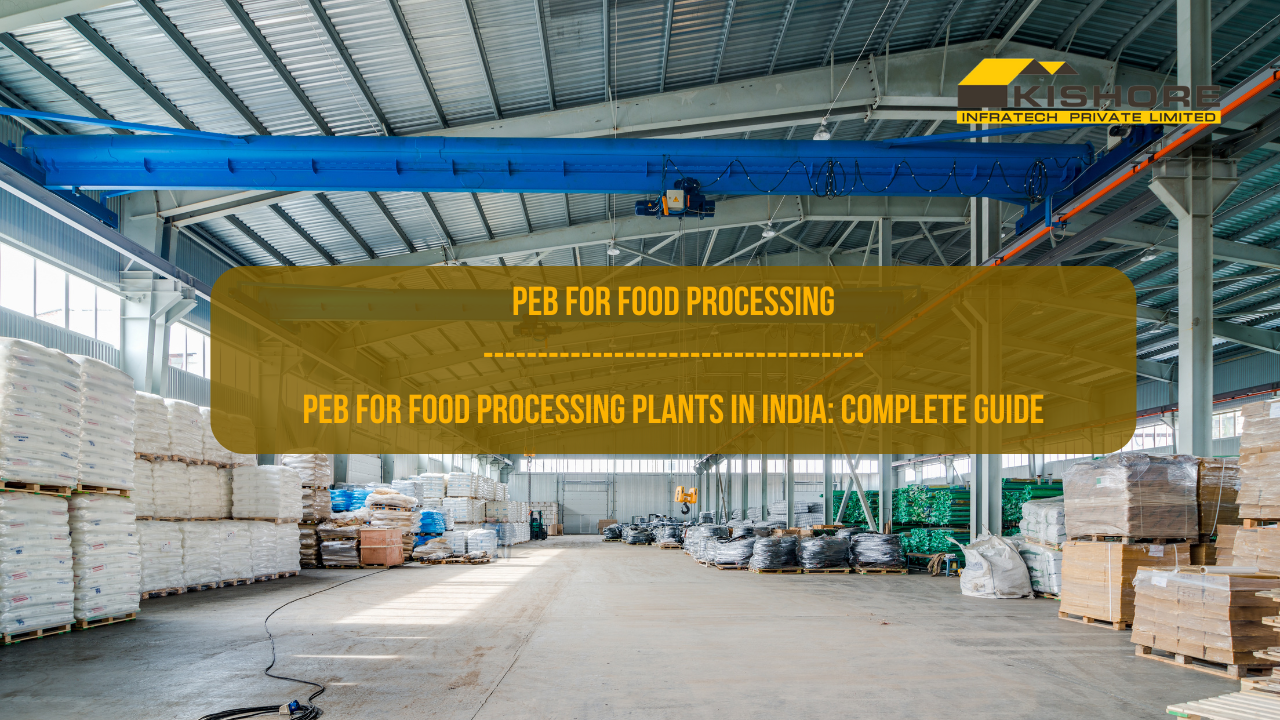
PEB for food processing plants in India is rapidly transforming how the food industry builds manufacturing, packaging, and storage facilities. India’s food processing sector — valued at over $535 billion and growing at 11% CAGR — demands construction technology that delivers speed, hygiene compliance, thermal control, and scalability. Pre-Engineered Buildings (PEB) meet every one of these requirements, making them the preferred structural solution for food processing units across the country in 2026.
Quick Answer: PEB for food processing plants in India costs ₹1,400–₹2,800 per sq ft (structure + civil), which is 25-35% lower than conventional RCC construction. A typical 10,000 sq ft food processing unit can be built in 8-14 weeks using PEB vs 8-12 months with RCC. PEB structures provide FSSAI-compliant hygienic interiors, clear spans up to 60m for unobstructed production lines, seamless integration of insulated sandwich panels for temperature-controlled zones, and modular expandability. With government schemes like PMFME, PLI for food processing, and Mega Food Parks offering 35-75% subsidies, PEB-based food processing plants deliver ROI within 3-5 years. Kishore Infratech Private Limited has built 700+ PEB projects across India, including food-grade and pharma-grade facilities.
Disclaimer: All cost figures mentioned in this guide are estimates based on 2026 market rates and Kishore Infratech’s project data. Actual costs vary based on location, specifications, equipment, and regulatory requirements. Contact us for a project-specific quotation.
Why India’s Food Processing Boom Demands PEB Construction
India is the world’s largest producer of milk, second-largest producer of fruits and vegetables, and third-largest in fisheries. Yet, food processing levels remain at just 10-12% — compared to 65-70% in developed nations. The Government of India has set an ambitious target to raise this to 25% by 2030, creating a massive construction demand for food processing plants built using PEB technology.
Key market drivers fuelling this demand in 2026:
- ₹10,900 crore PLI scheme for food processing — incentivizing new manufacturing capacity
- 42 sanctioned Mega Food Parks — each requiring 30-50 food processing units with standardized industrial buildings
- PMFME scheme offering up to 35% subsidy (max ₹10 lakh) for micro food enterprises
- ₹6,000 crore PM Kisan Sampada Yojana — covering cold chains, food parks, and processing infrastructure
- Rising export demand — India’s processed food exports crossed $50 billion, requiring FSSAI + international standards compliance
- Telangana, Andhra Pradesh, Maharashtra, Gujarat, and UP emerging as top food processing corridors
Traditional RCC construction takes 10-14 months and struggles to meet the hygiene, thermal, and flexibility requirements of modern food processing. PEB for food processing plants solves every one of these challenges.
What Makes PEB Ideal for Food Processing Plants?
Key takeaway: PEB structures are not generic sheds — they are precision-engineered, factory-fabricated steel buildings designed to integrate seamlessly with food production lines, cold zones, packaging areas, and FSSAI hygiene requirements. A well-designed PEB food processing plant costs ₹1,400–₹2,800/sq ft and gets operational 50-60% faster than RCC.
1. FSSAI-Compliant Hygienic Design
Food processing buildings must meet stringent FSSAI (Food Safety and Standards Authority of India) requirements. PEB structures achieve this through:
- Smooth, non-porous interior cladding — no crevices for bacterial buildup
- Food-grade PUF/PIR sandwich panels — washable, chemical-resistant surfaces
- Seamless wall-to-ceiling junctions — eliminates dust and pest harbourage points
- Epoxy-coated or anti-skid flooring integration — designed for wet processing areas
- Pest-proof construction — sealed joints, vermin guards, and insect-proof ventilation
2. Temperature-Controlled Zones
Food processing plants require multiple temperature zones — ambient processing halls, chilled rooms (0-4°C), freezer sections (-18 to -25°C), and blast freezing (-35°C). PEB structures accommodate this with insulated sandwich panels (40-150mm PUF/PIR) that create airtight thermal envelopes for each zone, reducing energy consumption by 25-40% compared to RCC buildings.
3. Clear-Span Layouts for Production Lines
Modern food production requires unobstructed floor space for conveyor systems, sorting lines, batch processing equipment, and packaging machines. PEB frames deliver clear spans of 30-60 metres without intermediate columns, giving plant designers complete freedom to optimize production flow, material handling, and worker movement.
4. Speed of Construction
Time is money in food processing — seasonal raw material availability means delayed construction equals lost revenue. A 10,000 sq ft PEB food processing plant can be erected in 8-14 weeks (design to handover), compared to 8-12 months for RCC. This speed advantage lets entrepreneurs capitalize on government subsidy timelines and seasonal market windows.
5. Easy Expansion and Modular Growth
Food businesses scale quickly. PEB’s modular bolt-on design allows bay-by-bay expansion — add a new processing line, cold room, or packaging wing without disrupting existing operations. This is nearly impossible with load-bearing RCC walls.
PEB for Food Processing Plants: Cost Breakdown 2026
Key takeaway: The total cost of a PEB-based food processing plant ranges from ₹1,400 to ₹2,800 per sq ft depending on temperature requirements, equipment, and finish level. The PEB structure itself accounts for only 25-35% of total project cost — the majority goes toward processing equipment, cold rooms, utilities, and compliance infrastructure.
| Cost Component | Cost Range (₹/sq ft) | % of Total Cost | Notes |
|---|---|---|---|
| PEB Structure (Steel Frame + Cladding) | ₹450–₹850 | 25-35% | Includes columns, rafters, purlins, roof & wall sheeting |
| Civil Works & Foundation | ₹200–₹400 | 12-18% | RCC foundations, floor slab, drainage, epoxy coating |
| Insulated Panels (PUF/PIR) | ₹150–₹400 | 10-15% | 40mm ambient to 150mm freezer; food-grade finish |
| Electrical & HVAC | ₹150–₹350 | 10-15% | Power distribution, ventilation, HVAC for controlled zones |
| Refrigeration System | ₹200–₹500 | 12-20% | Ammonia/freon-based; depends on temperature requirements |
| Plumbing, ETP & Utilities | ₹100–₹200 | 5-8% | Water supply, ETP/STP, fire safety, boiler room |
| Interior Finishes & Compliance | ₹100–₹250 | 5-10% | FSSAI-grade walls, SS fittings, pest-proof doors, air curtains |
| Total Project Cost | ₹1,400–₹2,800/sq ft | 100% | Varies by category and temperature zones |
For comparison, a similar food processing plant using conventional RCC construction costs ₹2,000–₹4,000/sq ft and takes 3-4x longer — making PEB the clear winner for food industry investors.
PEB Cost by Food Processing Plant Type
Key takeaway: A basic spice grinding unit using PEB costs ₹40-60 lakh for 5,000 sq ft, while a fully equipped frozen food processing plant with blast freezing can cost ₹5-8 crore for 20,000 sq ft. The PEB structure remains the most cost-efficient component across all categories.
| Food Processing Type | Typical Size (sq ft) | PEB Project Cost (₹) | Construction Time | Key Requirements |
|---|---|---|---|---|
| Spice Grinding & Packaging | 3,000–8,000 | ₹30–80 lakh | 6-10 weeks | Dust extraction, dry zone, packaging area |
| Rice/Dal/Flour Mill | 5,000–15,000 | ₹50 lakh–2 crore | 8-12 weeks | Heavy equipment foundation, silo integration |
| Fruit/Vegetable Processing | 8,000–25,000 | ₹1.2–4 crore | 10-16 weeks | Wet processing, ETP, cold rooms, sorting lines |
| Dairy Processing Plant | 10,000–30,000 | ₹2–6 crore | 12-18 weeks | Chilled zones, SS cladding, boiler room, CIP systems |
| Meat/Poultry Processing | 10,000–25,000 | ₹2–5 crore | 12-16 weeks | HACCP zones, blast chillers, drainage systems |
| Frozen Food / Ready-to-Eat | 15,000–30,000 | ₹3–8 crore | 14-20 weeks | Blast freezing, multi-temp zones, clean rooms |
| Beverage / Juice Plant | 8,000–20,000 | ₹1.5–4 crore | 10-14 weeks | Wet area drainage, water treatment, bottling line |
| Snack / Bakery Production | 5,000–15,000 | ₹60 lakh–2.5 crore | 8-12 weeks | Oven exhaust, dry storage, packaging zones |
PEB vs RCC for Food Processing Plants: Detailed Comparison
Key takeaway: PEB beats RCC on 8 out of 10 critical parameters for food processing plants. PEB costs 25-35% less, builds 50-60% faster, provides superior hygiene compliance, and allows modular expansion — making it the industry-standard choice for new food processing facilities in India.
| Parameter | PEB Construction | RCC Construction |
|---|---|---|
| Construction Cost | ₹1,400–₹2,800/sq ft | ₹2,000–₹4,000/sq ft |
| Construction Time | 8-14 weeks (design to handover) | 8-14 months |
| Clear Span | Up to 60m column-free | 6-9m between columns |
| Hygiene Compliance | Seamless panels, washable surfaces, pest-proof | Requires extensive plastering, cladding, and sealing |
| Thermal Insulation | Integrated PUF/PIR panels (40-150mm) | Separate insulation layer required |
| Energy Efficiency | 25-40% lower energy costs | Higher energy loss from thermal bridging |
| Expansion Capability | Modular bay-by-bay expansion | Difficult; requires structural rework |
| Seismic Resistance | Excellent — lightweight steel flexes | Good but heavy — higher seismic loads |
| Maintenance | Low — galvanized/painted steel, replaceable panels | Higher — plastering, waterproofing, crack repair |
| Resale/Relocation | Can be dismantled and relocated | Permanent — demolition only |
Design Considerations for PEB Food Processing Plants
Building a food processing plant using PEB requires careful planning beyond the basic structure. Based on our experience building food-grade facilities across Telangana and South India, here are the critical design elements:
Zone Planning and Material Flow
FSSAI mandates a linear flow from raw material intake to finished product dispatch — no cross-contamination paths. PEB’s clear-span design makes this straightforward:
- Zone 1 — Raw Material Receiving: Dock levellers, weighbridges, inspection area
- Zone 2 — Primary Processing: Washing, sorting, cutting, grading
- Zone 3 — Secondary Processing: Cooking, mixing, blending, pasteurization
- Zone 4 — Packaging: Automated packaging lines, labelling, metal detection
- Zone 5 — Cold Storage/Warehouse: Finished goods storage at required temperatures
- Zone 6 — Dispatch: Loading docks, vehicle staging area
PEB allows these zones to be built under a single continuous roof with internal partition walls, or as connected modular bays — each with independent temperature and hygiene controls.
Flooring for Food Processing PEB
Food processing floors must withstand chemical spills, thermal cycling, heavy equipment loads, and constant washdowns. Recommended options:
- Epoxy flooring — seamless, chemical-resistant, FDA-compliant (₹80-150/sq ft)
- Polyurethane (PU) flooring — superior thermal shock resistance for cold zones (₹120-200/sq ft)
- VDF (Vacuum Dewatered Flooring) — for heavy equipment areas (₹60-100/sq ft)
- Anti-skid tile flooring — for wet processing areas (₹100-180/sq ft)
All floors must have proper slope (1:80 to 1:100) toward drainage channels for washdown water and spill management.
Ventilation and Air Handling
PEB food processing plants integrate ventilation systems directly into the building design:
- Positive pressure systems to prevent outside contamination
- HEPA/HVAC air handling units for clean room areas
- Air curtains at zone transitions and dock doors
- Ridge ventilators and turbo vents for ambient processing halls
- Exhaust systems for cooking, frying, and heat-generating processes
Government Subsidies for Food Processing Plants in India 2026
Key takeaway: Food processing entrepreneurs can access subsidies of 35-75% on capital investment through central and state schemes. A ₹2 crore PEB food processing plant can effectively cost ₹50 lakh–₹1.3 crore after availing applicable subsidies — making PEB + government funding the most cost-effective path to starting a food processing business.
| Scheme | Subsidy % | Max Amount | Who Can Apply |
|---|---|---|---|
| PMFME (PM Formalisation of Micro Food Processing) | 35% | ₹10 lakh | Micro food enterprises, SHGs, FPOs |
| PLI for Food Processing | 4-10% of incremental sales | Varies | Companies with ₹100+ crore revenue; SMEs for millet-based products |
| Mega Food Park Scheme | 50-75% | ₹50 crore per park | SPVs with consortium of food processors |
| Cold Chain Scheme (PM Kisan Sampada) | 35-50% | ₹10 crore | Companies, cooperatives, FPOs setting up cold chains |
| TS-iPASS (Telangana) | 15-25% capital subsidy | ₹5 crore | Food processing units in Telangana |
| AP Food Processing Policy | 20-35% capital subsidy | ₹5 crore | Food processing industries in Andhra Pradesh |
Pro tip: PEB construction qualifies under all major subsidy schemes as eligible plant and machinery infrastructure. Entrepreneurs in Telangana can stack TS-iPASS with central schemes to reduce capital outlay by up to 50-60%. Our team at KIPL helps clients with subsidy documentation and DPR preparation.
State-Wise Comparison: PEB Food Processing Plant Costs in India
Key takeaway: Telangana and Andhra Pradesh offer the best combination of low construction costs (₹1,300-₹2,500/sq ft), strong government subsidies, and proximity to agricultural raw materials. Compared to Maharashtra (₹1,600-₹3,200/sq ft) and Gujarat (₹1,500-₹2,800/sq ft), South India offers 15-25% lower overall project costs for food processing PEB plants.
| State | PEB Cost (₹/sq ft) | State Subsidy | Key Advantage |
|---|---|---|---|
| Telangana | ₹1,300–₹2,500 | 15-25% | TS-iPASS fast approvals, Hyderabad logistics hub, KIPL headquarters |
| Andhra Pradesh | ₹1,300–₹2,500 | 20-35% | Seafood & horticulture corridor, port access for exports |
| Maharashtra | ₹1,600–₹3,200 | 15-25% | Largest food processing market, Mumbai port proximity |
| Gujarat | ₹1,500–₹2,800 | 20-25% | Dairy and oilseed hub, Mundra/Kandla port access |
| Uttar Pradesh | ₹1,400–₹2,600 | 25-30% | Largest agricultural output, low labour costs |
| Karnataka | ₹1,500–₹2,800 | 20-30% | Coffee, spice processing hub, Bangalore tech ecosystem |
| Tamil Nadu | ₹1,500–₹2,800 | 15-25% | Strong food processing ecosystem, Chennai port |
| Punjab / Haryana | ₹1,500–₹2,700 | 20-30% | Grain basket of India, flour/rice mill hub |
FSSAI and Compliance Requirements for PEB Food Processing Plants
Every food processing plant in India must comply with FSSAI regulations. A well-designed PEB for food processing inherently meets many structural compliance requirements:
| FSSAI Requirement | How PEB Addresses It |
|---|---|
| Smooth, washable walls and ceilings | Pre-coated steel panels with food-grade polyester/PVDF finish |
| Pest-proof construction | Sealed joints, vermin guards at base, insect screens on openings |
| Adequate ventilation and lighting | Designed-in ridge vents, translucent sheets, and HVAC integration |
| Separate zones for raw/cooked/packaging | Modular bays with partition walls and air curtains |
| Floor drainage with proper slope | Engineered floor slab with 1:80-1:100 slope to SS channels |
| Temperature control documentation | IoT-enabled sensors integrated into PEB panel systems |
| Effluent Treatment Plant (ETP) | PEB shed for ETP can be planned as attached modular bay |
| HACCP/ISO 22000 layout requirements | Clear-span allows linear flow without cross-contamination |
Beyond FSSAI, food processing plants exporting products must also comply with HACCP, ISO 22000, BRC, and USFDA/EU standards. PEB structures provide the controlled, cleanable environment that these certifications require — a significant advantage over traditional construction where achieving compliance often means expensive retrofitting.
Food Processing Categories Best Suited for PEB in India
Not all food processing is the same. Here’s how PEB for food processing plants serves each major category:
Grain and Cereal Processing
Rice mills, flour mills, dal mills, and cereal processing units are among the most common PEB food processing applications in India. PEB provides:
- High eave heights (8-12m) for vertical equipment like silos and elevators
- Heavy crane beam integration for equipment installation
- Dust collection system integration into roof design
- Large truck bay doors for bulk material handling
Dairy and Milk Processing
Dairy plants are among the most demanding food processing applications. A 10,000-litre/day dairy processing PEB plant costs approximately ₹2-3.5 crore including pasteurization, homogenization, and packaging equipment. PEB provides the stainless steel-friendly interior, chilled zone separation, and CIP (Clean-in-Place) system routing that dairy operations demand.
Fruit and Vegetable Processing
Mango pulp processing, tomato paste production, and vegetable dehydration units benefit from PEB’s wet-area design capabilities — corrosion-resistant panels, effective drainage, and temperature zoning from ambient processing halls to cold storage for finished products.
Meat, Poultry, and Seafood Processing
These facilities have the strictest hygiene requirements. PEB enables HACCP-compliant zones with separate ante-rooms, air showers, temperature-controlled processing halls (10-12°C), blast chillers, and frozen storage. India’s meat export market ($4+ billion) demands these standards — and PEB delivers them at 30% lower cost than RCC.
Why Choose Kishore Infratech for PEB Food Processing Plants
Kishore Infratech Private Limited (KIPL), an ISO 9001:2015 certified PEB manufacturer headquartered in Hyderabad, Telangana, with 45+ years of steel fabrication experience and 700+ completed projects, delivers turnkey PEB solutions for the food processing industry across India.
KIPL Capabilities for Food Processing PEB
- In-house design and engineering — 3D modelling with Tekla/STAAD for food-grade structural design
- Factory fabrication — CNC-cut, plasma-processed steel components with zero site wastage
- Food-grade insulation expertise — PUF/PIR panel integration for multi-temperature zones
- FSSAI-compliant construction — washable interiors, pest-proof design, drainage engineering
- Turnkey project delivery — from foundation to handover, including MEP coordination
- Multi-state execution — projects delivered across Telangana, AP, Karnataka, Maharashtra, Tamil Nadu, and beyond
- Subsidy documentation support — DPR preparation, project reports for PMFME/PLI applications
- Post-construction support — AMC, structural audits, and expansion planning
Based on our experience building 700+ PEB projects across South India, we understand the unique challenges of food processing construction — from managing wet-dry zone transitions to integrating refrigeration contractor coordination within the PEB erection timeline.
How to Plan Your PEB Food Processing Plant: Step-by-Step
Here’s a practical roadmap for entrepreneurs and investors planning a food processing plant using PEB technology:
- Product and capacity finalization — Define what you’ll process, daily throughput, and target markets (domestic vs export)
- Land selection — Industrial zone / food park, minimum 0.5-2 acres, with road access, water supply, and power connectivity
- DPR preparation — Detailed Project Report for bank financing and subsidy applications
- FSSAI licence application — Central licence for units with ₹12+ lakh annual turnover
- PEB design and engineering — Work with KIPL for structural design, 3D modelling, and BOQ
- Foundation and civil works — 3-4 weeks for isolated footings and floor slab
- Steel fabrication — 4-6 weeks concurrent with civil works (factory fabrication)
- Erection and cladding — 3-6 weeks for structure erection, roofing, and wall panels
- MEP and equipment installation — Electrical, plumbing, HVAC, and processing machinery
- Compliance and commissioning — FSSAI inspection, fire NOC, pollution board consent, trial runs
Total timeline: 4-6 months from land possession to commercial production — compared to 12-18 months with conventional construction.
Watch: PEB Construction Process for Industrial Plants
See how Kishore Infratech’s factory-fabricated PEB structures are designed, manufactured, and erected for industrial applications including food processing facilities. This video demonstrates our precision engineering and rapid construction methodology.
[Embed KIPL YouTube video here]
How much does a PEB food processing plant cost in India?
A PEB food processing plant in India costs ₹1,400–₹2,800 per sq ft including structure, civil works, insulation, and basic MEP. A 10,000 sq ft unit typically costs ₹1.4–₹2.8 crore. This is 25-35% lower than conventional RCC construction. Processing equipment, cold rooms, and compliance infrastructure are additional costs that vary by product category.
How long does it take to build a food processing plant using PEB?
A PEB food processing plant can be built in 8-14 weeks from design to structural handover — compared to 8-14 months for RCC construction. Including equipment installation, MEP, and commissioning, the total project timeline is 4-6 months. Factory fabrication of steel components runs concurrently with civil works, saving significant time.
Does a PEB food processing plant meet FSSAI requirements?
Yes, PEB structures are inherently suited for FSSAI compliance. They feature smooth, washable interior panels, pest-proof sealed joints, proper ventilation integration, and modular zone separation for raw and processed areas. PEB food processing plants can also be designed to meet HACCP, ISO 22000, BRC, and export-grade standards.
What government subsidies are available for food processing plants in India?
Key subsidies include PMFME (35% up to ₹10 lakh for micro enterprises), PLI scheme for food processing (4-10% of incremental sales), Mega Food Park scheme (50-75%), and Cold Chain scheme under PM Kisan Sampada Yojana (35-50% up to ₹10 crore). State-level subsidies like TS-iPASS (Telangana) and AP Food Processing Policy offer additional 15-35% capital subsidies. These can be stacked to reduce capital outlay by 50-60%.
Is PEB better than RCC for food processing plants?
PEB is better than RCC for food processing in almost every parameter — 25-35% lower cost, 50-60% faster construction, superior hygiene compliance with seamless panels, clear spans up to 60m for unobstructed production lines, integrated insulation for temperature control, and modular expandability. RCC may be preferred only for very heavy multi-storey structures.
Can PEB food processing plants have multiple temperature zones?
Yes, PEB structures excel at multi-temperature zone design. Using insulated sandwich panels of varying thickness (40mm for ambient zones, 80mm for chilled rooms, 120-150mm for freezer sections), PEB creates airtight thermal envelopes for each zone. This reduces energy consumption by 25-40% compared to RCC buildings with retrofitted insulation.
Is food processing a profitable business in India in 2026?
Food processing is highly profitable in India with 15-25% profit margins depending on the product category. India processes only 10-12% of its agricultural output vs 65-70% in developed countries, creating massive growth potential. Government subsidies (35-75%), rising consumer demand for packaged food, and export opportunities ($50+ billion market) make 2026 an excellent time to invest. PEB construction reduces capital costs by 25-35%, improving ROI further.
How much land is needed for a food processing plant?
A small-scale food processing unit (5,000-10,000 sq ft) requires 0.5-1 acre of land, including building, yard, parking, and ETP. Medium-scale plants (15,000-30,000 sq ft) need 1-2 acres. Large integrated facilities with cold storage and warehousing need 3-5 acres. Industrial zones and food parks offer ready-to-use plots with infrastructure.
What types of food processing plants can be built using PEB?
PEB is suitable for virtually all food processing categories: grain/cereal mills, dairy processing, fruit and vegetable processing, meat and poultry processing, seafood processing, frozen food and ready-to-eat facilities, beverage and juice plants, snack and bakery production, spice processing, and edible oil refining. Each category has specific design requirements that PEB can accommodate through modular customization.
Can a PEB food processing plant be expanded later?
Yes, one of PEB’s greatest advantages is modular expandability. New bays can be bolted on to the existing structure without disrupting operations — adding processing lines, cold rooms, packaging sections, or warehouse space. This is nearly impossible with load-bearing RCC walls, which require structural rework for expansion.
Who is the best PEB manufacturer for food processing plants in Hyderabad?
Kishore Infratech Private Limited (KIPL) is Hyderabad’s leading PEB manufacturer for food processing facilities, with 45+ years of steel fabrication experience, ISO 9001:2015 certification, and 700+ completed projects. KIPL provides turnkey solutions including design, fabrication, erection, and FSSAI compliance support. Contact KIPL at 9440407852 for a project consultation.
Can PEB food plants meet export standards like HACCP and BRC?
Yes, PEB food processing plants can be designed to meet international export standards including HACCP, ISO 22000, BRC Global Standards, and USFDA requirements. The controlled, cleanable environment of PEB — with smooth panels, sealed joints, positive pressure ventilation, and temperature monitoring — provides the foundation that these certifications require. Many Indian food exporters now prefer PEB for new facilities.
Data methodology: Cost figures based on Kishore Infratech Private Limited’s project data from 700+ PEB projects across Telangana, Andhra Pradesh, Karnataka, Tamil Nadu, and Maharashtra (2020-2026), current 2026 market rates for SAIL/JSW structural steel, and MoFPI (Ministry of Food Processing Industries) published scheme guidelines. Subsidy percentages are based on active scheme documents as of April 2026. All figures are estimates — actual costs vary by project specifics, location, and equipment selection.
Conclusion
PEB for food processing plants in India is no longer an alternative — it is the industry standard for new food manufacturing facilities. With construction costs 25-35% lower than RCC, project timelines of 4-6 months instead of 12-18 months, built-in FSSAI compliance, energy-efficient insulated panels, and modular expansion capability, PEB technology checks every box for food processing entrepreneurs, investors, and corporates.
India’s food processing sector is at an inflection point — with only 10-12% of agricultural output currently processed, the growth runway is massive. Government schemes like PMFME, PLI, and Mega Food Parks are pumping thousands of crores into the sector. The entrepreneurs who act now — with cost-effective PEB construction and smart subsidy utilization — will capture the first-mover advantage in India’s ₹535 billion food processing market.
Ready to build your food processing plant using PEB? Contact Kishore Infratech Private Limited today for a free consultation, site assessment, and project quotation. Call 9440407852 or visit kishoreindustries.in to get started.