
Rice mill layout and plant design decisions are the single biggest determinant of how efficiently a paddy intake becomes polished rice in a sack — more than the brand of huller, more than the capacity of the polisher, more than the speed of the bagging line. A well-designed layout uses gravity flow, minimises horizontal conveying, separates dusty zones from clean zones, and leaves enough aisle width that operators, forklifts, and maintenance crews never collide. A badly designed layout traps an owner with bottlenecks for the next twenty years. This guide consolidates the paddy-to-polished rice process flow, standard zones, equipment spacing, PEB shed dimensions, and floor-plan principles followed across modern Indian rice mills, aligned with NBC 2016, FSSAI Schedule 4, and the Factories Act 1948.
Quick Answer: A modern Indian rice mill layout follows a 10-stage process flow — intake, pre-cleaning, de-stoning, drying or storage, husking, paddy separation, whitening, polishing, length grading, colour sorting, and bagging — arranged either in a linear single-floor PEB shed (1-2 TPH mills) or a multi-floor process tower inside a PEB envelope (4 TPH and above). PEB shed widths typically range from 15 m for 1 TPH mills to 30-40 m for 12 TPH and above, with clear heights of 6 m for flat layouts and 12-16 m for hi-tech multi-floor process towers. Gravity-fed multi-floor design reduces bucket elevator count, energy consumption, and dust generation. Layouts must comply with NBC 2016 Part 4 (egress), FSSAI Schedule 4 (hygiene zoning), and Factories Act 1948 (ventilation, exits, sanitation).
Disclaimer: Equipment footprints, shed dimensions, and clearance figures in this guide are typical values used in Indian rice mill planning. Actual layout must be designed by a qualified mechanical and structural consultant for the specific paddy variety, target output capacity, machinery brand, plot dimensions, and applicable state pollution control board norms. All references to NBC, FSSAI, IS codes, and Factories Act are for general guidance and must be confirmed against the latest amendments at the time of project approval.
Why Rice Mill Layout Decides Profitability for the Next 20 Years
A rice mill is not a single machine — it is a sequence of 10 to 12 process operations that must hand off material cleanly from one to the next. If the husker and paddy separator are 25 metres apart and connected by a horizontal conveyor, every kilogram of brown rice and unhusked paddy generates dust, broken grains, and wear on the conveyor. If the polished rice bagging line is on the same side as the raw paddy intake, dust and broken-rice fines contaminate the finished product. If the husk discharge is downwind of the panel room, electronics fail prematurely. None of these problems are visible on the equipment datasheet — they only show up in head-rice yield, downtime, and operator complaints once the mill is running.
Layout decisions are also effectively permanent. Foundations, RCC process tower floors, bucket elevator boots, machine plinths, and electrical cable trays are all built in the first six months of construction. Reworking them after commissioning means partial plant shutdown, foundation demolition, and revised electrical wiring — typically 6 to 10 weeks of lost production for a mid-sized mill. Owners who treat the layout drawing as the most important deliverable of the project — more important than even the choice of machinery brand — consistently outperform owners who let the equipment supplier dictate the floor plan.
The Paddy-to-Polished Rice Process Flow: 10 Stages Every Layout Must Sequence
Key takeaway: Every modern Indian rice mill — whether a 1 TPH single-floor operation or a 12 TPH hi-tech multi-floor plant — sequences the same 10 process stages from paddy intake to bagged polished rice. The number of machines per stage varies with target output and final grade, but the order of operations is fixed by the physics of separating husk, bran, broken rice, and discoloured grains from head rice. Layouts that re-order stages or omit zones (especially de-stoning or colour sorting) fail FSSAI inspection and produce uncompetitive rice grade.
| Stage | Process Operation | Primary Machinery | Purpose & Output |
|---|---|---|---|
| 1 | Intake & Weighing | Truck-tipping hopper, weighbridge, intake bucket elevator | Receive raw paddy from farmer or trader; weigh, sample for moisture, lift to pre-cleaning |
| 2 | Pre-Cleaning | Drum sieve, vibratory cleaner with aspirator | Remove straw, dust, light impurities, immature grains; deliver clean paddy to de-stoner |
| 3 | De-Stoning | Gravity-based density de-stoner | Remove stones, mud balls, glass — protects rubber rolls of husker downstream |
| 4 | Drying / Storage (optional inline) | Inline paddy dryer (LSU or column dryer); paddy storage silos or bag godown | Bring paddy moisture to 13-14% for optimal husking; buffer storage between paddy procurement and milling |
| 5 | Husking | Rubber roll husker (sheller); husk aspirator | Separate husk from kernel; output is a mix of brown rice and unhusked paddy |
| 6 | Paddy Separation | Compartment or indented paddy separator | Segregate brown rice from unhusked paddy; recirculate unhusked paddy back to husker |
| 7 | Whitening | Abrasive whitener (usually 2 stages in series) | Remove bran layer from brown rice using abrasive emery rollers |
| 8 | Polishing | Friction polisher (water or mist polisher) | Buff the grain surface for a shiny, market-grade finish; reduces broken rice |
| 9 | Length Grading | Indented cylinder length grader (rotary sifter) | Separate head rice from large broken (2/3 length), small broken, and tip broken |
| 10 | Colour Sorting | CCD or NIR optical colour sorter | Remove discoloured grains, yellow grains, chalky grains, foreign matter; final grade upgrade |
| 11 | Bagging & Dispatch | Auto-weigher, bag stitching machine, conveyor to godown | Fill, weigh, stitch and palletise polished rice bags; dispatch to retail or export |
The 10-stage flow above is the canonical sequence followed in modern (rubber-roll) and hi-tech rice mills. Older huller-type mills compress stages 5 through 8 into a single Engelberg-type huller — at the cost of 15 to 20 percent lower head-rice yield and unmarketable colour. Modern FSSAI-compliant mills selling branded rice or supplying exporters must follow the full 10-stage flow with colour sorting as a non-negotiable last step.
Standard Zones in a Rice Mill: How to Plan the Plot
Key takeaway: A rice mill plot must be divided into eight functional zones — paddy intake, drying and storage, milling, by-product handling, finished product warehouse, dispatch, utilities, and administration. These zones must be separated by either physical walls or sufficient clear distance to prevent cross-contamination (FSSAI Schedule 4 requirement) and to comply with NBC 2016 Part 4 fire egress rules. A 4 TPH hi-tech mill typically needs 1.5 to 2 acres of plot to accommodate all zones with logistic access and future expansion room.
| Zone | Function | Layout Considerations |
|---|---|---|
| Paddy Intake | Truck unloading, weighbridge, sampling, intake elevator | Truck turning radius 12-15 m; weighbridge 18 m × 3 m; intake hopper below grade or at-grade with tipping platform |
| Drying & Storage | Paddy dryer, paddy silos or bag-stack godown | Silos 4-15 m diameter, 10-18 m tall; godown clear height 5-6 m for bag stacks; firewall separation from milling zone |
| Milling (Process Tower) | Husker, paddy separator, whitener, polisher, grader, sorter, all bucket elevators | 3-5 floor RCC or steel tower inside PEB shed; gravity flow downward; aisle 1.2 m around each machine |
| By-Product Handling | Husk silo or shed, bran silo, broken rice bagging | Downwind of milling block; husk to separate fire-rated shed; bran outlet near loading dock |
| Finished Product Warehouse | Bagged polished rice stack-stored before dispatch | FSSAI-compliant clean zone; 5-6 m clear height; pallet racking or floor stack with 1 m wall clearance |
| Dispatch & Loading Dock | Truck loading bays, finished bag conveyor outlet | Loading dock 1.2 m high; canopy of 4.5 m clear for truck height; separate from intake gate |
| Utility Block | Main panel, transformer, compressor, water tank, fire pump house | Separate from dust-generating zones; transformer in fire-rated enclosure; water tank elevated 6-8 m for gravity flow |
| Administration & QC Lab | Office, QC laboratory, security cabin, washrooms | Near main gate; QC lab adjacent to milling for fast sampling; FSSAI hygiene corridor to milling zone |
PEB Shed Dimensions by Rice Mill Capacity
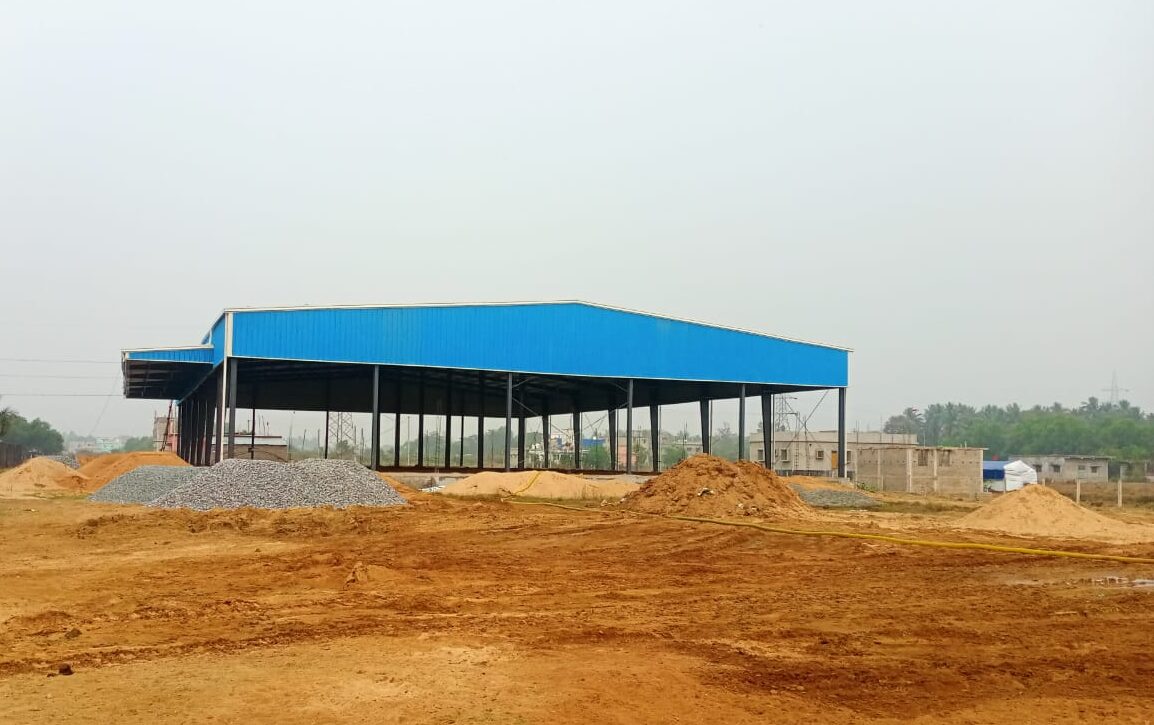
Key takeaway: Pre-engineered building shed dimensions for rice mills are driven by the process tower height (which is in turn driven by gravity flow), the equipment footprint of the milling line, and the storage and dispatch volumes. A 1 TPH single-floor mill needs a 12-15 m wide × 30-40 m long PEB shed with 6-8 m clear height. A 4 TPH hi-tech mill needs an 18-25 m wide × 60-80 m long PEB envelope, with an internal 3-4 floor process tower of 12-15 m clear height. A 12 TPH plant requires 30-40 m wide × 100-120 m long PEB sheds with 12-16 m clear height, often as multiple connected blocks.
| Mill Capacity | PEB Shed Width (Clear Span) | PEB Shed Length | Clear Height (Eaves) | Configuration |
|---|---|---|---|---|
| 1 TPH (modern) | 12-15 m | 30-40 m | 6-8 m | Single-floor linear layout; bucket elevators on platform |
| 2 TPH | 15-20 m | 40-60 m | 7-10 m | Single-floor or compact 2-floor process tower |
| 4 TPH (hi-tech) | 18-25 m | 60-80 m | 10-14 m | 3-4 floor process tower inside PEB shed; gravity flow |
| 8 TPH (hi-tech) | 25-30 m | 80-100 m | 12-16 m | 4-floor process tower + dedicated bagging block |
| 12 TPH+ | 30-40 m | 100-120 m | 14-18 m | 4-5 floor process tower; multiple connected PEB blocks |
| Paddy Storage Godown | 20-30 m | 40-100 m | 5-6 m | Single-floor stack-storage; sized by months of paddy buffer |
| Finished Rice Warehouse | 15-25 m | 30-60 m | 5-6 m | Clean FSSAI-zoned area; pallet racks or floor stacks |
The clear height column is the most consequential dimension in the whole layout. A 4 TPH hi-tech mill cannot be retrofitted into an 8 m clear-height shed — the bucket elevators and gravity hoppers will not fit. A 12 TPH plant designed with 10 m clear height instead of 14 m forces horizontal conveying between every stage, doubling energy consumption and dust. The eaves height must be locked in at the structural design stage, not negotiated downward for material savings.
Equipment Footprints & Clearance Requirements
Key takeaway: Every rice mill machine needs both a footprint (the floor area it occupies) and a clearance envelope (the surrounding space needed for operator access, maintenance, and roll or screen change). Layouts that ignore clearance — typically because the equipment supplier sends only the bare footprint drawing — force operators to dismantle adjacent machines whenever a husker rubber roll or a colour sorter camera needs servicing. Standard practice is 1.0 to 1.5 m clearance around each machine, with extra space at the front for component removal.
| Equipment | Typical Footprint | Machine Height | Clearance Required |
|---|---|---|---|
| Drum Pre-Cleaner | 2.0 × 1.5 m | 2.5 m | 1.0 m all sides; drum end pull-out space |
| De-Stoner | 2.5 × 1.5 m | 2.0 m | 1.0 m all sides; screen change clearance |
| Rubber Roll Husker | 1.5 × 1.0 m | 2.0 m | 1.2 m front (roll change); 0.8 m other sides |
| Husk Aspirator | 1.2 × 1.0 m | 2.0 m | 0.8 m all sides; duct connection clearance to husk silo |
| Paddy Separator | 4.0 × 2.0 m | 2.5 m | 1.0 m all sides; balance and oscillation clearance |
| Abrasive Whitener | 1.5 × 1.0 m | 2.2 m | 1.5 m front (emery roller change); 1.0 m other sides |
| Friction Polisher | 1.5 × 1.0 m | 2.2 m | 1.5 m front; mist water inlet on side |
| Length Grader (Indented Cylinder) | 2.5 × 1.5 m | 2.5 m | 1.0 m all sides; cylinder end pull-out 1.5 m |
| Colour Sorter (CCD/NIR) | 2.0 × 1.5 m | 2.5 m | 1.2 m front (camera and chute access); air-conditioned cabin recommended |
| Auto Bag Weigher | 1.5 × 1.5 m | 2.5 m | 1.5 m operator space; conveyor approach 3.0 m |
| Bucket Elevator (per unit) | 0.6 × 0.6 m (boot) | 10-18 m | 0.5 m clear on each side; belt inspection door access |
Layout Configurations: Linear, L-Shape, U-Shape & Multi-Floor Tower
Key takeaway: Four standard layout configurations cover almost every Indian rice mill. The choice depends on plot dimensions, capacity, and whether the mill uses gravity flow or horizontal conveying. Linear single-floor is the simplest for 1-2 TPH mills on long plots. L-shape is used on square plots where intake and dispatch share one side. U-shape compresses footprint by looping flow back. Multi-floor process towers — used in 4 TPH and above hi-tech mills — are the most efficient because gravity replaces conveying for nine out of ten transitions.
| Layout Type | Best For | Advantages | Limitations |
|---|---|---|---|
| Linear (In-Line) Single-Floor | 1-2 TPH mills, long narrow plots | Simple, low PEB height, easy operator workflow, lowest capex | Many horizontal conveyors and bucket elevators; high energy use; more dust generation |
| L-Shape Single-Floor | 1-4 TPH mills, square plots | Efficient plot use; intake and dispatch on different sides | 90-degree material flow turn requires intermediate elevator |
| U-Shape Single-Floor | 2-4 TPH mills, compact plots | Intake and dispatch on same side; single truck access | Risk of cross-contamination if intake dust drifts to bagging zone |
| Multi-Floor Process Tower | 4 TPH and above hi-tech mills | Gravity flow between most stages; minimum elevators; lowest energy per tonne | Higher structural cost (RCC tower or heavy steel); needs taller PEB envelope |
In a multi-floor process tower, the typical floor stack is: top floor for pre-cleaning and de-stoning (paddy enters by intake elevator), next floor down for husker and paddy separator (brown rice flows down by gravity), next floor for whitener and polisher, next floor for length grader, and ground floor for colour sorter and bagging. Each floor is 3.5 to 4.5 m high, giving a 14 to 18 m total tower height for a 4-floor design. The PEB envelope around the tower also houses the bag warehouse on the ground floor at one end.
Material Handling: Bucket Elevators, Conveyors & Pneumatic Transport
Key takeaway: A rice mill moves four distinct material streams — paddy, brown rice, polished rice, and by-products (husk, bran, broken rice). Each stream needs its own conveying line, sized to the maximum flow rate at peak capacity. Bucket elevators handle vertical transport for grain. Belt conveyors and screw conveyors handle horizontal flow. Pneumatic transport with cyclone separators handles husk and bran. Layouts that share conveying between streams cause contamination and downtime, and routinely fail FSSAI audits.
| Material Stream | Typical Conveying Method | Layout Notes |
|---|---|---|
| Raw Paddy | Bucket elevator (vertical), drag chain or belt conveyor (horizontal) | Gentle handling to avoid grain damage; dust suppression hoods at transfer points |
| Brown Rice | Bucket elevator (vertical), gravity chute (downward), short conveyor (horizontal) | Minimum drop height to prevent kernel breakage |
| Polished Rice (Head Rice) | Belt conveyor or gentle bucket elevator | FSSAI clean zone; food-grade contact surfaces; sealed enclosure |
| Husk | Pneumatic transport with cyclone, screw conveyor | Discharge to husk silo or shed; fire-rated zone; separate from grain flow |
| Bran | Pneumatic transport, screw conveyor | Bran silo near loading dock; oxidises quickly so dispatch within 48 hours |
| Broken Rice (graded) | Gravity chute, dedicated bagging line | Separate from head rice bagging to avoid mix-up |
Utility Block Layout: Panel Room, Compressor, Water & Fire
Key takeaway: The utility block is what keeps the mill running, but it is the most under-planned zone in most Indian rice mill layouts. Five utilities must be planned at the layout stage — electrical (transformer, panel room, DG), compressed air (compressor and receiver), water (tanks, pumps, fire hydrant), husk-fired furnace or boiler if present, and fire safety (hydrants, sprinklers, hose reels). Every one of these has a code-prescribed location relative to the main building.
| Utility | Typical Footprint & Location | Code & Safety Note |
|---|---|---|
| Transformer Yard | 3 × 3 m fenced enclosure outside main shed; 250-1000 kVA depending on mill | CEA Safety Regulations 2010; 4.5 m clearance from building; fire-rated enclosure if oil-cooled |
| Main Electrical Panel Room | 4 × 6 m enclosed AC room adjacent to milling zone | Dust-tight; IS 8623 panels; 1.2 m clearance front and rear; positive pressure ventilation |
| Compressor Room | 3 × 4 m; one or two 10-50 hp screw compressors with receiver | Required for colour sorter and pneumatic valves; cool ventilated room; PESO receiver registration |
| Overhead Water Tank | 10,000-50,000 litre RCC or steel tank, 6-8 m elevated | Process water + fire hydrant; NBC 2016 Part 4 fire reserve minimum |
| Husk-Fired Furnace / Boiler (if parboiling) | 8 × 10 m separate shed downwind of milling block | IBR registration if steam pressure > 1 kg/cm²; CPCB stack emission norms; fire-rated wall |
| DG Set Room | 4 × 6 m acoustic enclosure; 125-500 kVA | CPCB noise norms (75 dB at 1 m); 10 m chimney height; PESO bulk fuel storage if > 2500 litres |
| Fire Pump House | 2 × 3 m housing electric + diesel pump set | NBC 2016 Part 4 mandatory for assembly > 500 sq m; hydrants every 30 m on perimeter |
Egress, Fire Safety & FSSAI Hygiene Zoning
Key takeaway: Three regulatory frameworks shape the non-negotiable parts of any Indian rice mill layout — NBC 2016 Part 4 (fire and life safety, egress), FSSAI Schedule 4 (food safety hygiene zoning), and the Factories Act 1948 (ventilation, sanitation, exit doors). Layouts that ignore any of the three either fail approval or face running-time compliance notices. Owners should treat these as fixed constraints from Day 1, not amendments after the layout is “done”.
- NBC 2016 Part 4 — Egress: Travel distance to nearest exit not more than 22.5 m for industrial occupancy (Group G2); minimum 2 exits for floor area above 500 sq m; exit doors 1.0 m minimum width opening outward; staircases minimum 1.2 m wide for process tower.
- NBC 2016 Part 4 — Fire Safety: Hydrants on every external face at 30 m spacing; sprinklers for finished product warehouse above 1000 sq m; fire-rated wall (2 hour rating) between milling block and storage; smoke detectors in panel room.
- FSSAI Schedule 4: Physical separation between raw paddy zone and polished rice zone; no cross-flow of personnel between dusty and clean zones without intermediate hand-wash; pest control routes; QC lab adjacent to milling.
- Factories Act 1948: Minimum 4.25 m³ space per worker; minimum 14.2 m³ if work area; toilets ratio 1 per 25 workers; first-aid room if 150+ workers; cool drinking water within 6 m of work area.
- CPCB / SPCB Pollution Control: Husk and bran dust emission below 150 mg/Nm³; bag filters or cyclones on all dust generators; ambient noise below 75 dB inside premises.
- IS 875 Part 3 — Wind Load: PEB shed designed for the wind zone of the project location (Zone II to Zone V); coastal Andhra and Odisha sites require Zone V design.
- IS 1893 — Seismic Load: Seismic zone factor for the project location must inform structural design of process tower and PEB columns.
Aisle Widths, Truck Movement & Plot Layout
Key takeaway: The plot layout outside the buildings is as important as the floor plan inside them. Trucks must enter, weigh, unload paddy, drive to a holding zone, and exit — and loaded trucks must access the dispatch dock without crossing the intake queue. Internal aisles must allow forklift movement, operator passage, and emergency egress simultaneously. A 4 TPH rice mill plot needs at least 1.5 to 2 acres to accommodate a working layout with room for future expansion.
| Movement Type | Clear Width | Clear Height | Application |
|---|---|---|---|
| Pedestrian Aisle | 1.0-1.2 m | 2.4 m | Between machines on milling floor |
| Hand Trolley / Pallet Jack | 1.5 m | 2.5 m | Bag movement inside warehouse |
| Forklift One-Way | 2.5-3.0 m | 3.5 m | Storage and warehouse aisles |
| Forklift Two-Way | 4.0-4.5 m | 3.5 m | Main warehouse spine aisle |
| Truck Loading Bay | 3.5 m per truck | 4.5 m | Dispatch dock canopy clear height |
| Truck Internal Road | 6.0-7.5 m | 5.0 m | Two-way truck circulation; 12-15 m turning radius at corners |
| Fire Tender Access | 6.0 m | 5.0 m | Mandatory all-weather access on at least one perimeter face (NBC 2016) |
Common Rice Mill Layout Mistakes (And How to Avoid Them)
Based on Kishore Infratech’s experience designing and constructing PEB sheds for rice mills across Telangana, Andhra Pradesh, Karnataka, and Tamil Nadu, the following are the recurring layout mistakes that owners and contractors make:
- Letting the machinery supplier dictate the layout: Equipment vendors design for their own machines, not for the integrated plant. An independent plant layout consultant must lead the floor plan.
- Designing the PEB shed first and squeezing machines in later: The shed dimensions must follow from the layout, never the other way around. Eaves height, clear span, and column-free zones are downstream of process flow, not upstream.
- Locating the husk silo upwind of the panel room: Husk dust kills electronic panels within months. Husk handling must always be downwind of all electrical zones.
- Skipping the colour sorter at the design stage: Many mid-sized mills are built without a colour sorter pad, then have nowhere to retrofit one when buyers demand it. Always reserve floor space and elevator capacity for a sorter even if not installed initially.
- Mixing raw paddy and finished rice flows on the same conveyor: FSSAI Schedule 4 violation; immediate failed audit. Each material stream must have a dedicated conveying line.
- Insufficient clear height in the process tower: A 10 m clear-height shed cannot accommodate a 4-floor gravity-flow tower. Owners try to save on PEB capex and pay for it for the next 20 years in elevator energy.
- No fire tender access on one perimeter face: Triggers refusal of fire NOC. Fire tender access must be planned at the plot layout stage with 6 m all-weather road.
- Cramming the QC lab into a corner: Quality control needs daylight, AC, and proximity to the bagging line for fast sample turnaround. A poorly located lab guarantees inconsistent grade.
- Ignoring future expansion: A mill built today as 2 TPH almost always wants to be 4 TPH within 5 years. Reserve plot frontage and PEB envelope for a second milling line from Day 1.
- Locating the intake and dispatch on the same gate: Causes truck congestion at peak harvest. Intake and dispatch must be on separate gates whenever the plot permits.
Planning a Rice Mill?
Get a Free Layout Review & Quotation.
Share your requirement — our engineers call you back within 24 hours with a PEB shed design coordinated to your milling plant layout, from 1 TPH to 12 TPH.
- Process-tower PEB envelopes up to 16 m clear height
- Layout coordination with your machinery supplier
- FSSAI Schedule 4 hygiene zoning built in
- Paddy storage & finished-rice warehouse design
- 45+ years steel fabrication, 700+ projects delivered
Prefer to speak directly? Call 9440407852
Thank You!
Our PEB engineers will call you back shortly with your free rice mill shed proposal and quotation.
Want a faster response?
📱 Chat with us on WhatsAppWhy Kishore Infratech for Rice Mill PEB Construction
Kishore Infratech Private Limited (KIPL), an ISO 9001:2015 certified PEB manufacturer headquartered in Hyderabad, Telangana, with 45+ years of steel fabrication experience and 700+ completed projects, designs and constructs PEB sheds for rice mills of every capacity from 1 TPH single-floor operations to 12+ TPH hi-tech multi-floor process plants across South India. Our structural design accounts for the eaves height, clear span, column-free process tower zone, and bucket elevator support points that machinery suppliers and mechanical consultants need — handing over a building that the milling line drops cleanly into.
- Clear-span PEB structures from 15 m to 40 m wide for rice mill operations
- Eaves heights of 6-18 m designed for the specific layout — single-floor, multi-floor process tower, or warehouse blocks
- IS 875, IS 1893, IS 800 compliant structural design with Staad.Pro and Tekla simulation
- Process tower coordination — column locations, plinth heights, and floor cutouts matched to the milling-line drawing
- Bucket elevator and conveyor support points pre-fabricated into the PEB columns and rafters
- Bag warehouse and finished product godowns in matching PEB design — FSSAI-compliant hygiene zoning
- Husk silo and shed structures with fire-rated wall separation from the milling block
- Project execution across the rice belt of Telangana, Andhra Pradesh, Karnataka, Tamil Nadu, Odisha, and Chhattisgarh
Frequently Asked Questions
How many process stages are there in a modern Indian rice mill?
A modern FSSAI-compliant rice mill follows a 10-stage process flow — paddy intake, pre-cleaning, de-stoning, drying or storage, husking, paddy separation, whitening, polishing, length grading, and colour sorting — followed by bagging and dispatch. Older Engelberg huller-type mills compress stages 5-8 into a single huller but produce lower head-rice yield and uncompetitive grade.
What size PEB shed is needed for a rice mill?
A 1 TPH mill needs a 12-15 m × 30-40 m shed with 6-8 m clear height. A 4 TPH hi-tech mill needs 18-25 m × 60-80 m with 10-14 m clear height to accommodate a 3-4 floor process tower. An 8 TPH plant needs 25-30 m × 80-100 m with 12-16 m clear height. Paddy storage and finished rice warehouses are separate single-floor sheds of 5-6 m clear height.
Why is a multi-floor process tower preferred for hi-tech rice mills?
A multi-floor process tower uses gravity to move grain between stages, eliminating most bucket elevators and horizontal conveyors. This reduces energy consumption per tonne of rice, lowers grain breakage, and minimises dust generation. Typical hi-tech mills above 4 TPH use a 3-4 floor RCC or heavy-steel tower inside a PEB envelope of 12-16 m clear height.
How much land is needed for a rice mill plant?
A 1-2 TPH mill needs 0.5 to 0.75 acres. A 4 TPH hi-tech mill needs 1.5 to 2 acres including paddy intake, drying and storage, milling block, finished product warehouse, husk shed, utility block, and truck circulation. An 8 TPH plant needs 2.5 to 3 acres. Always reserve 25-30 percent additional plot area for future capacity expansion.
What are the standard zones in a rice mill layout?
Eight functional zones are standard — paddy intake (with weighbridge), drying and paddy storage, milling block (process tower), by-product handling (husk and bran), finished product warehouse, dispatch and loading dock, utility block (panel, compressor, water, fire), and administration with QC lab. Each zone must be physically separated from incompatible zones per FSSAI Schedule 4.
Which codes govern rice mill plant design in India?
NBC 2016 Part 4 governs fire and life safety and egress. NBC 2016 Part 8 covers building services. FSSAI Schedule 4 mandates hygiene zoning. The Factories Act 1948 sets ventilation, sanitation, and exit door requirements. IS 875 Part 3 (wind) and IS 1893 (seismic) govern structural loads. IS 800 governs steel structural design. CPCB and SPCB norms cover dust emissions, noise, and consent to operate.
How much clearance space is needed around rice mill machinery?
Standard practice is 1.0 to 1.5 m clearance around each machine, with 1.5 m at the front of huskers and whiteners for roller change. Bucket elevators need 0.5 m on each side for belt inspection access. Colour sorters need 1.2 m at the front and air-conditioned ambient. Operator aisles between machines must be at least 1.0 m and forklift aisles 2.5 to 4.5 m depending on one-way or two-way movement.
What are the layout options for a rice mill?
Four standard layouts cover almost every Indian rice mill — linear in-line single-floor (best for 1-2 TPH on long plots), L-shape single-floor (for square plots), U-shape single-floor (for compact plots with intake and dispatch on the same side), and multi-floor process tower (for 4 TPH and above hi-tech mills). Multi-floor tower is the most energy-efficient because gravity replaces conveying for most transitions.
Where should the husk silo or shed be located in the layout?
Always downwind of the panel room and electrical zones to prevent husk dust damage to electronics. Husk handling should also be physically separated by a fire-rated wall (2 hour rating) from the milling and warehouse blocks because husk is a Class A combustible material. Husk transport from the husker is by pneumatic conveying through cyclones to either a steel silo or a fire-rated PEB husk shed.
How should truck movement be planned in a rice mill plot?
Trucks must enter through a separate intake gate, weigh at the weighbridge (typically 18 m × 3 m), proceed to the intake hopper, then exit. Loaded dispatch trucks should use a separate gate to prevent congestion during peak harvest. Internal roads should be 6.0 to 7.5 m wide for two-way truck movement with a 12 to 15 m turning radius at all corners. Fire tender access of 6 m wide must be planned on at least one perimeter face.
How should a rice mill layout plan for future expansion?
Reserve PEB envelope, plot frontage, and electrical capacity for at least a second milling line of equal capacity. A 2 TPH mill should design the plot to accommodate a 4 TPH expansion. Reserve 25-30 percent additional ground area beyond the Day 1 footprint, keep one side of the PEB shed expandable, and oversize the transformer and main panel by 50 percent. Bagging and warehouse zones expand in parallel with milling capacity.
Why is a colour sorter important to plan at the layout stage?
A colour sorter is the final quality upgrade that determines whether the mill’s rice meets buyer specifications for branded retail or export. Many mid-sized mills omit the sorter at Day 1 to save capex, then discover they cannot retrofit one because the floor space, bucket elevator, and compressed air supply were not planned for. Always reserve a 2 m × 1.5 m sorter pad, an elevator slot, and a compressed air line during initial layout design even if the sorter is added in Phase 2.
What utility infrastructure is needed in a rice mill layout?
A 4 TPH rice mill typically needs a 250-500 kVA transformer in a fenced yard, a main electrical panel room of 4 × 6 m with positive-pressure ventilation, a compressor room of 3 × 4 m for the colour sorter and pneumatics, an overhead water tank of 30,000-50,000 litres elevated 6-8 m, a DG set of 125-250 kVA with acoustic enclosure, and a fire pump house of 2 × 3 m. A husk-fired furnace or steam boiler is additional if the mill includes parboiling.
What does FSSAI Schedule 4 require in a rice mill layout?
FSSAI Schedule 4 mandates physical separation between raw paddy zones and polished rice zones to prevent cross-contamination, dedicated personnel hygiene corridors between dusty and clean areas, pest control routes around the perimeter, washable food-contact surfaces on all polished rice conveyors, and a dedicated QC laboratory adjacent to the bagging zone for sample testing. Violation results in failed audits and licence suspension.
Data methodology: Process flow, equipment footprints, PEB shed dimensions, zone separation guidelines, and clearance figures in this guide are based on standard Indian rice mill design practice, NBC 2016 (Parts 4 and 8), FSSAI Schedule 4 (food safety hygiene), Factories Act 1948 (working conditions), IS 875 Part 3 (wind loads), IS 1893 (seismic), IS 800 (steel design), and CPCB / state pollution control board norms for milling industries. Equipment footprint and clearance figures are drawn from datasheets of major Indian and international rice mill machinery suppliers (Buhler, Satake, Milltec, Aksharama, Jiangsu) and Kishore Infratech Private Limited’s project experience executing PEB sheds for rice mills across the South Indian rice belt. All figures are typical values; actual plant layout must be designed by a qualified mechanical and structural consultant for the specific paddy variety, output grade, machinery brand, and plot dimensions.
Final Thoughts: Design the Layout Before You Pick the Machine
The single highest-leverage decision in building an Indian rice mill is not which brand of huller you select, which colour sorter you specify, or even how much paddy you procure in the first season. It is the floor plan. A well-designed layout — sequenced correctly, zoned for FSSAI and NBC compliance, dimensioned for gravity flow, and plotted for clean truck and operator movement — pays back every single hour the mill runs, for the next 20 years. A badly designed layout is a tax on every kilogram of rice the mill ever produces.
Owners who treat layout drawings as the first deliverable — before machinery quotations, before PEB tenders, before plot finalisation — consistently outperform owners who treat them as a documentation afterthought. The codes (NBC, FSSAI, Factories Act, IS structural codes) define the floor; the federation between mechanical, electrical, and structural consultants defines the ceiling. The owner’s job is to keep the layout drawing at the centre of every design conversation until the first bag of rice leaves the dispatch dock.
Plan Your Rice Mill PEB Shed With Kishore Infratech
If you are planning a rice mill anywhere in South India — 1 TPH starter operation, 4 TPH hi-tech plant, or 12 TPH export-grade facility — the PEB shed must be designed around the plant layout from the very first sketch. Kishore Infratech’s design team coordinates the structural geometry, eaves height, column-free process tower zone, and bucket elevator support points with your machinery and mechanical consultants so the milling line drops cleanly into the building on commissioning day.
Call us at +91 9440407852 or visit kishoreindustries.in to discuss your rice mill project. We work across Hyderabad, Bengaluru, Chennai, Vijayawada, Vizag, Warangal, Karimnagar, Nizamabad, Raipur, Bhubaneswar, and the entire South Indian rice belt.