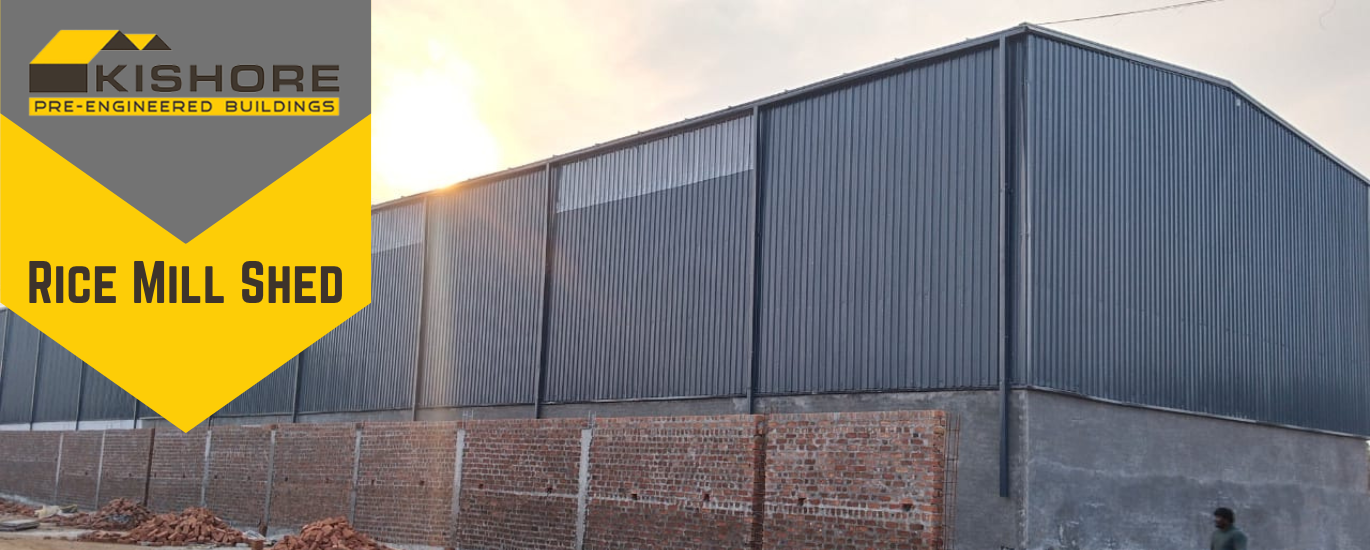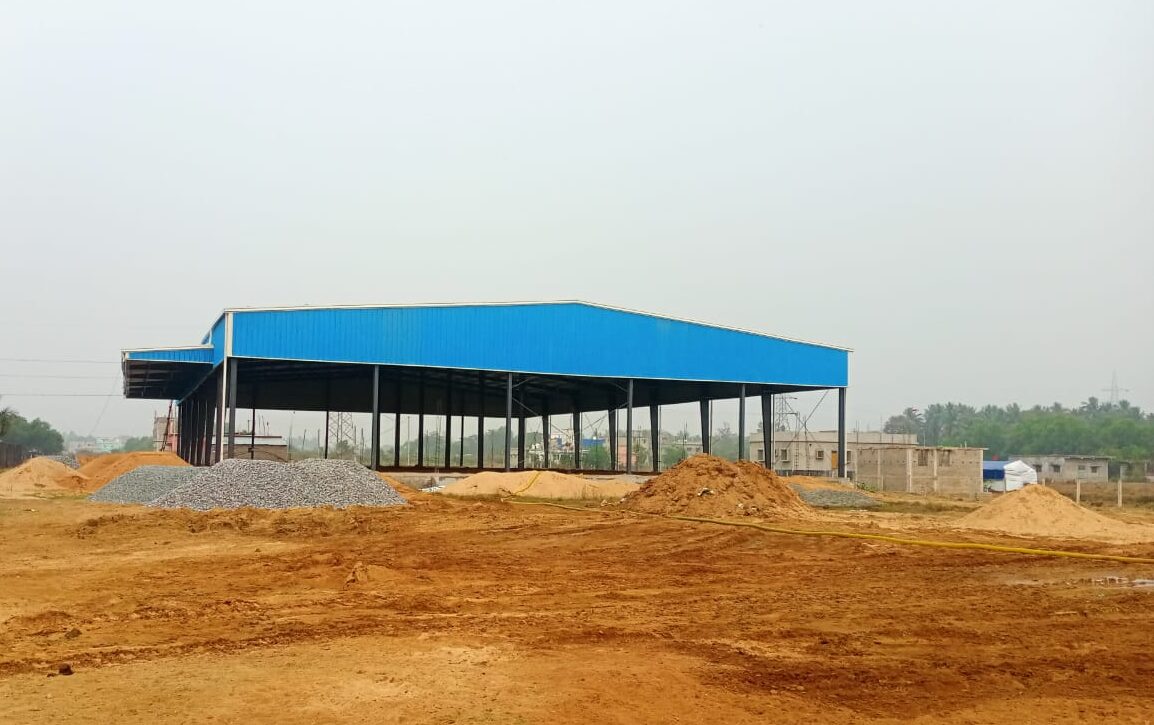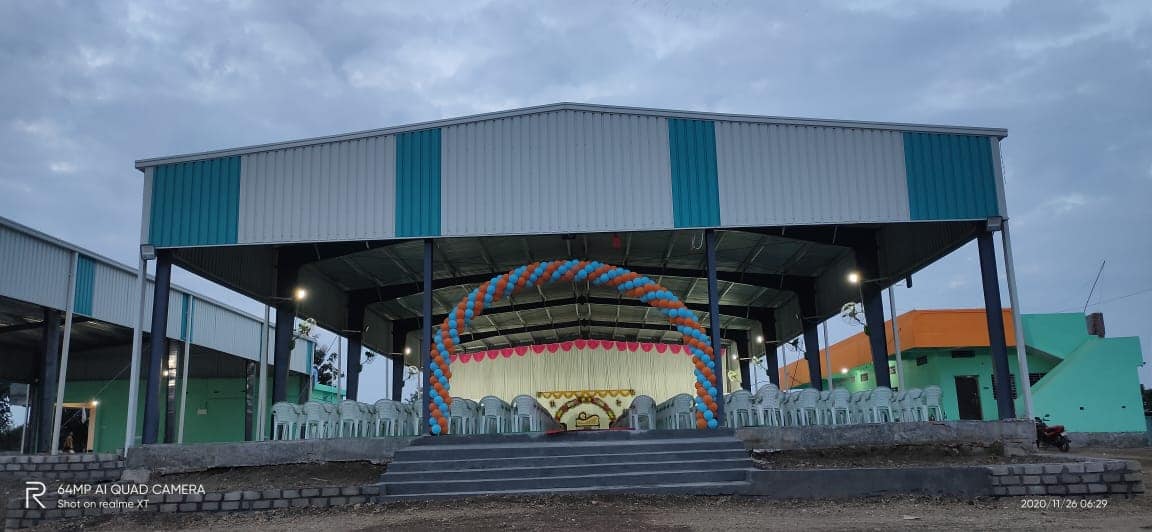

Quick Answer: Rice mill construction cost in India in 2026 runs an estimated ₹35-60 lakh for a 2 TPH mini mill, ₹1.2-2.5 crore for a 4 TPH small commercial mill, ₹3-5 crore for an 8 TPH medium mill and ₹6-15 crore for a 10+ TPH automated mill, covering PEB shed, machinery, land and working capital. PEB rice mill sheds cost ₹1,400-2,600 per sq ft against ₹1,800-3,200 for RCC, and a typical 4 TPH mill needs 8,000-12,000 sq ft of covered area on 1.5-2 acres. Machinery alone accounts for 50-65% of total cost. Clear height and floor loading are the two structural decisions that move the building estimate most. All figures are indicative estimates, not quotations.
At-a-Glance: Rice Mill Project Cost by Capacity (2026)
| Mill Capacity | Total Project Cost | PEB Shed Area | Land Required | Annual Paddy Capacity | Payback Period |
|---|---|---|---|---|---|
| Mini Mill (2 TPH) | ₹35-60 lakh | 3,000-5,000 sq ft | 0.5-1 acre | 4,000-6,000 MT | 2.5-3.5 years |
| Small Commercial (4 TPH) | ₹1.2-2.5 crore | 8,000-12,000 sq ft | 1.5-2 acres | 15,000-20,000 MT | 3-4 years |
| Medium Commercial (8 TPH) | ₹3-5 crore | 15,000-25,000 sq ft | 2.5-4 acres | 35,000-45,000 MT | 3.5-4.5 years |
| Modern Automated (10+ TPH) | ₹6-15 crore | 25,000-40,000 sq ft | 4-10 acres | 50,000-80,000 MT | 4-5.5 years |
| Mega Integrated (20+ TPH) | ₹20-50+ crore | 50,000+ sq ft | 10-25 acres | 1,00,000+ MT | 5-7 years |
Understanding Rice Mill Construction in India 2026
India produced 137 million tonnes of paddy in the 2024-25 crop year and exported 17.7 million tonnes of rice — making it the world’s largest rice exporter and a structurally underserved market for modern milling capacity. An estimated 40% of operating rice mills in India still use 1980s-era huller technology with head-rice recovery below 60%, while modern food-processing PEB plants with rubber-roll shellers and multi-stage sortex routinely deliver 67-70% head-rice yield. That 7-10% recovery gap is exactly where new rice mill investors are making money in 2026.
Rice mill construction cost in India is driven by four cost centres: the PEB or RCC shed (15-25% of project cost), milling machinery (50-65%), paddy and finished-rice storage (8-12%), and working capital for paddy procurement (10-15%). Unlike a generic warehouse project, a rice mill needs heavy floor loads (3-5 T/sq m), high bay heights (8-12 m for elevators and silos), and specific layout zoning for paddy intake, drying, milling, sortex and finished-rice storage — which is why pre-engineered building (PEB) construction has become the default choice for 70%+ of new rice mill projects in 2026.
PEB Shed Cost for Rice Mills in India 2026
Key takeaway: A PEB rice mill shed costs ₹1,400-2,600 per sq ft in 2026 — 22-30% cheaper than RCC and delivered in 4-6 months vs 12-18 months for traditional construction. For a typical 4 TPH mill needing 10,000 sq ft of covered shed, PEB saves ₹40-60 lakh in direct construction cost and another ₹15-25 lakh in interest cost from earlier production start.
| Shed Component | PEB Cost (₹/sq ft) | RCC Cost (₹/sq ft) | Specifications for Rice Mill |
|---|---|---|---|
| Main Milling Hall | 1,800 – 2,400 | 2,400 – 3,000 | 10-12 m bay height, 3-5 T/sq m floor load |
| Paddy Storage Godown | 1,400 – 1,800 | 1,800 – 2,400 | 8-9 m clear height, ventilation cowls, bag storage |
| Finished Rice Godown | 1,500 – 2,000 | 1,900 – 2,500 | FCI-grade insulation, rodent-proof, dock leveler |
| Drying Yard / Tarpaulin Cover | 800 – 1,200 | 1,200 – 1,600 | Concrete floor, partial roof, 6 m height |
| Office & QC Lab Block | 2,200 – 2,800 | 2,000 – 2,600 | RCC often preferred for AC/false ceiling |
| Husk Storage / Boiler Room | 1,200 – 1,600 | 1,600 – 2,100 | Fire-rated cladding, separate compartment |
| Blended Average (Full Mill) | ₹1,600 – 2,200 | ₹2,000 – 2,700 | PEB saves 18-25% on average |
Based on our experience building 60+ agri-processing PEB structures across Telangana, Andhra Pradesh and Karnataka, a 4 TPH rice mill with 10,000 sq ft of covered area can be erected and made machinery-ready in 90-110 days from foundation start using PEB — compared to 8-12 months for RCC. PEB construction timelines are particularly important for rice mills because most operators time their commissioning to the kharif paddy harvest in October-November — missing one harvest cycle delays revenue by an entire year.
Rice Mill Machinery Cost in India 2026 (By Capacity & Brand)
Key takeaway: Machinery accounts for 50-65% of total rice mill project cost. A complete 4 TPH machinery line costs ₹65 lakh-1.4 crore depending on brand selection — Indian brands like Milltec and Sona Husker price 30-45% lower than Japanese Satake and Swiss Bühler, but premium imports deliver 5-8% higher head-rice recovery, which can pay back the price gap in 18-24 months on high-value basmati or export contracts.
Complete Machinery Cost by Mill Capacity
| Machinery Stage | 2 TPH (Mini) | 4 TPH (Small) | 8 TPH (Medium) | 10+ TPH (Modern) |
|---|---|---|---|---|
| Pre-Cleaner / Destoner | ₹1.5-2.5 L | ₹3-5 L | ₹6-10 L | ₹12-20 L |
| Paddy Sheller (Rubber Roll) | ₹3-5 L | ₹7-12 L | ₹15-25 L | ₹30-50 L |
| Husk Aspirator / Separator | ₹1-2 L | ₹2-4 L | ₹5-8 L | ₹10-15 L |
| Paddy Separator | ₹2-3 L | ₹5-8 L | ₹10-16 L | ₹20-30 L |
| Whitener / Polisher (2-stage) | ₹3-5 L | ₹10-18 L | ₹25-40 L | ₹50-90 L |
| Silky Polisher / Mist Polisher | Optional | ₹6-10 L | ₹15-22 L | ₹30-50 L |
| Length Grader / Indented Cylinder | Optional | ₹5-9 L | ₹12-20 L | ₹25-40 L |
| Color Sortex (RGB / NIR) | ₹8-15 L (3-chute) | ₹15-30 L (5-chute) | ₹40-70 L (7-chute) | ₹80 L-1.5 Cr (10+ chute) |
| Elevators & Conveyors | ₹2-3 L | ₹5-9 L | ₹12-20 L | ₹25-45 L |
| Packing Line (Auto Bagging) | Manual ₹1-2 L | ₹5-10 L | ₹15-30 L | ₹40-80 L |
| Control Panel / PLC Automation | ₹1-2 L | ₹4-7 L | ₹10-18 L | ₹25-50 L |
| Total Machinery Cost | ₹22-37 lakh | ₹65 L-1.4 Cr | ₹1.65-2.8 Cr | ₹3.5-7.5 Cr |
Brand Comparison: Satake vs Bühler vs Milltec vs Sona Husker
Key takeaway: For a 4 TPH commercial rice mill, Bühler/Satake systems cost ₹1.2-1.4 crore vs ₹65-90 lakh for Milltec/Sona — a 40-50% premium. Premium imports justify themselves only if you process basmati for export (₹65-90/kg pricing) or have high-value contract milling. For non-basmati domestic rice (₹28-38/kg), Indian brands deliver 90-92% of the value at 55-65% of the cost.
| Brand | Origin | 4 TPH Line Cost | Head-Rice Yield | Best For |
|---|---|---|---|---|
| Bühler (with Sortex) | Switzerland | ₹1.3-1.5 Cr | 68-71% | Basmati export, premium brands |
| Satake | Japan | ₹1.2-1.4 Cr | 68-70% | Export, large contract milling |
| Milltec Machinery | India (Bengaluru) | ₹70-95 Lakh | 64-67% | Domestic non-basmati, FCI supply |
| Sona Husker / Sona Engg | India (Punjab) | ₹65-90 Lakh | 63-66% | North India, basmati & non-basmati |
| AGI Milltec / Forsberg | India / USA JV | ₹90 L-1.2 Cr | 66-68% | Mid-tier export, branded retail |
| Local / Custom-Built | India (regional) | ₹40-65 Lakh | 58-62% | Village-scale, low-investment entry |
Regional Cost Analysis: Rice Mill Construction Across India
| State / Region | Land Cost (₹/sq ft) | PEB Shed (₹/sq ft) | 4 TPH Total Project | Key Advantage |
|---|---|---|---|---|
| Andhra Pradesh (Godavari belt) | 350 – 800 | 1,500 – 2,300 | ₹1.3 – 2.1 Cr | Largest paddy producer in South |
| Chhattisgarh (Raipur, Bilaspur) | 200 – 500 | 1,400 – 2,100 | ₹1.15 – 1.9 Cr | Lowest land cost, custom milling |
| Punjab (Amritsar, Patiala) | 800 – 1,800 | 1,700 – 2,600 | ₹1.7 – 2.5 Cr | Basmati hub, export logistics |
| West Bengal (Bardhaman, Hooghly) | 400 – 900 | 1,600 – 2,400 | ₹1.4 – 2.2 Cr | Eastern India paddy, port access |
| Odisha (Bargarh, Sambalpur) | 250 – 600 | 1,500 – 2,200 | ₹1.2 – 1.95 Cr | FCI procurement, export to SE Asia |
| Uttar Pradesh (Lucknow, Bareilly) | 500 – 1,200 | 1,600 – 2,400 | ₹1.5 – 2.3 Cr | Largest paddy producer overall |
| Tamil Nadu (Thanjavur, Tiruvarur) | 600 – 1,400 | 1,700 – 2,500 | ₹1.55 – 2.35 Cr | Cauvery delta, parboiled rice demand |
Compared to Punjab where a 4 TPH rice mill costs ₹1.7-2.5 crore, the same project in Telangana costs ₹1.2-2.0 crore — a 25-30% saving driven primarily by land prices and lower steel logistics costs. Andhra Pradesh and Chhattisgarh sit in the same competitive band, while Uttar Pradesh and Tamil Nadu offer better access to specific paddy varieties (sona masuri, ponni, basmati) but at 15-20% higher project cost.
Rice Mill Types & Their Cost Variations
Key takeaway: The same 4 TPH milling capacity can range from ₹85 lakh (huller-based raw rice) to ₹3.5 crore (parboiled rice with full automation and 7-chute sortex) — a 4× cost variation driven by mill type, not capacity. Choose mill type before sizing capacity.
| Rice Mill Type | 4 TPH Project Cost | Head-Rice Yield | Output / Use Case |
|---|---|---|---|
| Huller / Engelberg Mill | ₹35-60 lakh | 52-58% | Village custom milling, lowest CapEx |
| Sheller (Disc/Rubber Roll) Mill | ₹85 lakh-1.4 Cr | 62-66% | Domestic raw rice, FCI supply |
| Modern Rice Mill (with Sortex) | ₹1.5-2.5 Cr | 66-69% | Branded retail, mid-tier export |
| Parboiled Rice Mill | ₹2.2-3.5 Cr | 68-72% | South India, Africa export, FCI |
| Basmati Mill (with Length Grader) | ₹2.5-4 Cr | 66-69% | Premium export, GCC & Iran market |
| Fully Automated Mill (PLC + Bühler) | ₹3.5-5 Cr | 68-71% | Large export, branded retail chains |
Hidden Costs in Rice Mill Construction (Don’t Skip These)
Key takeaway: First-time rice mill investors typically underestimate project cost by 18-25% because they budget only for shed and machinery. The hidden cost stack — paddy storage, drying, weighbridge, husk handling, lab, transformer and licensing — adds ₹40-90 lakh to a 4 TPH project. Build these into your DPR (Detailed Project Report) before applying for bank finance.
| Hidden Cost Item | Cost (4 TPH Mill) | Why It’s Critical |
|---|---|---|
| Paddy Storage Silos (500-1000 MT) | ₹15-40 lakh | Procurement is seasonal; need 3-6 month stock |
| Mechanical Paddy Dryer (LSU/Continuous) | ₹15-35 lakh | Wet paddy from harvest needs drying to 14% MC |
| Husk-Fired Boiler (Parboiling) | ₹12-25 lakh | Free fuel from husk byproduct, 60% of mills use this |
| Electronic Weighbridge (50 MT) | ₹8-15 lakh | Mandatory for FCI procurement & mandi sales |
| QC Lab (Moisture, Whiteness, Broken Analyzer) | ₹3-8 lakh | Required for FSSAI, export, brand standards |
| Power Transformer (250-500 kVA) + DG Set | ₹12-25 lakh | Mill consumes 60-120 kW; rural areas need DG |
| Compound Wall, Gate, Internal Roads | ₹6-15 lakh | Truck movement, security, FSSAI compliance |
| Husk & Bran Storage / Briquette Plant | ₹4-12 lakh | Husk = 22% of paddy weight, valuable byproduct |
| Fire Safety Systems & NOC | ₹3-7 lakh | Mandatory for factory license & insurance |
| Working Capital (3-month paddy buffer) | ₹40-80 lakh | Highest-impact line item; under-funded mills shut down |
| Total Hidden Cost Stack | ₹1.18-2.62 Cr | 25-40% of headline project cost |
Phasing a Rice Mill Build to Spread Capital
Most rice mill projects do not need their full footprint on day one, and the cheapest way to manage capital is to build in stages that were planned as stages from the beginning.
Key takeaway: Designing the shed for its eventual size but erecting it in phases typically defers 30-40% of the building spend, provided the frame, foundations and services routes are engineered for the final configuration at the outset. Retro-fitting that capability later costs far more than it saves.
- Expandable end bay — detail the end frame so bays can be added along the length without dismantling a gable wall when throughput grows.
- Foundations for the final load — cast footings for the eventual silo, elevator and paddy storage loads now; they are a small part of cost and impossible to upgrade cheaply later.
- Services routed for the full plant — power, dust extraction and conveying routes set out for the finished layout, capped off where the plant has not been built yet.
- Clear height fixed early — elevator and destoner heights drive eaves height. Raising it later means replacing columns, so it is decided once, at design stage.
All figures in this guide are indicative estimates for planning, not quotations.
Licenses & Approvals Required for Rice Mills in India
Key takeaway: Total licensing cost for a 4 TPH rice mill is ₹1.5-3.5 lakh, but the timeline is the real cost — FSSAI Central License, PCB Consent to Establish/Operate, factory license, and mandi registration together take 90-150 days if filed sequentially. File in parallel with PEB construction to avoid commissioning delays.
| License / Approval | Authority | Approx. Cost | Timeline |
|---|---|---|---|
| FSSAI Central License | FSSAI | ₹7,500/yr (5 yr block) | 30-60 days |
| Pollution Control Board Consent (Air & Water) | State PCB | ₹50,000-2 lakh | 60-120 days |
| Factory License (Factories Act 1948) | State Factories Dept | ₹20,000-50,000 | 45-90 days |
| GST Registration | CBIC | Free | 7-15 days |
| Mandi / APMC License | State Mandi Board | ₹10,000-50,000 | 15-30 days |
| Weights & Measures Certification | State Legal Metrology | ₹5,000-15,000 | 15-30 days |
| Fire NOC | State Fire Dept | ₹10,000-30,000 | 30-60 days |
| Trade License (Local Body) | Municipality / Panchayat | ₹5,000-20,000 | 15-30 days |
| Udyam (MSME) Registration | MoMSME | Free | Same day |
| IEC (Import Export Code) – for export mills | DGFT | ₹500 | 5-10 days |
Rice Mill ROI & Payback Analysis (4 TPH Sample Project)
Key takeaway: A well-run 4 TPH rice mill in Telangana with ₹1.8 crore CapEx delivers ₹35-50 lakh annual EBITDA on ₹15-22 crore turnover — a 3-4 year payback at 18-25% internal rate of return. Husk and bran byproduct sales alone (₹40-60 lakh/year) cover the entire term loan EMI for the first 5 years, making rice milling one of the most cash-flow-resilient agri businesses available to MSME operators in 2026.
| Financial Parameter | Value (4 TPH Mill) | Calculation Basis |
|---|---|---|
| Total Project Cost | ₹1.8 crore | Shed + machinery + land + WC |
| Annual Paddy Processing Capacity | 17,500 MT | 4 TPH × 18 hr × 250 days |
| Rice Output (66% recovery) | 11,550 MT | Head rice + broken rice |
| Husk Output (22%) | 3,850 MT | Sold @ ₹4-7/kg |
| Bran Output (8%) | 1,400 MT | Sold @ ₹18-24/kg |
| Annual Revenue (Rice) | ₹34-40 crore | 11,550 MT × ₹30-35/kg |
| Byproduct Revenue (Husk + Bran) | ₹40-60 lakh | Husk fuel + bran for oil mills |
| Gross Margin | 7-9% | After paddy procurement cost |
| Annual EBITDA | ₹35-50 lakh | Rice margin + byproducts – opex |
| Term Loan EMI (10 yr @ 9%) | ₹19 lakh/yr | On ₹1.26 crore loan |
| Net Cash Flow (After EMI) | ₹16-31 lakh/yr | EBITDA – EMI |
| Payback Period | 3-4 years | On promoter equity |
| 5-Year IRR | 18-25% | Post-tax, post-EMI |
PEB vs Traditional RCC for Rice Mills: The Real Comparison
Key takeaway: For rice mills specifically, PEB beats RCC on 8 of 9 criteria — cost, speed, span, expandability, vibration tolerance for milling machinery, fire safety, maintenance, and resale value. RCC only wins on perceived permanence, which matters less when the asset is depreciated to zero in 15 years anyway. 70%+ of new rice mills built across South India in 2024-26 used PEB.
| Parameter | PEB Rice Mill Shed | Traditional RCC Shed | Winner |
|---|---|---|---|
| Construction Cost (10,000 sq ft) | ₹1.4-2.2 Cr | ₹1.8-2.7 Cr | PEB |
| Construction Time | 3-5 months | 10-14 months | PEB |
| Clear Span (No Internal Columns) | Up to 90 m | Max 12-15 m | PEB |
| Future Expansion (Adding Bays) | Easy, modular | Difficult, costly | PEB |
| Vibration Tolerance (Sheller/Polisher) | Excellent (steel flex) | Good but cracks over 10 yr | PEB |
| Husk Dust Fire Risk | Fire-rated cladding available | Inherently non-combustible | RCC (slight) |
| Maintenance Cost (10 yrs) | ₹40-60/sq ft (repaint) | ₹80-120/sq ft (crack repair) | PEB |
| Resale / Relocation Value | 40-60% recoverable (dismantle) | 5-10% recoverable | PEB |
| Insurance Premium | 0.15-0.25% of asset value | 0.18-0.30% of asset value | PEB |
Related rice mill guides: For per-area benchmarking, see the detailed rice mill construction cost per square foot breakdown, and plan equipment placement with the rice mill layout and plant design guide.
Planning a Rice Mill?
Get a Free PEB Design & Quotation.
Share your mill capacity — our engineers call you back within 24 hours with a machinery-coordinated shed design and transparent costing.
- Mill sheds with machinery-coordinated layouts & spans
- Hot-dip galvanized purlins for parboiling & dryer zones
- Godown, dryer & silo blocks integrated in one structure
- Faster erection than RCC — months, not years
- 45+ years steel fabrication, 700+ projects delivered
Prefer to speak directly? Call 9440407852
Thank You!
Our PEB engineers will call you back shortly with your free rice mill shed proposal and quotation.
Want a faster response?
📱 Chat with us on WhatsAppWhy Choose Kishore Infratech for Your Rice Mill Construction
Kishore Infratech Private Limited (KIPL), an ISO 9001:2015 certified PEB manufacturer headquartered in Hyderabad, Telangana, with 45+ years of steel fabrication experience and 700+ completed projects across 45 lakh sq ft of constructed area, has emerged as one of South India’s most trusted partners for agri-processing PEB construction including rice mills, dal mills, oil mills, cold storage, and feed mills. Our in-house design, fabrication, and erection capability — combined with deep familiarity with rice-mill-specific requirements like elevator pits, paddy silo foundations, husk-handling fire safety, and machinery vibration isolation — lets us deliver turnkey PEB sheds for 2-15 TPH rice mills in 90-150 days from foundation start.
- Rice mill design experience: 60+ agri-processing PEB projects across Telangana, AP, Karnataka, Tamil Nadu and Odisha
- Heavy floor load engineering: Foundations rated for 3-5 T/sq m with isolation pads for sheller and polisher vibration
- High-bay design: Clear heights of 8-14 m for paddy elevators, finished-rice conveyors and silo integration
- Husk-fire-safe cladding: Fire-rated panels and compartmentalisation for boiler rooms and husk storage
- Modular bay design: Rice mill operators routinely expand from 4 TPH to 8 TPH within 2-3 years — our PEB structures are designed to accept additional bays without disruption
- Foundation-to-handover delivery: Single-vendor accountability across design, fabrication, erection, and finishing — no contractor coordination headaches
- Steel sourcing from SAIL/JSW/Tata: Tier-1 mill steel only, with mill test certificates for every consignment
- Turnkey support including civil works: Foundations, flooring, compound wall, internal roads and weighbridge pit
- Post-handover service: Annual inspection, repainting, and bay extensions — single OEM relationship for the full asset life
If you’re evaluating PEB manufacturers for your rice mill project, our detailed guide on how to choose the right PEB manufacturer in India covers the 12 evaluation criteria — design capability, steel grade, in-house vs outsourced fabrication, erection track record, post-sale service — that separate reliable partners from low-cost vendors who disappear after handover.
Frequently Asked Questions: Rice Mill Construction Cost in India 2026
What is the total cost of setting up a rice mill in India in 2026?
The total cost of setting up a rice mill in India in 2026 ranges from ₹35-60 lakh for a 2 TPH mini mill to ₹6-15 crore for a 10+ TPH modern automated mill. A typical 4 TPH small commercial mill costs ₹1.2-2.5 crore including PEB shed (₹15-22 lakh), machinery (₹65 lakh-1.4 crore), land (₹15-30 lakh for 1.5-2 acres in tier-2 locations), licensing (₹2-3 lakh), and 3-month working capital (₹40-80 lakh). Telangana, Andhra Pradesh and Chhattisgarh offer the lowest project cost — 18-25% below Punjab.
How much does a 2 TPH mini rice mill cost in 2026?
A 2 TPH mini rice mill costs ₹35-60 lakh as total project cost in 2026 — including ₹6-10 lakh for PEB shed (3,000-5,000 sq ft), ₹22-37 lakh for sheller-based machinery, ₹3-6 lakh for licensing and electrical setup, and ₹8-15 lakh working capital for paddy procurement. Annual paddy capacity is 4,000-6,000 MT with 2.5-3.5 year payback for village-scale custom milling operations.
How much does a 4 TPH rice mill project cost?
A 4 TPH rice mill costs ₹1.2-2.5 crore as total project cost in 2026, depending on machinery brand selection (Indian vs imported), automation level, and state. Cost breakdown: PEB shed of 8,000-12,000 sq ft costs ₹15-25 lakh, machinery from Milltec/Sona costs ₹65-90 lakh (or ₹1.2-1.4 crore for Bühler/Satake), land of 1.5-2 acres costs ₹15-30 lakh in tier-2 paddy belts, paddy storage and ancillary equipment ₹35-60 lakh, and 3-month working capital ₹40-80 lakh. Annual processing capacity of 17,500 MT delivers ₹35-50 lakh EBITDA with a 3-4 year payback.
How much land is required to set up a rice mill in India?
Land requirement for a rice mill in India ranges from 0.5 acre for a 2 TPH mini mill to 10+ acres for a 10+ TPH modern mill. A typical 4 TPH commercial rice mill needs 1.5-2 acres to accommodate the milling shed, paddy storage godown, drying yard, finished-rice godown, weighbridge, parking and truck movement area. Always procure 25-30% extra land for future expansion — most successful rice mills double capacity within 5 years and need adjacent land for second-stage growth.
What is the cost of rice mill machinery in India in 2026?
Rice mill machinery cost in India in 2026 ranges from ₹22-37 lakh for a 2 TPH line, ₹65 lakh-1.4 crore for 4 TPH, ₹1.65-2.8 crore for 8 TPH, and ₹3.5-7.5 crore for 10+ TPH automated lines. Machinery includes pre-cleaner, destoner, paddy sheller (rubber roll), husk aspirator, paddy separator, two-stage whitener, silky polisher, length grader, color sortex, elevators, packing line and PLC control panel. Indian brands like Milltec and Sona Husker cost 30-45% less than Japanese Satake and Swiss Bühler, but premium imports deliver 5-8% higher head-rice recovery.
Which is the best rice mill machinery brand: Satake, Bühler, Milltec or Sona?
For domestic non-basmati and FCI supply, Milltec (Bengaluru) and Sona Husker (Punjab) offer the best value at ₹65-95 lakh for a 4 TPH line with 64-67% head-rice yield. For basmati export and premium branded retail, Bühler (Switzerland) and Satake (Japan) are the gold standard at ₹1.2-1.5 crore for the same 4 TPH capacity, delivering 68-71% yield — the 5-8% extra recovery pays back the price gap in 18-24 months on high-value basmati. AGI Milltec and Forsberg occupy the mid-tier at ₹90 lakh-1.2 crore for buyers wanting export-grade quality without full premium pricing.
What licenses are required to start a rice mill in India?
Total cost is ₹1.5-3.5 lakh and full timeline is 90-150 days if filed in parallel.
Is rice mill business profitable in India in 2026?
Yes, rice mill business is one of the most consistently profitable agri-processing investments in India in 2026. A well-run 4 TPH rice mill in Telangana with ₹1.8 crore CapEx delivers ₹35-50 lakh annual EBITDA on ₹15-22 crore turnover, with 3-4 year payback and 18-25% IRR. Profitability is driven by India’s structural rice surplus, FCI assured procurement, growing branded retail demand, and strong byproduct revenue — husk and bran sales alone generate ₹40-60 lakh/year, often covering the entire term loan EMI. The biggest risks are paddy procurement timing and working capital management, not market demand.
What is the ROI and payback period for a rice mill in India?
A 4 TPH rice mill in India delivers 18-25% post-tax IRR with 3-4 year payback on promoter equity in 2026. On ₹1.8 crore total project cost (₹54 lakh equity, ₹1.26 crore term loan), annual EBITDA is ₹35-50 lakh and net cash flow after EMI is ₹16-31 lakh per year. Larger 8 TPH mills payback in 3.5-4.5 years with 22-28% IRR due to economies of scale, while 2 TPH mini mills payback fastest at 2.5-3.5 years but on smaller absolute returns. Rice mill ROI is among the most stable in agri-processing because of FCI procurement floor pricing and resilient byproduct demand.
Why is PEB construction better than RCC for a rice mill?
PEB construction is better than RCC for rice mills on 8 of 9 criteria: 22-30% lower cost (₹1,400-2,200/sq ft vs ₹1,800-2,700/sq ft), 60-70% faster delivery (3-5 months vs 10-14 months), clear spans up to 90 m (vs 12-15 m for RCC) which simplifies machinery layout, easy modular expansion as capacity grows from 4 to 8 TPH, better vibration tolerance for sheller and polisher machinery, lower 10-year maintenance cost, and 40-60% recoverable resale value if the asset is dismantled and relocated. RCC has only one marginal advantage — inherent fire resistance against husk dust — which is offset by fire-rated PEB cladding panels available from any reputable manufacturer.
How much does a PEB rice mill shed cost per sq ft in 2026?
A PEB rice mill shed costs ₹1,400-2,600 per sq ft in India in 2026, depending on shed component and specifications: main milling hall with 10-12 m bay height costs ₹1,800-2,400/sq ft, paddy storage godowns ₹1,400-1,800/sq ft, finished rice godowns ₹1,500-2,000/sq ft, drying yard tarpaulin cover ₹800-1,200/sq ft, and office/QC lab block ₹2,200-2,800/sq ft. Blended average for a complete 4 TPH rice mill (10,000 sq ft) is ₹1,600-2,200/sq ft — 18-25% cheaper than equivalent RCC construction at ₹2,000-2,700/sq ft.
Conclusion: Building Your Rice Mill in 2026
Whether you’re planning a 2 TPH mini mill in your village or a 15 TPH export-grade modern mill near a paddy belt, the PEB shed is the foundation that determines speed, cost, expandability and machinery uptime for the next 30 years. Choose your PEB partner with the same rigour you choose your machinery brand.
Get a Rice Mill PEB Shed Quote from KIPL Today
Ready to build your rice mill? Kishore Infratech Private Limited offers two engagement options for rice mill investors:
- PEB Shed Quote: Send us your mill capacity (TPH), location, and machinery layout — receive a detailed PEB shed cost estimate, BOQ, foundation drawing, and 3D rendering within 5-7 working days.
Call +91 94404 07852 or visit kishoreindustries.in to request a free site assessment and rice mill PEB shed quote. Our team has built 60+ agri-processing PEB structures across South and Central India, and our project engineers will visit your site, evaluate paddy belt logistics, and design a PEB shed optimised for your specific mill capacity, layout and budget.