
The Real Cost CEOs Don’t Calculate
When planning an industrial project, most factory owners, promoters, and CEOs begin with one question:
“What is the construction cost per square foot?”
While cost matters, it is no longer the most important metric in industrial construction.
In today’s competitive manufacturing environment, time-to-commission—the time taken from project approval to production start—has a far greater financial impact than the difference between RCC and PEB construction costs.
In fact, for many industries across Telangana and Andhra Pradesh, delayed commissioning silently destroys profits—often far exceeding the visible construction budget.
This is why fast industrial construction in India is no longer a preference.
It is a business necessity.
This blog explains:
Quick Answer: On most industrial projects, time-to-commission costs more than construction rate does. A factory that starts producing six months earlier earns six months of margin, and that usually dwarfs a difference of a few hundred rupees per square foot on the building. This is where pre-engineered construction wins: fabrication runs in parallel with foundation work rather than after it, site labour requirements are smaller and more predictable, and the programme is far less exposed to the labour availability that drives most RCC delays. The practical advice is to evaluate bids on committed handover date and programme certainty alongside rate — not rate alone.
- Why time is more valuable than cost
- A clear PEB vs RCC time comparison
- How delays affect revenue, working capital, and market share
- Why Pre-Engineered Buildings (PEB) consistently outperform RCC for industrial projects
- How CEOs should evaluate construction decisions in 2025 and beyond
Understanding Time-to-Commission in Industrial Construction
Time-to-commission refers to the total duration required to start operations, not just complete the structure.
It includes:
- Design & approvals
- Foundation & civil work
- Structural erection
- Roofing & cladding
- Electrical, plumbing & services
- Machinery installation
- Trial runs & statutory clearances
For a manufacturing business, production does not start when construction finishes—it starts only when machines run and goods move out.
Every additional day of construction delay is a day of lost revenue.
Real Construction Timelines in India (2025 Data)
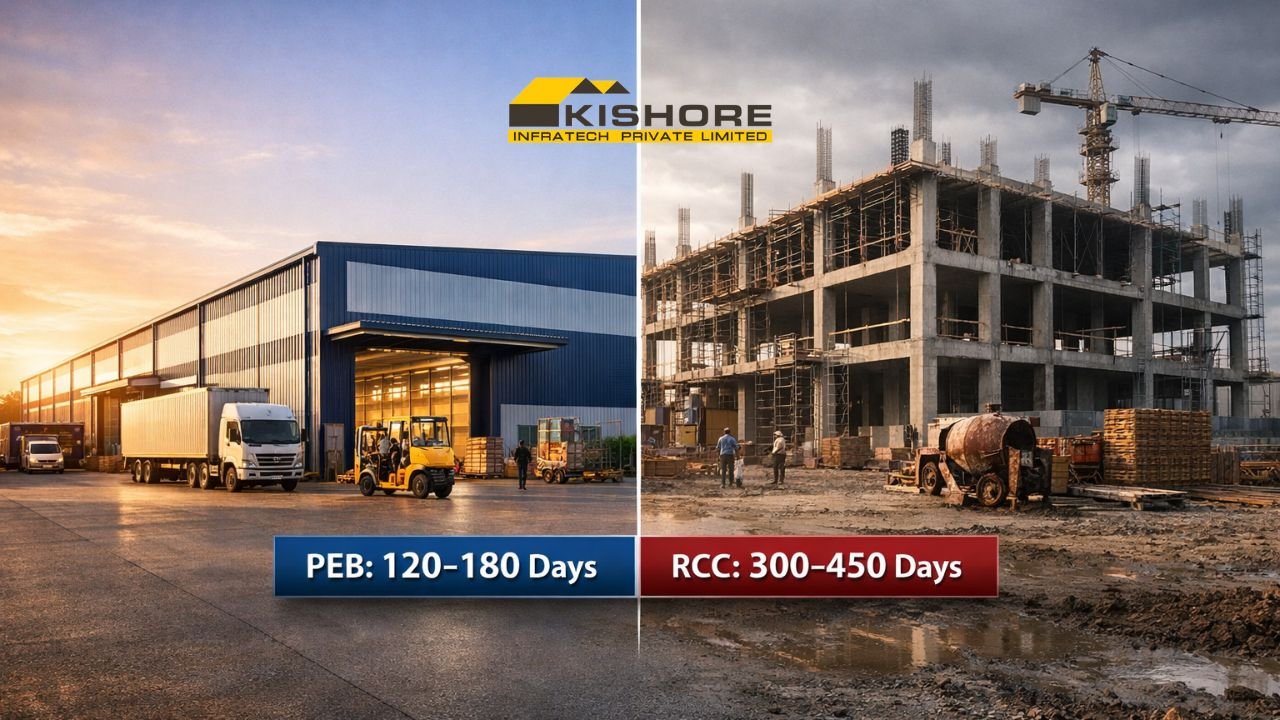
PEB vs RCC: Time Comparison Table
| Construction Method | Average Time to Commission |
|---|---|
| PEB Structure | 120–180 days |
| RCC Construction | 300–450 days |
This single difference is the reason why fast industrial construction in India is dominated by PEB projects.
Why RCC Construction Is Inherently Slow
RCC construction depends on sequential, site-dependent activities:
- Excavation → footing → curing
- Columns → beams → slab → curing
- Brickwork → plastering → curing
- Multiple wet trades competing for time
Key Time Killers in RCC:
- Mandatory curing cycles (7–28 days per slab)
- Weather dependency (rain halts work)
- Labour availability fluctuations
- Design changes causing rework
- Slow procurement of materials
Even with good contractors, RCC projects struggle to maintain predictable timelines.
Why PEB Enables Fast Industrial Construction in India
Pre-Engineered Buildings are designed for speed.
How PEB Saves Time:
- Structural members are manufactured in factories
- Parallel execution of foundation + fabrication
- Bolt-based erection (no curing delays)
- Minimal site labour dependency
- Faster approvals due to standardized drawings
PEB construction is engineered for time certainty, which is why fast industrial construction in India almost always uses PEB systems.
Opportunity Cost: The Hidden Financial Drain
Let’s convert time delay into actual money loss.
Example: Medium Manufacturing Unit
- Built-up area: 50,000 sq. ft.
- Monthly turnover potential: ₹4 Crores
- Gross margin: 15%
Delay Comparison
| Construction Type | Commissioning Delay |
|---|---|
| PEB | 6 months |
| RCC | 12–15 months |
Opportunity Loss Calculation
If RCC delays commissioning by 6 extra months:
- Lost revenue = ₹24 Crores
- Lost gross profit = ₹3.6 Crores
Now compare this with construction cost difference:
- PEB cost premium (if any): ₹30–40 Lakhs
Time delay wipes out profits that are 10× higher than construction savings.
This is why fast industrial construction in India directly impacts EBITDA, not just project budgets.
Speed-to-Market: The Competitive Advantage
In sectors like:
- FMCG
- Warehousing
- Food processing
- Textiles
- Auto components
- Cold storage
The first unit to start operations captures the market.
Fast industrial construction in India allows companies to:
- Secure early customer contracts
- Lock long-term supply agreements
- Avoid price wars
- Improve investor confidence
Construction speed is no longer an engineering decision—it is a strategic business weapon.
Labour Unpredictability: India’s Biggest Construction Risk
RCC Is Labour-Intensive
- Skilled masons
- Bar benders
- Shuttering carpenters
- Multiple subcontractors
Any labour disruption:
- Festival migration
- Health issues
- Local shortages
- Wage inflation
can derail timelines instantly.
PEB Minimizes Labour Dependency
- Factory-fabricated components
- Smaller erection teams
- Shorter site presence
- Less skill dependency
This labour resilience is a key reason why fast industrial construction in India increasingly favors PEB structures.
Predictability: The Most Underrated Metric
CEOs don’t just want speed.
They want certainty.
PEB projects offer:
- Fixed timelines
- Defined milestones
- Predictable cash flow planning
- Better coordination with machinery suppliers
RCC projects often:
- Slip silently
- Require continuous follow-ups
- Cause financial stress due to timeline uncertainty
Predictability is why PEB vs RCC time comparison always favors PEB in industrial environments.
Financial Impact Beyond Construction
Delayed commissioning affects:
1. Loan Repayments
- Interest starts before revenue
- EMI burden without cash inflow
2. Working Capital
- Raw material purchases postponed
- Supplier relationships strained
3. Compliance & Licenses
- Pollution, fire, factory licenses tied to timelines
4. Human Resources
- Skilled staff waiting idle
- Recruitment timing mismatch
Fast industrial construction in India ensures alignment between infrastructure, finance, and operations.
Case Insight: Expansion vs New Facility
Many factories expand due to:
- New orders
- Export demand
- Capacity constraints
In expansion projects:
- Delays directly disrupt existing production
- Temporary shutdowns multiply losses
PEB allows:
- Side-bay expansion
- Mezzanine additions
- Phased construction
without stopping operations—making fast industrial construction in India essential for growth-oriented businesses.
Sustainability & Speed Go Together
Contrary to myth, faster construction is often more sustainable.
PEB advantages:
- Less material wastage
- Controlled fabrication
- Reduced site pollution
- Lower rework rates
Sustainability + speed is another reason PEB dominates fast industrial construction in India.
When Cost Still Matters (And How to Balance It)
Cost is not irrelevant—but it must be contextualized.
Choose RCC only when:
- Heavy multi-storey loads are unavoidable
- Architectural complexity outweighs speed
- Time-to-market is not critical
For most factories, warehouses, sheds, and processing units:
Speed beats marginal cost savings.
CEO Decision Framework (2025)
Before approving construction, ask:
- How much revenue do we lose per month of delay?
- Can we afford a 6-month commissioning slip?
- Is labour availability predictable?
- Will faster commissioning improve market share?
- Can expansion be done without shutdown?
If speed matters → PEB is the logical answer.
Why Kishore Industries Focuses on Speed-Engineered PEB Solutions
Kishore Industries designs industrial buildings with:
- Time-bound execution
- Expansion-ready layouts
- Crane-compatible structures
- Solar-ready roofing
- Fire-compliant planning
This approach aligns with the core principle of fast industrial construction in India—helping businesses start earning sooner, not just build cheaper.
Frequently Asked Questions (FAQs)
Is PEB always faster than RCC?
Yes, for single-storey and large-span industrial buildings, PEB is consistently faster.
Does faster construction compromise quality?
No. PEB components are factory-controlled, often resulting in higher consistency.
What industries benefit most from fast industrial construction in India?
Manufacturing, warehousing, food processing, poultry, logistics, and cold storage.
Can PEB reduce approval delays?
Yes. Standardized designs simplify fire and factory approvals.
Is RCC ever better?
RCC suits multi-storey commercial or residential structures—not speed-driven industrial projects.
How much faster is PEB realistically?
Typically 40–60% faster than RCC from approval to commissioning.
Get a Free PEB Design & Indicative Estimate.
Share your plot location and requirement — our engineers call you back within 24 hours with a PEB factory or warehouse design and transparent costing.
- Clear-span PEB buildings engineered per IS 800
- Wind & seismic design per IS 875 Part 3 / IS 1893
- In-house fabrication at Jeedimetla, Hyderabad
- Faster erection than RCC — months, not years
- 45+ years steel fabrication, 700+ projects delivered
Prefer to speak directly? Call 9440407852
Our PEB engineers will call you back shortly with your free PEB proposal and quotation.
Want a faster response?
📱 Chat with us on WhatsAppFinal Thought: Time Is the New Currency
In industrial construction, every delayed day is a lost business opportunity.
While RCC may appear cheaper on paper, PEB wins where it truly matters—time, predictability, and profitability.
In 2025, the smartest industrialists are not asking:
“What is the cheapest way to build?”
They are asking:
“What is the fastest way to start earning?”
And that is why fast industrial construction in India is reshaping how factories are built.