
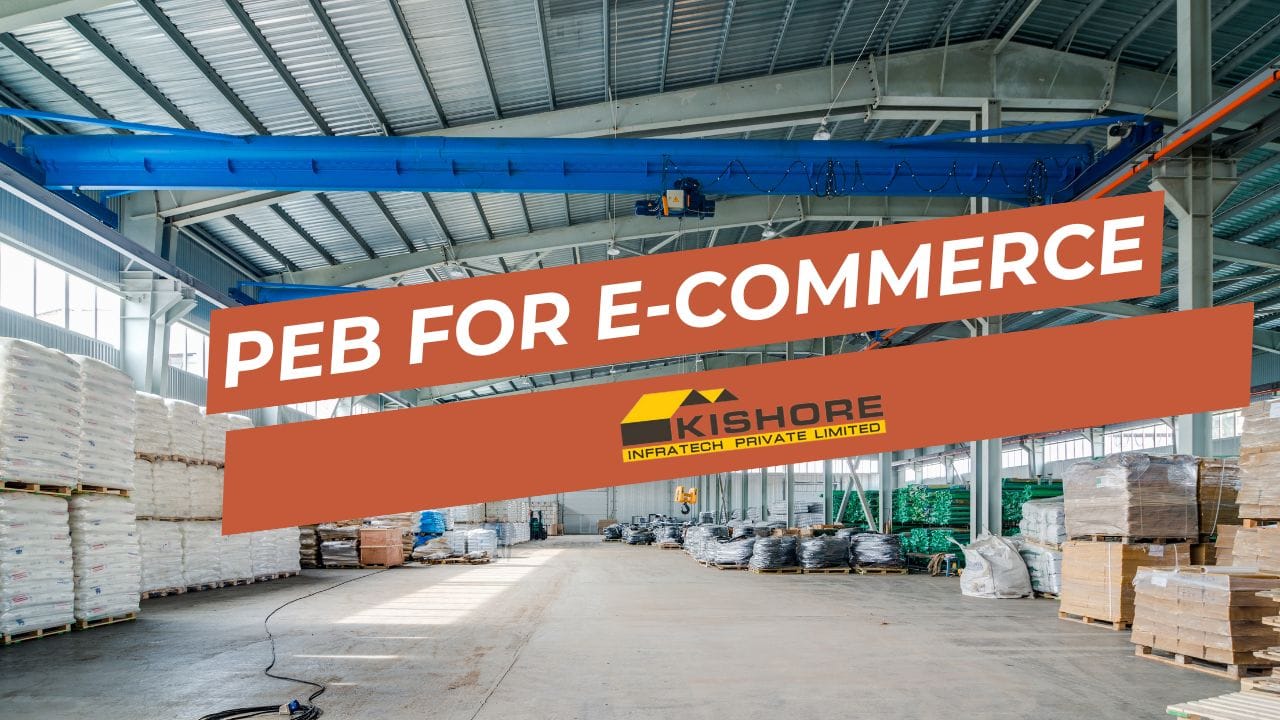
Transform your e-commerce logistics with cutting-edge PEB warehouse solutions from Kishore In
Quick Answer: An e-commerce fulfilment warehouse built as a pre-engineered building costs an estimated ₹1,350–2,100 per sq ft all-in against ₹2,000–3,000 for conventional construction, and reaches handover in roughly 4–6 months rather than 18–24. What distinguishes a fulfilment warehouse from plain storage is the specification: high clear height for racking, floor flatness and loading for automated handling, wide column-free spans so pick paths are not designed around structure, generous dock provision, and mezzanine-capable framing for sortation. Fix clear height, floor flatness and dock count before the frame is engineered. All figures are indicative estimates, not quotations.
PEB for E-commerce: Revolutionizing Warehouse Construction in India
The e-commerce revolution in India has created an unprecedented demand for sophisticated warehouse infrastructure. With online retail projected to reach ₹24 lakh crores by 2030, traditional warehouse construction methods simply cannot meet the pace and scale requirements of modern e-commerce operations.
Pre-Engineered Buildings (PEB) for e-commerce have emerged as the definitive solution, offering unparalleled speed, cost-effectiveness, and operational flexibility. At Kishore Infratech Private Limited, we’ve pioneered e-commerce-specific PEB warehouse solutions that have transformed logistics operations across India.
The E-commerce Warehouse Challenge in India
India’s e-commerce sector absorbed 64.5 million square feet of industrial warehousing space in 2024 alone—a staggering 30% increase from the previous year. This explosive growth, driven by:
- Quick commerce expansion (10-minute delivery services)
- Tier-2 and Tier-3 city penetration of e-commerce platforms
- Government initiatives like the National Logistics Policy
- Growing consumer demand for faster deliveries
Has created a critical shortage of purpose-built e-commerce warehouse facilities across major Indian cities including Hyderabad, Mumbai, Delhi, Pune, Chennai, and Bangalore.
What Makes PEB Ideal for E-commerce Warehouses
Pre-engineered building warehouse construction offers e-commerce businesses several critical advantages:
Traditional Construction Challenges vs PEB for E-commerce Solutions
| Traditional Construction Challenges | PEB for E-commerce Solutions |
|---|---|
| 18-24 months construction timeline | 3-6 months rapid deployment |
| High material wastage (15-20%) | Optimized material usage (2-5% wastage) |
| Weather-dependent construction | Factory-manufactured, weather-independent |
| Limited design flexibility | Modular, expandable architecture |
| Higher long-term maintenance costs | 50% lower maintenance requirements |
Why E-commerce Giants Choose PEB Warehouses: The Competitive Advantage
Lightning-Fast Deployment for Market Expansion
In the hyper-competitive e-commerce landscape, speed to market is everything. PEB warehouse construction enables e-commerce companies to establish new fulfillment centers in record time:
Construction Timeline Comparison
| Project Phase | Traditional Method | PEB Solution | Time Saved |
|---|---|---|---|
| Design & Engineering | 3-4 months | 1-2 months | 50-67% |
| Approval Process | 2-3 months | 1-2 months | 33-50% |
| Construction | 12-18 months | 2-4 months | 75-83% |
| Total Timeline | 17-25 months | 4-8 months | 76% faster |
Massive Clear Spans for Automated E-commerce Operations
Modern e-commerce warehouse design requires obstacle-free spaces to accommodate:
- Automated Storage and Retrieval Systems (ASRS)
- Robotic fulfillment systems
- Conveyor belt networks spanning entire warehouse floors
- Multi-tier picking systems
Kishore Infratech’s PEB solutions provide:
- Clear spans up to 60 meters without internal columns
- Ceiling heights of 12-18 meters for vertical storage optimization
- Floor load capacity up to 10 tons/sqm for heavy inventory storage
- Integrated crane systems up to 25-ton capacity
Modular Expansion Capability for Growing E-commerce Businesses
E-commerce businesses experience rapid growth spurts that require immediate warehouse capacity expansion. PEB warehouses for e-commerce offer:
Expansion Benefits
- Horizontal expansion: Add new bays within 4-6 weeks
- Vertical expansion: Multi-story additions without structural modifications
- Functional reconfiguration: Convert storage areas to fulfillment zones
- Seasonal flexibility: Temporary structures for peak season demand
Advanced Technology Integration in E-commerce PEB
Pre-engineered building technology enables seamless integration of modern e-commerce systems:
IoT and Automation Ready Infrastructure
- Pre-installed cable management systems for warehouse management software
- RFID antenna mounting points throughout the structure
- Climate control zones for temperature-sensitive products
- EV charging infrastructure for electric delivery fleets
- Solar panel mounting systems for sustainable operations
Technical Specifications for E-commerce PEB Warehouses
Structural Engineering Requirements for E-commerce Operations
E-commerce PEB warehouses must meet stringent structural requirements to support intensive automated operations:
Primary Structural Elements
| Component | Specification | E-commerce Application |
|---|---|---|
| Primary Frame | High-strength steel (Fe 415/550) | Supports automated cranes and conveyors |
| Secondary Frame | Cold-formed steel sections | Enables flexible partition walls |
| Foundation | Reinforced concrete (M25/M30) | Heavy load distribution for ASRS systems |
| Floor Slab | 200-250mm with VDF finish | Smooth operations for AGVs and forklifts |
| Roof Structure | Insulated sandwich panels | Weather protection and temperature control |
Load Calculations for E-commerce PEB Design
Live Load Requirements:
- Storage areas: 8-10 kN/sqm for high-density racking
- Picking zones: 5-7 kN/sqm for operational flexibility
- Dispatch areas: 12-15 kN/sqm for truck loading operations
- Crane loads: Up to 25 tons for material handling systems
Wind Load Considerations:
- Basic wind speed: 44-55 m/s (depending on location)
- Terrain category: Category 2/3 for industrial areas
- Risk coefficient: 1.08 for important structures
MEP (Mechanical, Electrical, Plumbing) Systems for E-commerce PEB
Electrical Infrastructure
Power Requirements:
- Connected load: 15-25 watts per sqft for automated warehouses
- Emergency backup: 100% backup power for critical operations
- Lighting systems: 200-300 lux LED lighting with occupancy sensors
- EV charging: 22kW AC and 50kW DC charging stations
HVAC Systems for E-commerce Warehouses
Temperature Control Requirements:
- General storage: 18-25°C ambient temperature
- Cold storage zones: -18°C to +4°C with vapor barriers
- Electronics storage: 15-20°C with humidity control (45-55% RH)
- Battery storage areas: Explosion-proof ventilation systems
Fire Safety Systems
Comprehensive Fire Protection:
- Early Smoke Detection Systems (ESDS) with warehouse management integration
- Automatic sprinkler systems with ESFR (Early Suppression Fast Response) heads
- Foam-based suppression for battery and electronics storage
- Emergency evacuation systems with voice announcements
Cost Analysis: PEB vs Traditional E-commerce Warehouse Construction
Detailed Cost Breakdown for E-commerce PEB Warehouses
Construction Cost Comparison (per sq ft)
| Cost Component | Traditional Construction | PEB Solution | Savings |
|---|---|---|---|
| Structural Work | ₹800-1,200 | ₹500-800 | 25-37% |
| Civil Work | ₹400-600 | ₹200-350 | 33-50% |
| Roofing & Cladding | ₹300-450 | ₹250-350 | 17-28% |
| MEP Systems | ₹500-750 | ₹400-600 | 20-25% |
| Total Cost/sq ft | ₹2,000-3,000 | ₹1,350-2,100 | 30-32% |
ROI Analysis for E-commerce PEB Investment
Project Timeline Impact on Revenue
For a 100,000 sq ft e-commerce fulfillment center:
Traditional Construction:
- Construction time: 20-24 months
- Total investment: ₹25-30 crores
- Lost revenue during construction: ₹15-20 crores
- Total cost impact: ₹40-50 crores
PEB Solution by Kishore Infratech:
- Construction time: 5-7 months
- Total investment: ₹18-22 crores
- Lost revenue: ₹3-5 crores
- Total cost impact: ₹21-27 crores
Net Savings: ₹19-23 crores (46% cost reduction)
Operational Cost Savings with E-commerce PEB
Annual Operating Cost Comparison
| Operating Expense | Traditional | PEB | Annual Savings |
|---|---|---|---|
| Energy Costs | ₹80/sq ft | ₹55/sq ft | ₹25/sq ft (31%) |
| Maintenance | ₹50/sq ft | ₹20/sq ft | ₹30/sq ft (60%) |
| Insurance | ₹15/sq ft | ₹10/sq ft | ₹5/sq ft (33%) |
| Property Tax | ₹25/sq ft | ₹18/sq ft | ₹7/sq ft (28%) |
| Total/Year | ₹170/sq ft | ₹103/sq ft | ₹67/sq ft (39%) |
Design Considerations for E-commerce PEB Warehouses
Functional Zone Planning for E-commerce Operations
E-commerce warehouse design requires specialized zoning for optimal operational efficiency:
Zone Distribution and Requirements
| Functional Zone | Area % | Height (m) | Special Requirements |
|---|---|---|---|
| Receiving Dock | 15-18% | 6-8m | Hydraulic dock levelers, weather seals |
| Inbound Sorting | 8-10% | 4-6m | Conveyor integration, barcode scanning |
| Storage Area | 45-50% | 12-15m | High-density racking, narrow aisles |
| Pick & Pack Zone | 12-15% | 4-6m | Ergonomic workstations, good lighting |
| Sortation | 8-10% | 6-8m | Automated sorting systems, crossbelts |
| Outbound Staging | 10-12% | 4-6m | Order consolidation, shipping prep |
| Dispatch Dock | 15-18% | 6-8m | Multi-carrier shipping, truck parking |
Advanced Automation Integration in PEB Design
Automated Storage and Retrieval Systems (ASRS)
Design Requirements for ASRS Integration:
- Structural reinforcement for vertical loads up to 15 tons/sqm
- Precision foundation work with tolerance ±2mm
- Dedicated electrical infrastructure with 99.9% uptime guarantee
- Climate control maintaining ±1°C temperature variation
Robotic Fulfillment System Accommodation
Infrastructure for Robotic Operations:
- Smooth concrete floors with Surface Regularity Index (SRI) > 80
- Wireless network infrastructure with 5G capability throughout
- Charging stations for Automated Guided Vehicles (AGVs)
- Safety systems including light curtains and emergency stops
Sustainable Design Features for E-commerce PEB
Green Building Elements
Energy Efficiency Features:
- Cool roof technology reducing heat gain by 40%
- Natural lighting systems with automated dimming controls
- High-performance insulation (R-value 25-30) for temperature-sensitive areas
- Rainwater harvesting with 1 million liter capacity storage
Renewable Energy Integration:
- Solar panel mounting on 80% of roof area
- Battery energy storage systems for peak shaving
- Electric vehicle charging powered by renewable energy
- Green certification pathway (IGBC Platinum rating)
Case Studies: Successful E-commerce PEB Implementations
Case Study 1: Major E-commerce Giant – Hyderabad Fulfillment Center
Project Overview:
- Client: Leading Indian e-commerce platform
- Location: Hyderabad, Telangana
- Size: 300,000 sq ft automated fulfillment center
- Timeline: 6 months (design to completion)
Key Challenges Solved:
- Rapid deployment requirement for festive season operations
- Integration with existing warehouse management systems
- Seismic resistance for Hyderabad’s Zone II classification
- 24/7 operations with minimal maintenance windows
Results Achieved:
- 40% reduction in construction time vs traditional methods
- ₹8 crores savings compared to initial traditional construction quote
- 99.8% uptime achieved in first year of operations
- IGBC Gold certification for sustainable design
Case Study 2: Quick Commerce Dark Store Network
Project Scope:
- Client: Quick commerce startup
- Locations: 15 cities across India
- Individual Size: 10,000-25,000 sq ft per facility
- Total Network: 450,000 sq ft
Standardized PEB Solution Benefits:
- Modular design replicated across all locations
- 45-day deployment per facility
- Quality consistency across the entire network
- 30% cost savings through standardization
Regulatory Compliance and Approvals for E-commerce PEB
Building Approvals and Clearances
State-Specific Approval Requirements
| State | Approval Authority | Timeline | Key Requirements |
|---|---|---|---|
| Telangana | GHMC/HMDA | 45-60 days | Building permission, NOC from fire dept |
| Karnataka | BBMP/BDA | 30-45 days | Khata certificate, trade license |
| Maharashtra | PCMC/PMC | 60-90 days | IOD approval, environmental clearance |
| Gujarat | Various Municipal Corps | 30-60 days | Town planning scheme compliance |
| Tamil Nadu | CMDA/DTCP | 45-75 days | CTS approval, water connection NOC |
Industry-Specific Clearances for E-commerce
Essential Certifications:
- Fire Safety Certificate (NOC from State Fire Department)
- Pollution Control Board clearance for battery storage
- Electrical Safety Certificate for high-load operations
- Labor Department registration for 24/7 operations
- Goods and Services Tax registration for warehouse operations
Environmental Impact Assessment
EIA Requirements for Large E-commerce PEB
Projects Requiring EIA:
- Warehouse area > 20,000 sqm (2.15 lakh sq ft)
- Cold storage capacity > 5,000 MT
- Battery storage > 1 MWh capacity
- Hazardous material storage facilities
EIA Process Timeline:
- Scoping: 30 days
- Public consultation: 30 days
- Appraisal: 60 days
- Decision: 45 days
- Total: 165 days (can run parallel to design phase)
ROI Calculator for E-commerce PEB Investment
Investment Analysis Framework
Capital Investment Components
Land and Infrastructure:
- Land cost: ₹15-50 lakhs per acre (location-dependent)
- Site development: ₹200-400 per sq ft
- Utilities connection: ₹50-100 per sq ft
PEB Construction Costs:
- Structural: ₹500-800 per sq ft
- MEP systems: ₹400-600 per sq ft
- Automation integration: ₹200-400 per sq ft
- Total construction: ₹1,100-1,800 per sq ft
Revenue Generation Model
Revenue Streams from E-commerce PEB:
| Revenue Source | Rate | Annual Income |
|---|---|---|
| Rental (Built-to-Suit) | ₹25-35/sq ft/month | ₹300-420/sq ft/year |
| 3PL Services | ₹40-60/sq ft/month | ₹480-720/sq ft/year |
| Cross-docking | ₹15-25/sq ft/month | ₹180-300/sq ft/year |
| Value-added Services | ₹10-20/sq ft/month | ₹120-240/sq ft/year |
Payback Period Calculation
Example: 100,000 sq ft E-commerce PEB Facility
Total Investment:
- Land: ₹5 crores
- Construction: ₹15 crores
- Equipment: ₹5 crores
- Total: ₹25 crores
Annual Revenue: ₹18-25 crores Operating Expenses: ₹8-12 crores
Net Annual Profit: ₹10-13 crores
Payback Period: 2.5-3.0 years
Future Trends in E-commerce PEB Construction
Emerging Technologies Shaping E-commerce PEB
Industry 4.0 Integration
Smart Manufacturing Elements:
- Digital twin technology for predictive maintenance
- AI-powered optimization of warehouse layouts
- Blockchain integration for supply chain transparency
- Augmented reality for worker training and operations
Sustainable Construction Innovations
Green Technology Adoption:
- Carbon-negative materials in PEB manufacturing
- Vertical farming integration within warehouse spaces
- Circular economy principles in building design
- Net-zero energy warehouse operations
Next-Generation E-commerce Requirements
Drone Delivery Integration
Infrastructure Modifications:
- Rooftop landing pads with automated charging
- Drone traffic management systems integration
- Weather protection for drone operations
- Security systems for aerial vehicle management
Autonomous Vehicle Preparation
AV-Ready Infrastructure:
- Smart loading docks with vehicle communication
- Dedicated AV lanes within warehouse complexes
- Charging infrastructure for electric autonomous fleets
- 5G connectivity for real-time vehicle coordination
Frequently Asked Questions: PEB for E-commerce Warehouses
What does an e-commerce PEB warehouse cost compared with conventional construction?
A pre-engineered fulfilment warehouse costs an estimated ₹1,350–2,100 per sq ft all-in, against ₹2,000–3,000 per sq ft for conventional construction — roughly 25–35% lower. On a 100,000 sq ft facility that difference is in the range of ₹5–8 crore, before counting the revenue earned during the months the building is operating earlier. All figures are indicative estimates for planning, not quotations.
How long does an e-commerce PEB warehouse take to build?
Reckon on 4–8 months from design to handover against 18–24 months for conventional construction. Design and engineering take 1–2 months, and erection 2–4 months, because fabrication runs in the factory in parallel with foundation work on site. Weather independence during assembly is a large part of why the schedule holds.
What clear span is achievable, and why does it matter for fulfilment?
Clear spans of up to 60 m without internal columns are achievable, with clear heights of 12–18 m for vertical storage. That matters because pick paths, conveyor runs and ASRS aisles should be laid out by process logic, not designed around column positions. A column in the wrong place permanently costs throughput in a fulfilment building.
Can a PEB warehouse carry ASRS and heavy automation?
Yes. The frame and slab can be designed for floor loads up to 15 tonnes per sq m for high-density racking and integrated crane systems up to 25-tonne capacity. Storage areas are typically designed at 8–10 kN/sq m, picking zones at 5–7 kN/sq m and dispatch areas at 12–15 kN/sq m. These loads must be fixed before the frame is engineered, because rack point loads drive the footing design.
What floor specification does automated handling need?
A 200–250 mm slab with a VDF finish is the usual starting point, with flatness controlled to suit the equipment rather than to a general tolerance. AGVs, VNA trucks and ASRS are far more sensitive to floor flatness than to slab thickness, so the tolerance class should be set by the handling equipment supplier. Retrofitting flatness after the slab is cast is disproportionately expensive.
How do PEB warehouses perform in different Indian climate zones?
The frame is the same; the envelope changes. Hot dry regions such as Rajasthan take cool-roof coatings and enhanced insulation, humid regions such as coastal Kerala need vapour barriers and controlled ventilation, and coastal sites such as Mumbai need marine-grade galvanising and corrosion-resistant coatings. Specifying the envelope for the actual site, rather than to a standard sheet, is what determines the building’s life.
What fire safety standards apply to an e-commerce warehouse?
Design is to NBC 2016, the National Building Code of India, together with IS 1641 for fire safety requirements. High-piled storage in fulfilment buildings usually calls for ESFR sprinkler systems, which impose their own demands on roof height, clearance to storage and pipe support from the roof structure. Sprinkler loads have to be carried by the purlin and rafter design, so bring them in at design stage.
Can the building be expanded after it is operating?
Yes, if the expansion is designed in from the start. Additional bays can be added horizontally in around 4–6 weeks, storage areas can be reconfigured into fulfilment zones, and mezzanine framing for sortation can be added within the existing envelope. The critical decision is to specify the end gable as an expansion bay at the outset — retrofitting one into a completed building costs far more.
What does it cost to run and maintain, year on year?
Annual maintenance on a PEB warehouse typically runs 1–2% of building cost against 3–5% for conventional construction, and comes down to an annual structural inspection, gutter cleaning and sealant checks. On the operating side, superior insulation cuts HVAC cost by an estimated 25–30% and integrated roof lighting cuts lighting cost by around 40%. Roof geometry also suits solar mounting, which is easier to plan at design stage than to retrofit.
How many dock doors should a fulfilment warehouse have?
Dock provision follows throughput, not floor area, so it should be calculated from vehicle movements per shift and the dwell time per vehicle. Getting it wrong is one of the few mistakes that cannot be corrected later without cutting into the structure, since dock positions fix the frame, the apron levels and the yard circulation. Fix clear height, floor flatness and dock count before the frame goes to engineering.
What approvals does an e-commerce warehouse need?
Typically building plan approval from the local authority, a fire NOC from the state fire department, environmental clearance for larger facilities, an electrical safety certificate for high-load operations, and labour department registration where the building runs round the clock. Timelines are set by those authorities and vary considerably by state.
Does Kishore Infratech obtain these approvals on my behalf?
No. Kishore Infratech Private Limited is a PEB manufacturer and does not file applications, liaise with departments or act as an approval agency. We supply the structural drawings, design calculations and stamped documentation that your architect or licensed liaison consultant submits. That division of work is worth planning for in your programme from the beginning.
Get a Free PEB Design & Indicative Estimate.
Share your plot location and requirement — our engineers call you back within 24 hours with a PEB factory or warehouse design and transparent costing.
- Clear-span PEB buildings engineered per IS 800
- Wind & seismic design per IS 875 Part 3 / IS 1893
- In-house fabrication at Jeedimetla, Hyderabad
- Faster erection than RCC — months, not years
- 45+ years steel fabrication, 700+ projects delivered
Prefer to speak directly? Call 9440407852
Our PEB engineers will call you back shortly with your free PEB proposal and quotation.
Want a faster response?
📱 Chat with us on WhatsAppConclusion: Partner with Kishore Infratech for Your E-commerce PEB Success
The e-commerce revolution in India demands innovative, scalable, and cost-effective warehouse solutions. Pre-engineered buildings for e-commerce represent the perfect convergence of speed, technology, and operational efficiency that modern logistics operations require.
At Kishore Infratech Private Limited, we’ve positioned ourselves as India’s leading specialist in e-commerce PEB warehouse construction. Our comprehensive approach encompasses:
Why Choose Kishore Infratech for Your E-commerce PEB Project
Technical Excellence:
- 25+ years of PEB manufacturing experience
- 500+ successful projects across India
- In-house engineering team specializing in e-commerce applications
- ISO 9001:2015 certified quality management systems
E-commerce Expertise:
- Deep understanding of automated warehouse requirements
- Technology integration capabilities for modern fulfillment systems
- Regulatory expertise across all major Indian states
- End-to-end solutions from design to commissioning
Proven Track Record:
- 99.2% on-time delivery rate for all projects
- ₹200+ crores in client cost savings achieved
- Zero safety incidents in our construction projects
- Long-term partnerships with India’s leading e-commerce companies
Take the Next Step Toward E-commerce Excellence
The future of e-commerce logistics is being built today with pre-engineered building solutions. Companies that invest in modern, efficient, and scalable PEB warehouses will have a significant competitive advantage in tomorrow’s market.
Ready to transform your e-commerce operations with cutting-edge PEB solutions?
Contact Kishore Infratech Private Limited Today
Get Your Free Consultation:
- ✅ Site feasibility analysis
- ✅ Preliminary cost estimation
- ✅ ROI assessment
- ✅ Technical requirement review
- ✅ Regulatory compliance roadmap
Transform your e-commerce vision into reality with India’s most trusted PEB partner. Contact us today to discuss your project requirements and discover how we can accelerate your business growth.