

India’s Education Infrastructure Challenge
India operates one of the world’s largest school education systems, serving 24.69 crore students across 14.71 lakh schools with over 1.01 crore teachers (UDISE+ 2024-25). Yet, despite this massive scale, the country faces a critical infrastructure gap that threatens its educational ambitions. According to the latest government data, 45% of government schools lack basic computer facilities, only 65% have computers (with just 58% functional), and more than 25,000 schools operate without working electricity.
The National Education Policy (NEP) 2020 envisions achieving 100% Gross Enrolment Ratio from pre-primary to secondary education by 2030. With the government allocating ₹83,562 crore for school education in Budget 2026-27 and launching ambitious programs like PM SHRI Schools, the demand for rapid, cost-effective, and quality school infrastructure has never been higher.
This is where prefabricated school buildings in India are emerging as a game-changing solution. Pre-Engineered Building (PEB) technology enables schools to be constructed 50% faster, at 30–40% lower cost, with superior quality and durability compared to traditional brick-and-mortar construction.
Kishore Infratech Private Limited, a leading PEB manufacturer in Hyderabad, is at the forefront of this transformation—delivering modern, safe, and inspiring prefabricated school buildings across India. In this comprehensive guide, we explore why PEB technology is the answer to India’s school infrastructure crisis, the types of prefab school structures available, costs, benefits, and how Kishore Infratech can help build the schools of tomorrow.
Quick Answer: Prefabricated school buildings in India cost an estimated ₹800–1,400 per sq ft against ₹1,400–2,200 per sq ft for conventional construction — a saving of roughly 30–40% — and a classroom block typically completes in 12–14 weeks rather than around 18 months. The approach suits education infrastructure because school building programmes run to academic calendars, sites are often occupied, and blocks need to be extended as enrolment grows. Typical applications are single and multi-storey classroom blocks, laboratories, auditoriums, administrative blocks, hostels and toilet blocks. All figures are indicative estimates for planning, not quotations.
| Key Fact: India needs to bridge infrastructure gaps in 45% of government schools to meet NEP 2020 goals. Prefabricated school buildings offer the speed, cost-efficiency, and quality to make this achievable. |
What Are Prefabricated School Buildings?
Prefabricated school buildings in India are educational structures constructed using pre-engineered steel components that are designed, manufactured in a factory, and then assembled on-site. Unlike traditional construction that involves brick-by-brick building over many months, prefab schools use standardized structural elements—columns, beams, purlins, roof panels, and wall cladding—that are precision-fabricated off-site and bolted together at the school location.
Key Components of Prefabricated School Buildings
- Primary Steel Frame: High-strength steel columns and rafters forming the main load-bearing skeleton
- Secondary Members (Purlins & Girts): Z or C-section steel members supporting roof and wall panels
- Roofing & Wall Systems: Galvalume sheets, sandwich panels, or metal cladding for walls and roofs
- Insulation Panels: PUF (Polyurethane Foam) or EPS panels for temperature regulation and energy efficiency
- Doors & Windows: Aluminum or UPVC frames with safety glass for natural lighting and ventilation
- Foundation: Concrete footings with anchor bolts for structural stability
The result is a modern, bright, well-ventilated school building that can be ready for students in weeks rather than months—making prefabricated school buildings in India the smart choice for government programs, private schools, NGOs, and educational trusts looking to expand quickly.
Why India Urgently Needs Prefabricated School Buildings
The case for prefab schools is compelling when you examine India’s current education infrastructure reality:
The Infrastructure Gap: By the Numbers
| Infrastructure Parameter | Current Status (UDISE+ 2024-25) | Gap/Challenge |
|---|---|---|
| Schools with Computers | 65% (only 58% functional) | 35% schools have no computers at all |
| Schools with Internet | 63% overall (Govt: 58.6%, Private: 77.1%) | 37% schools lack internet connectivity |
| Schools with Electricity | ~97% | 25,000+ schools lack working electricity |
| Schools with Ramps (Accessibility) | 11.35 lakh schools | Many rural schools still lack CWSN facilities |
| Digital Infrastructure Gap | Govt vs Private divide | Private schools 20% ahead in digital readiness |
| Teacher Vacancy | 16% for Grades 1-8 | Some states like Jharkhand at 40% vacancy |
Why Traditional Construction Cannot Keep Up
Traditional RCC (Reinforced Cement Concrete) school construction faces multiple challenges:
- Long Construction Time: A typical school building takes 12–18 months to construct, missing academic year deadlines
- Cost Overruns: Higher material costs, labor expenses, and project delays inflate budgets
- Weather Dependency: Monsoon seasons halt construction for months, especially in rural areas
- Quality Variability: Inconsistent workmanship leads to cracks, leakages, and structural issues
- Difficult to Expand: Existing schools cannot easily add classrooms without major renovation
Prefabricated school buildings in India solve all these problems—offering speed, cost control, consistent quality, and future expandability.
10 Key Benefits of Prefabricated School Buildings
1. 50% Faster Construction
The most significant advantage of prefabricated school buildings in India is speed. Since components are manufactured in parallel at the factory while site preparation happens simultaneously, total project time is reduced by 50% or more. A school that would take 12–18 months with RCC can be completed in 8–12 weeks with PEB technology.
Why This Matters: Schools can be ready before the academic year begins, ensuring no disruption to students’ education.
2. 30–40% Cost Savings
Prefab school construction is significantly more cost-effective than traditional methods:
- Faster completion reduces labor costs and site supervision expenses
- Factory manufacturing minimizes material wastage (up to 40% less waste)
- Standardized components reduce design and engineering costs
- Lower foundation requirements due to lighter steel structure
3. Superior Build Quality
Factory-controlled manufacturing ensures consistent quality that is difficult to achieve with on-site construction. Steel components are precision-cut using CNC machines, welded by certified professionals, and quality-checked at multiple stages before dispatch.
4. Safe & Durable Structures
Prefabricated school buildings are inherently safer than RCC structures:
- Earthquake Resistant: High-strength steel frames withstand seismic forces better than masonry
- Fire Safe: Steel does not burn; PUF panels can be fire-retardant rated
- Weather Resistant: Galvanized steel and sealed panels prevent water ingress
- Long Lifespan: 40–50+ year structural life with minimal maintenance
5. Comfortable Learning Environment
Modern prefab schools incorporate features that enhance student comfort and learning:
- Natural Lighting: Large windows and translucent roof panels bring in natural light
- Thermal Insulation: PUF insulated panels maintain comfortable temperatures year-round
- Noise Control: Steel structures allow for better acoustic design
- Ventilation: Ridge ventilators and louvers ensure fresh air circulation
6. Easy Expansion & Modification
As student enrollment grows, prefabricated school buildings in India can be easily expanded. Additional classrooms, laboratories, or floors can be added without major renovation or disruption to ongoing classes.
7. Minimal Site Disruption
Since 85% of the construction happens off-site at the factory, on-site work is minimal. This means less noise, dust, and disturbance—particularly important for schools adding new buildings to existing campuses.
8. Eco-Friendly Construction
Prefab construction is greener than traditional methods:
- Steel is 100% recyclable at end of life
- 40% less material wastage compared to RCC
- No water required for curing (unlike concrete)
- Lower carbon footprint per square foot
9. Relocatable Option
In some cases, prefab school structures can be disassembled and relocated to a new site—a unique advantage for temporary schools, disaster relief education centers, or schools on leased land.
10. Modern Aesthetics
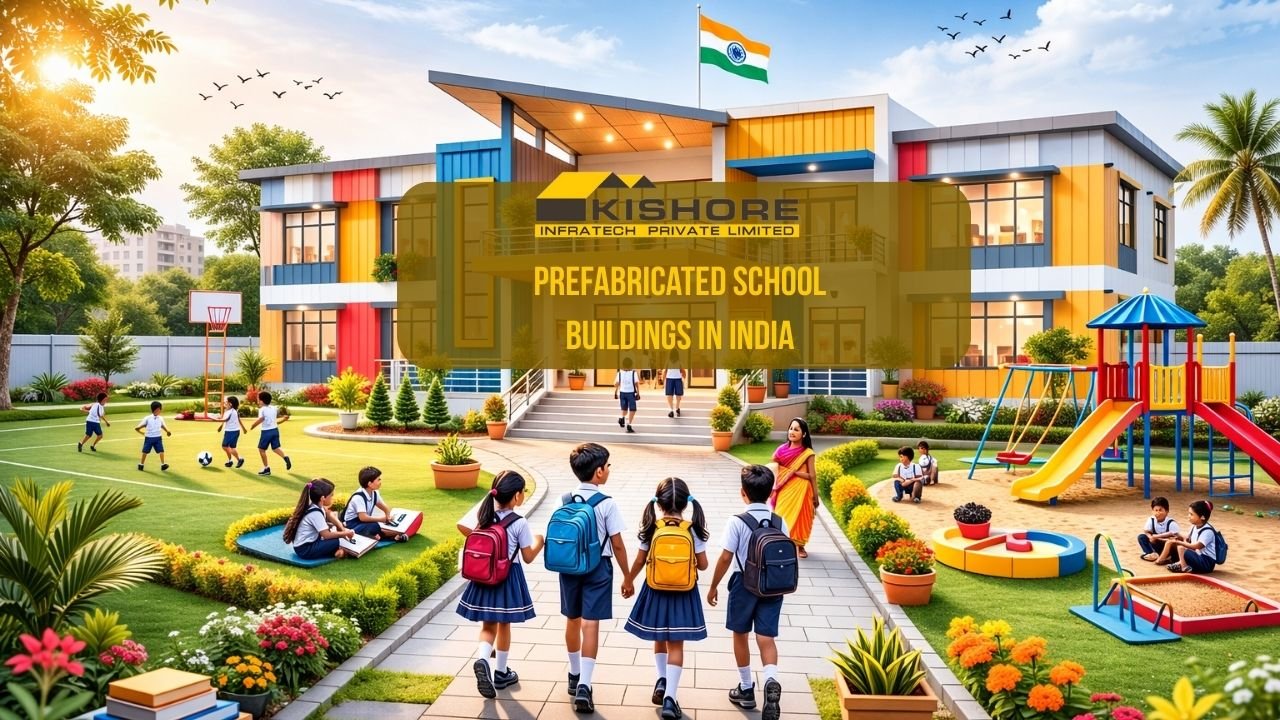
Gone are the days of dull, industrial-looking prefab buildings. Modern prefabricated school buildings in India feature contemporary designs, colorful exteriors, and child-friendly aesthetics that create inspiring learning environments.
Types of Prefabricated School Buildings
Kishore Infratech designs and manufactures a wide range of prefabricated school structures to meet diverse educational needs:
1. Single-Story Classroom Buildings
Ideal for primary schools and rural educational centers, single-story prefab classrooms offer quick deployment and easy accessibility. These structures can house 2–10 classrooms with corridors, verandahs, and attached washrooms.
Best For:
- Government primary schools
- Anganwadi and pre-primary centers
- Rural and tribal area schools
- Temporary classroom expansion
2. Multi-Story School Buildings
For urban schools with limited land, multi-story prefabricated school buildings (2–4 floors) provide maximum capacity in a compact footprint. These structures incorporate steel staircases, mezzanine floors, and can include elevators for accessibility.
Best For:
- Urban private schools
- CBSE/ICSE affiliated institutions
- Coaching institutes and tuition centers
- Vocational training centers
3. School Laboratories & Special Rooms
Specialized prefab structures for science laboratories, computer labs, libraries, and art rooms. These include appropriate electrical fittings, ventilation, and safety features required for each application.
4. School Auditoriums & Multi-Purpose Halls
Clear-span PEB structures are perfect for school auditoriums, indoor sports halls, and multi-purpose gathering spaces. Spans of 30–60 meters can be achieved without interior columns.
5. School Administrative Blocks
Prefab structures for principal offices, staff rooms, administrative offices, and reception areas. These can be standalone or integrated with classroom buildings.
6. School Hostels & Dormitories
Multi-story prefab hostel buildings with individual rooms, common areas, mess halls, and warden quarters. Insulated panels ensure comfortable living conditions.
7. School Canteens & Kitchens
Hygienic, well-ventilated prefab kitchen and dining facilities designed to meet food safety standards for mid-day meal programs and school cafeterias.
8. School Toilet Blocks
Standalone or attached prefab toilet facilities with proper drainage, ventilation, and accessibility features. Essential for meeting Right to Education (RTE) infrastructure norms.
Prefabricated School Building Cost in India
One of the most common questions about prefabricated school buildings in India is the cost. While pricing varies based on specifications, location, and customization, here is a general comparison:
| Cost Component | Traditional RCC School | Prefabricated PEB School |
|---|---|---|
| Basic Structure Cost | ₹1,400–2,200 per sq ft | ₹800–1,400 per sq ft |
| Foundation Cost | Higher (heavy structure) | Lower (lighter structure) |
| Construction Time | 12–18 months | 8–12 weeks |
| Labor Cost | Higher (more workers, longer duration) | Lower (faster assembly) |
| Material Wastage | 15–20% | 5–8% |
| Maintenance Cost (Annual) | Higher (repairs, repainting) | Lower (durable steel) |
| Expansion Cost | High (major renovation) | Low (modular addition) |
| Total Project Savings | Baseline | 30–40% savings |
Note: Final pricing depends on factors like building size, number of floors, insulation requirements, interior finishing, MEP (electrical, plumbing) specifications, and location. Contact Kishore Infratech for a customized quote for your school project.
Government Programs Driving Prefab School Demand
Prefabricated school buildings in India are increasingly being adopted for government education programs due to their speed and cost-effectiveness:
PM SHRI Schools (PM Schools for Rising India)
This flagship program aims to develop over 14,500 schools as model institutions showcasing NEP 2020 implementation. PM SHRI schools require modern infrastructure, smart classrooms, and contemporary facilities—making prefab construction an ideal solution.
Samagra Shiksha Abhiyan
With a budget of ₹42,100 crore for 2026-27, Samagra Shiksha is the umbrella scheme for school education infrastructure. It funds construction of new classrooms, laboratories, libraries, and toilet blocks—all of which can be efficiently delivered through prefab technology.
Kendriya Vidyalaya & Navodaya Vidyalaya Expansion
The government has approved 85 new Kendriya Vidyalayas and 28 new Jawahar Navodaya Vidyalayas in uncovered districts. Prefabricated construction can help these schools become operational faster.
Eklavya Model Residential Schools (EMRS)
Under the PM JANMAN scheme, the government is establishing residential schools for tribal students. The remote locations and tight timelines make prefab schools the practical choice.
State Government Initiatives
Multiple state governments are adopting prefab technology for rapid school expansion:
- Andhra Pradesh: Nadu-Nedu school transformation program
- Telangana: Model school upgradation under Mana Ooru Mana Badi
- Tamil Nadu: Infrastructure upgrades under Tamil Nadu School Education Department
- Karnataka: Vidya Vikasa schemes for rural schools
Why Choose Kishore Infratech for Prefabricated School Buildings?
Kishore Infratech Private Limited is a trusted prefabricated school building manufacturer in India with proven expertise in educational infrastructure. Here’s why schools across the country choose us:
1. Education-Specific Design Expertise
We understand that schools are not just buildings—they are spaces where children learn, grow, and dream. Our design team creates age-appropriate, child-friendly environments with proper classroom dimensions, natural lighting, ventilation, and safety features.
2. Complete Turnkey Solutions
From initial consultation and design to manufacturing, erection, and interior finishing, Kishore Infratech provides end-to-end turnkey solutions. We handle:
- Structural design and engineering
- Steel fabrication and surface treatment
- Civil foundation work
- Roofing, cladding, doors, and windows
- Electrical and plumbing (MEP) works
- Interior finishing and painting
3. Compliance with Safety Standards
All Kishore Infratech prefabricated school buildings comply with:
- National Building Code (NBC) of India
- IS 800:2007 for steel structure design
- IS 1893 for seismic resistance
- Fire safety norms with fire-retardant materials
- Accessibility standards for children with special needs
4. Proven Track Record
With decades of experience in PEB construction across industrial, commercial, and institutional sectors, Kishore Infratech brings unmatched expertise to every school project. Our portfolio includes educational buildings across Telangana, Andhra Pradesh, Karnataka, Tamil Nadu, and beyond.
5. Competitive Pricing
Our in-house manufacturing facility and optimized supply chain enable us to offer prefabricated school buildings at highly competitive prices without compromising on quality or safety.
Get a Free Design Review & Indicative Estimate.
Share your plot location and requirement — our engineers call you back within 24 hours with a PEB factory or warehouse design and transparent costing.
- Clear-span PEB buildings engineered per IS 800
- Wind & seismic design per IS 875 Part 3 / IS 1893
- In-house fabrication at Jeedimetla, Hyderabad
- Faster erection than RCC — months, not years
- 45+ years steel fabrication, 700+ projects delivered
Prefer to speak directly? Call 9440407852
Our PEB engineers will call you back shortly with your free PEB proposal and quotation.
Want a faster response?
📱 Chat with us on WhatsApp6. Fast Delivery
We understand that schools operate on academic calendars. Kishore Infratech commits to delivering projects on time so that students can begin learning in their new classrooms without delay.
| Ready to build a modern prefabricated school? Contact us today for a free site assessment and custom PEB proposal. Call +91-9440407852 or visit kishoreindustries.in |
The Kishore Infratech School Building Process
- Requirement Assessment: Understanding your student capacity, facilities needed, site conditions, and budget
- Concept Design: Creating preliminary layouts and 3D visualizations for stakeholder approval
- Detailed Engineering: Finalizing structural designs, MEP layouts, and working drawings
- Manufacturing: Precision fabrication of steel components at our facility with quality checks
- Site Preparation: Civil foundation work and site readiness in parallel with manufacturing
- Erection: Professional assembly of steel structure by trained crews
- Finishing: Roofing, cladding, doors, windows, electrical, plumbing, and painting
- Handover: Final inspection, documentation, and handover with maintenance guidelines
Typical Timeline: 8–14 weeks from design approval to handover, depending on building size and specifications.
Frequently Asked Questions (FAQs)
What are prefabricated school buildings?
A: Prefabricated school buildings are educational structures constructed using pre-engineered steel components manufactured in a factory and assembled on-site. They offer faster construction, lower costs, and superior quality compared to traditional brick-and-mortar schools.
How much do prefabricated school buildings cost in India?
A: Prefabricated school building costs in India typically range from ₹800 to ₹1,400 per square foot, depending on specifications, number of floors, insulation, and finishing requirements. This is 30–40% lower than equivalent RCC construction.
How long does it take to build a prefabricated school?
A: A prefabricated school building can be completed in 8–14 weeks from design approval, compared to 12–18 months for traditional RCC construction. This 50% faster timeline means schools can be ready before the academic year begins.
Are prefabricated schools safe for children?
A: Yes, prefabricated school buildings are extremely safe. They are designed to comply with National Building Code, seismic resistance standards (IS 1893), and fire safety norms. Steel structures are inherently earthquake-resistant and do not collapse suddenly like masonry buildings.
How long do prefabricated school buildings last?
A: With proper maintenance, prefabricated school buildings last 40–50+ years. The galvanized steel structure is highly durable and resistant to corrosion, termites, and weather damage.
Can prefabricated schools be multi-story?
A: Yes, modern prefabricated school buildings can be constructed up to 3–4 floors. Multi-story prefab schools are ideal for urban areas with limited land availability.
Are prefabricated schools comfortable in hot climates?
A: Yes, Kishore Infratech prefab schools use PUF-insulated panels that provide excellent thermal insulation, keeping interiors cool in summer and warm in winter. Combined with proper ventilation design, these buildings are comfortable in all Indian climates.
Can existing schools add prefab classrooms?
A: Absolutely. Prefabricated classroom blocks can be easily added to existing school campuses with minimal disruption to ongoing classes. The modular nature of PEB construction makes expansion simple and cost-effective.
Do prefabricated schools meet government standards?
A: Yes, all Kishore Infratech prefabricated school buildings comply with National Building Code (NBC), Right to Education (RTE) infrastructure norms, fire safety standards, and accessibility requirements for children with special needs.
Can prefabricated schools be relocated?
A: In many cases, yes. Prefabricated school structures can be disassembled and relocated to a new site if needed. This is particularly useful for temporary schools, disaster relief education centers, or schools on leased land.
What facilities can be included in a prefabricated school?
A: Prefabricated schools can include classrooms, science and computer laboratories, libraries, auditoriums, sports halls, administrative offices, staff rooms, canteens, hostels, and toilet blocks. Kishore Infratech provides complete turnkey solutions for all these facilities.
How do I get a quote for a prefabricated school building?
A: Contact Kishore Infratech at kishoreindustries.in or call our team for a free consultation. Share your requirements including student capacity, number of classrooms, facilities needed, and site location. We will provide a detailed proposal with design options and competitive pricing.
Building India’s Educational Future with Prefabricated Schools
India’s ambition to achieve universal quality education by 2030 demands a revolution in how we build schools. Traditional construction methods cannot keep pace with the scale and speed required. Prefabricated school buildings in India offer the solution—delivering modern, safe, and inspiring learning environments in half the time and at significantly lower cost.
With the government investing ₹83,562 crore in school education and launching programs like PM SHRI Schools and Samagra Shiksha, the opportunity for prefab school construction has never been greater. Whether you are a government education department, private school trust, NGO, or educational entrepreneur, Kishore Infratech has the expertise, capacity, and commitment to deliver prefabricated school buildings that transform how children learn.
Partner with Kishore Infratech and join the movement to build better schools, faster. Visit kishoreindustries.in or contact our team today to discuss your school project.
Together, let’s build schools where every child can learn, grow, and achieve their dreams.