
Why Disaster-Resilient PEB Structures Matter in India
India experienced extreme weather events on 331 out of 334 days in 2025, according to the Centre for Science and Environment (CSE). From cyclones battering the eastern and western coasts to devastating floods across Andhra Pradesh, Telangana, and Gujarat, the nation’s industrial infrastructure faces an unprecedented threat. In 2024 alone, flooding in Andhra Pradesh and Telangana caused combined losses exceeding ₹13,000 crore ($1.5 billion), with countless industrial sheds, warehouses, and factories damaged beyond repair.
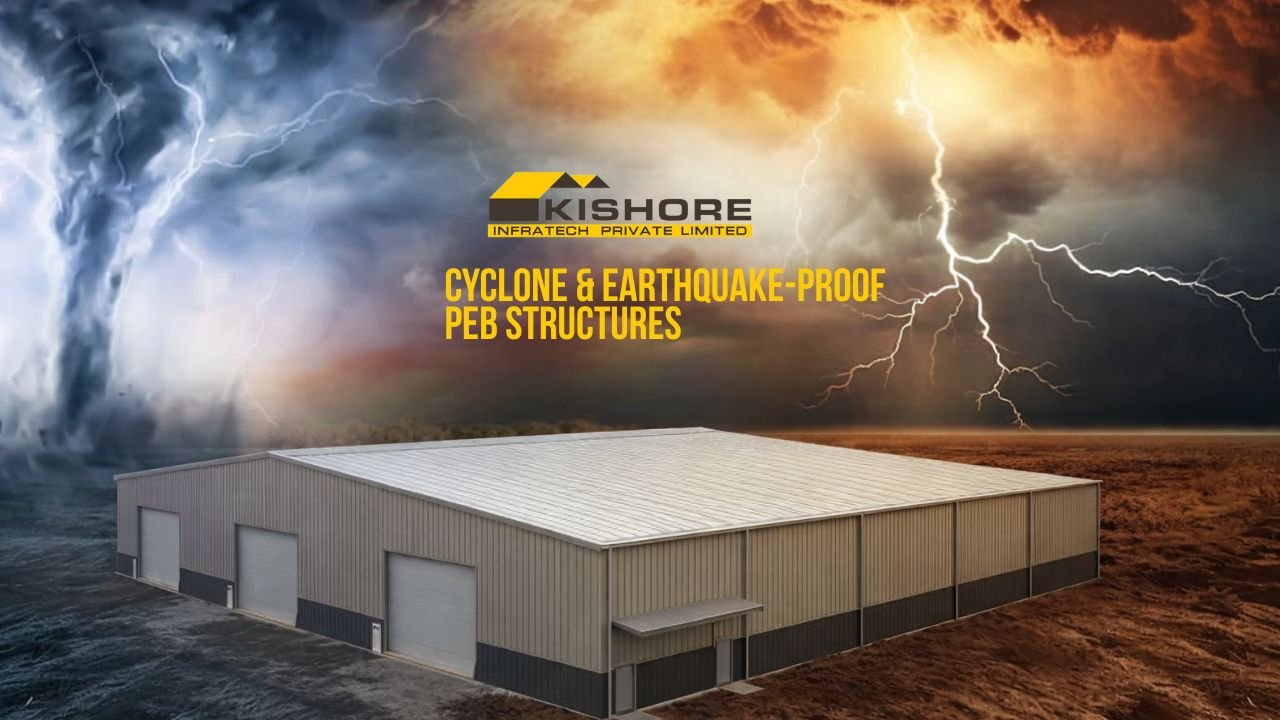
For business owners, factory operators, and industrial planners, the question is no longer whether a disaster will strike but when. This is precisely where disaster-resilient PEB structures in India are transforming the way industries protect their investments. Pre-Engineered Buildings (PEBs) manufactured by Kishore Infratech Private Limited offer a scientifically engineered, code-compliant, and cost-effective solution to withstand cyclones, earthquakes, and floods.
In this comprehensive guide, we explore why PEB structures outperform traditional RCC buildings in disaster scenarios, the engineering principles behind cyclone-proof and earthquake-resistant PEB design, and how Kishore Infratech is leading the charge in building disaster-resilient industrial infrastructure across India.
| Key Insight: A well-designed disaster-resilient PEB structure can withstand wind speeds of 200+ km/h and seismic forces up to Zone V, while costing 30–40% less than equivalent RCC construction. |
India’s Disaster Landscape: The Growing Threat to Industrial Buildings
India’s geographical position makes it one of the most disaster-prone countries in the world. The Indian plate’s collision with the Eurasian plate creates constant seismic activity, while two cyclone-active ocean basins surround the coastline. Understanding this threat landscape is essential for any industrial building decision.
Cyclone Threat: Coastal and Inland Devastation
India’s coastal states face regular cyclonic activity from both the Bay of Bengal and Arabian Sea. Recent major events include Cyclone Biparjoy (2023) which caused $148 million in damage in Gujarat, Cyclone Michaung (2023) with $1.32 billion in losses, and Cyclone Remal (2024) which affected 3.75 million people across eastern India and Bangladesh.
The cyclone-prone coastal belt spans Odisha, Andhra Pradesh, Tamil Nadu, West Bengal, Gujarat, and Maharashtra. Wind speeds during severe cyclonic storms routinely exceed 150–200 km/h, causing catastrophic roof uplift, wall collapse, and structural failure in conventional buildings. Industrial sheds built with traditional methods, especially those using lightweight roofing without proper anchoring, are among the first casualties.
Earthquake Risk: 59% of India in High-Danger Zones
According to the National Centre for Seismology, approximately 59% of India’s land area is vulnerable to moderate to severe earthquakes. The country is divided into four seismic zones (II to V), with Zone V being the most dangerous. States like Gujarat, Maharashtra, Uttarakhand, the entire Northeast, and parts of Telangana and Karnataka fall in high-risk zones.
For industrial facilities housing heavy machinery, chemical storage, and valuable inventory, an earthquake can mean not just structural damage but complete operational shutdown, safety hazards, and financial ruin. Traditional masonry and RCC structures tend to fail in a brittle manner during seismic events, whereas steel-based PEB structures offer ductile performance, absorbing and dissipating energy rather than cracking.
Flood Threat: India’s Annual Economic Drain
India experiences annual flood-related economic losses exceeding $3 billion, constituting 10% of global flood-induced economic losses. The 2024 monsoon season was particularly devastating. Gujarat received 118% of seasonal rainfall in a single 72-hour period. Vijayawada in Andhra Pradesh recorded over 290 mm of rainfall in a single day, one of the worst flood events in the history of the Krishna River.
Industrial buildings in flood-prone zones need elevated foundations, corrosion-resistant materials, and rapid drainage designs, all features that modern disaster-resilient PEB structures incorporate from the design stage itself.
What Makes PEB Structures Disaster-Resilient? The Engineering Advantage
Disaster-resilient PEB structures in India are not simply conventional buildings built stronger. They are fundamentally different in their approach to force distribution, material science, and structural behaviour under extreme loading conditions.
1. Superior Structural Ductility
Steel, the primary material in PEB construction, possesses inherent ductility, meaning it can undergo significant deformation before failure. During an earthquake, a steel portal frame bends, absorbs seismic energy, and returns toward its original shape. In contrast, RCC and masonry structures fail in a brittle manner, cracking and collapsing without warning.
| Engineering Fact: High-strength structural steel used in PEB (IS 2062 grade) has a yield strength of 250–350 MPa with 20–25% elongation at break. This ductility is what makes PEB structures inherently earthquake-resistant. |
2. Lightweight Yet High-Strength Design
A typical PEB industrial shed weighs 60–70% less than an equivalent RCC structure. This is critical during earthquakes because seismic forces are directly proportional to the mass of the building. A lighter structure experiences lower base shear forces, reducing the structural demand and making the building inherently safer.
For cyclone resistance, the lightweight design is combined with robust anchoring systems. The key is not to resist wind forces with sheer mass (as RCC does) but to create an aerodynamic, well-connected structure that channels wind forces through the frame to the foundation efficiently.
3. Bolted and Welded Connections
Every joint in a disaster-resilient PEB structure is either high-strength bolted (Grade 8.8 or 10.9 bolts) or factory-welded under controlled conditions. These connections are the lifeline of the structure during extreme events. Unlike site-cast RCC joints that depend on workmanship quality, PEB connections are engineered to precise tolerances and tested before dispatch.
4. Portal Frame Action
PEB structures utilise rigid portal frames, a system where columns and rafters act as a single unit, distributing lateral forces (wind or seismic) throughout the entire frame. This is far superior to load-bearing masonry walls which concentrate stress at weak points, leading to localised failure.
5. Designed for Specific Wind and Seismic Zones
Kishore Infratech designs every disaster-resilient PEB structure to the exact wind zone and seismic zone of its installation location, following Indian Standards rigorously:
| Parameter | Indian Standard | Key Design Input |
| Wind Load Design | IS 875 (Part 3): 2015 | Basic wind speed, terrain category, topography factor, importance factor (k4 for cyclonic regions) |
| Seismic Design | IS 1893 (Part 1): 2016 | Zone factor (Z), importance factor (I), response reduction factor (R), soil type |
| Steel Quality | IS 2062: 2011 | Grade E250/E350 structural steel with guaranteed yield strength and elongation |
| Foundation Design | IS 456: 2000 + IS 1893 | Combined footing design for uplift, overturning, and lateral thrust |
| Connection Design | IS 800: 2007 | High-strength friction grip (HSFG) bolts for critical joints |
PEB vs RCC: Disaster Performance Comparison
The debate between PEB and RCC construction takes on critical significance when viewed through the lens of disaster resilience. Here is a detailed comparison across key parameters:
| Parameter | PEB Steel Structure | Traditional RCC |
| Earthquake Behaviour | Ductile: bends and absorbs energy | Brittle: cracks and collapses |
| Cyclone Wind Resistance | Designed for 200+ km/h with proper bracing | Often fails at 120–150 km/h due to roof uplift |
| Weight (for same span) | 60–70% lighter | Heavy, attracts more seismic force |
| Construction Speed | 8–12 weeks | 6–12 months |
| Post-Disaster Repair | Localised member replacement | Often requires complete demolition |
| Foundation Size | Smaller isolated footings | Larger, deeper foundations needed |
| Cost (per sq ft) | ₹800–1,400 | ₹1,200–2,200 |
| Lifespan | 40–50+ years with maintenance | 30–40 years |
| Corrosion Resistance | Galvanised/painted coatings | Concrete spalling over time |
| Insurance Premium | Lower (proven resilience) | Higher in disaster zones |
This comparison clearly demonstrates why disaster-resilient PEB structures in India are the preferred choice for industrial, warehousing, and commercial construction in disaster-prone regions.
How Kishore Infratech Engineers Cyclone-Proof PEB Structures
Kishore Infratech Private Limited follows a rigorous engineering methodology specifically tailored for cyclone-prone regions. Here is the step-by-step approach:
Step 1: Site-Specific Wind Analysis
Every project begins with a detailed wind load analysis per IS 875 (Part 3): 2015. The design wind speed (Vz) is calculated using the formula:
Vz = Vb × k1 × k2 × k3 × k4
Where Vb is the basic wind speed for the region, k1 accounts for structure risk level, k2 for terrain and height, k3 for topography, and k4 is the critical cyclonic region importance factor. For coastal Andhra Pradesh or Odisha, Vb can reach 50 m/s (180 km/h), and with appropriate factors, the design wind speed may exceed 55–60 m/s.
Step 2: Enhanced Structural Bracing
- X-Bracing: Cross-bracing in both longitudinal and transverse directions using angle or rod bracing systems
- Knee Bracing: Portal frame knee connections with haunched sections for maximum rigidity at column-rafter junctions
- Horizontal Bracing: Continuous diagonal bracing in roof and wall planes to form a rigid diaphragm
Step 3: Roof Connection Reinforcement
Roof failure is the primary mode of cyclone damage. Kishore Infratech addresses this with:
- Self-drilling screws at every alternate crest (not every third) for roof sheeting in cyclonic zones
- Additional screws at sheet overlaps and ridge connections
- Minimum 0.50 mm TCT (Total Coated Thickness) Galvalume sheeting with anti-capillary grooves
- Sag rods between purlins to prevent lateral-torsional buckling under wind suction
Step 4: Foundation Uplift Resistance
In high-wind zones, the net uplift force on the roof can exceed the dead weight of the structure. Kishore Infratech designs foundations with:
- Deep anchor bolts (minimum 600 mm embedment) in reinforced concrete pedestals
- Foundation weight engineered to exceed calculated uplift by a safety factor of 1.5 or more
- Tie beams connecting all isolated footings to resist lateral thrust
How Kishore Infratech Engineers Earthquake-Resistant PEB Structures
For seismic zones III, IV, and V, Kishore Infratech incorporates advanced earthquake-resistant features in every disaster-resilient PEB structure:
Seismic Design Methodology (IS 1893)
The seismic base shear is calculated using:
VB = Ah × W
Where Ah is the design horizontal seismic coefficient (derived from zone factor, importance factor, response reduction factor, and spectral acceleration) and W is the seismic weight of the structure. For PEB structures, the low self-weight (W) directly translates to lower seismic force demand.
Key Earthquake-Resistant Features
- Ductile Connections: All connections designed as moment-resistant or semi-rigid to prevent sudden joint failure
- Energy Dissipation: Steel portal frames absorb and redistribute seismic energy through controlled yielding at designated plastic hinge locations
- Equipment Anchoring: Crane bracket and mezzanine connections designed with additional seismic factors per IS 1893
- Flexible Cladding: Sheeting panels connected with slotted holes to allow differential movement without tearing
Flood-Resistant PEB Design Features
While no above-ground structure is flood-proof, Kishore Infratech incorporates several flood-resistant design features in disaster-resilient PEB structures deployed in flood-prone industrial zones:
- Elevated Plinth Level: Foundation pedestals raised 600–1,200 mm above the recorded High Flood Level (HFL) of the site
- Corrosion-Resistant Coatings: Hot-dip galvanised structural members (IS 4759 compliant) with minimum 80–120 micron zinc coating to resist prolonged water exposure
- Integrated Drainage: Floor slopes and peripheral drains designed for rapid water evacuation, preventing ponding loads on the structure
- Utility Elevation: Critical electrical and mechanical equipment mounted above anticipated flood levels inside the PEB
Industries That Benefit Most from Disaster-Resilient PEB Structures
| Industry | Key Disaster Risk | PEB Solution by Kishore Infratech |
| Pharmaceuticals | Equipment damage from floods/earthquakes | Elevated PEB with seismic bracing and clean room compatibility |
| Warehousing & Logistics | Inventory loss from cyclone roof failure | High-wind rated PEB with reinforced roofing and wall systems |
| Food Processing & Cold Storage | Power system damage from storms | Insulated PEB with protected utility routing and backup mounting |
| Automobile & Engineering | Heavy machinery displacement during earthquakes | PEB with crane-rated seismic design and equipment anchor bolts |
| Textiles & Spinning Mills | Fire risk post-earthquake from electrical shorts | Steel PEB with inherent fire resistance and emergency ventilation |
| IT & Data Centres | Server and data loss from any disaster | Climate-controlled PEB with redundant structural safety systems |
Why Choose Kishore Infratech for Disaster-Resilient PEB Construction?
Kishore Infratech Private Limited is a leading PEB manufacturer in Hyderabad with a proven track record across India. Here is why industries trust Kishore Infratech for disaster-resilient PEB structures:
- Complete in-house engineering using advanced structural analysis software (STAAD.Pro, Tekla) for precise wind and seismic load calculations
- IS 2062 certified high-strength structural steel sourced from reputed mills with full traceability
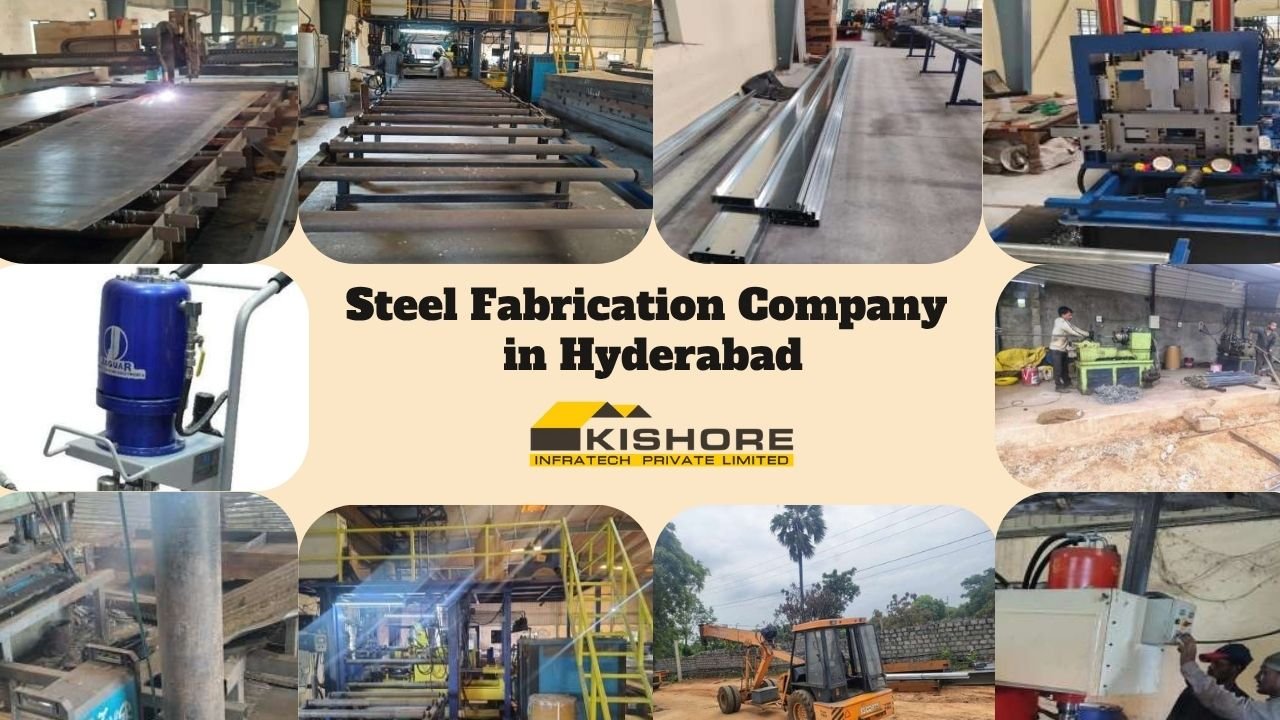
- Factory-controlled manufacturing with CNC cutting, automated welding, and rigorous QA/QC at every stage
- Turnkey EPC (Engineering, Procurement, and Construction) service from design to erection and finishing
- Pan-India project execution experience across Telangana, Andhra Pradesh, Karnataka, Tamil Nadu, Odisha, Maharashtra, Gujarat, and beyond
- Post-construction support including annual maintenance contracts and structural health assessments
| Ready to build a disaster-resilient PEB structure? Contact Kishore Infratech today for a free site assessment and custom engineering proposal. Call us at +91-9440407852 or visit kishoreindustries.in |
Frequently Asked Questions (FAQs)
Q: Can PEB structures really withstand cyclone-level winds?
A: Yes. When designed per IS 875 (Part 3): 2015 with cyclonic region factors, PEB structures can withstand wind speeds exceeding 200 km/h. Kishore Infratech specifically engineers bracing, roofing connections, and foundation uplift resistance for cyclone-prone coastal zones.
Q: Are PEB buildings earthquake-resistant?
A: Absolutely. Steel PEB structures are inherently more earthquake-resistant than RCC or masonry buildings due to their ductile behaviour and low self-weight. Kishore Infratech designs all disaster-resilient PEB structures to comply with IS 1893 (Part 1): 2016 seismic code provisions based on the project’s specific seismic zone.
Q: How does a PEB structure perform compared to RCC in a disaster?
A: PEB structures outperform RCC in disasters because steel bends (ductile failure) instead of cracking (brittle failure). They are 60–70% lighter, attracting less seismic force. Post-disaster, damaged PEB members can be individually replaced, whereas RCC buildings often require complete demolition.
Q: What are codes govern disaster-resilient PEB design in India?
A: The primary codes are IS 875 (Part 3): 2015 for wind loads, IS 1893 (Part 1): 2016 for seismic design, IS 800: 2007 for steel structure design, IS 2062: 2011 for steel material quality, and IS 456: 2000 for foundation concrete design.
Q: Is a disaster-resilient PEB structure more expensive than regular PEB?
A: The additional cost for cyclone and earthquake engineering is typically 8–15% above standard PEB pricing. However, this is significantly lower than the cost of disaster damage, business interruption, and post-disaster reconstruction. Insurance premiums are also lower for well-engineered PEB structures.
Q: Which areas in India need disaster-resilient PEB structures the most?
A: Cyclone-prone coastal regions (Odisha, Andhra Pradesh, Tamil Nadu, West Bengal, Gujarat, Maharashtra coast), seismic zones IV and V (Northeast India, Uttarakhand, Himachal Pradesh, Gujarat, parts of Maharashtra), and flood-prone industrial belts (Telangana, Andhra Pradesh, Bihar, Assam) benefit the most.
Q: Can existing industrial sheds be retrofitted for disaster resilience?
A: Yes. Kishore Infratech offers structural assessment and retrofitting services for existing PEB and conventional structures. This includes adding bracing members, reinforcing connections, upgrading roofing fasteners, and strengthening foundations for improved cyclone and earthquake resistance.
Q: How quickly can Kishore Infratech deliver a disaster-resilient PEB structure?
A: Depending on project size and complexity, typical timelines are 4–6 weeks for engineering and manufacturing, followed by 4–8 weeks for erection and finishing. Total project delivery ranges from 8–14 weeks, significantly faster than conventional RCC construction.
Q: Does Kishore Infratech provide disaster-resilient PEB solutions for multi-story buildings?
A: Yes. Kishore Infratech designs and manufactures multi-story PEB structures with full seismic and wind load compliance. These are ideal for industrial facilities, warehouses with mezzanine floors, and commercial buildings in disaster-prone regions.
Q: What maintenance does a disaster-resilient PEB structure require?
A: Annual inspection of bolted connections, roof fasteners, and bracing members is recommended. Recoating of exposed steel surfaces every 5–7 years and immediate post-storm inspection are also part of the maintenance protocol. Kishore Infratech offers comprehensive annual maintenance contracts.
Build to Withstand, Not Just to Stand
In a country where extreme weather events now occur on over 99% of days in a year, building disaster-resilient PEB structures is not a luxury but a necessity. Every rupee invested in proper engineering, code-compliant design, and quality materials pays back manyfold by protecting lives, machinery, inventory, and business continuity.
Kishore Infratech Private Limited combines decades of PEB manufacturing expertise with a deep understanding of India’s unique disaster landscape. Whether you are building a pharmaceutical plant in cyclone-prone Vizag, a warehouse in flood-prone Hyderabad, or a factory in earthquake-sensitive Gujarat, Kishore Infratech delivers structures engineered to not just stand, but to withstand.Contact Kishore Infratech today to discuss your disaster-resilient PEB requirements. Visit kishoreindustries.in or call our engineering team for a free consultation and site assessment