
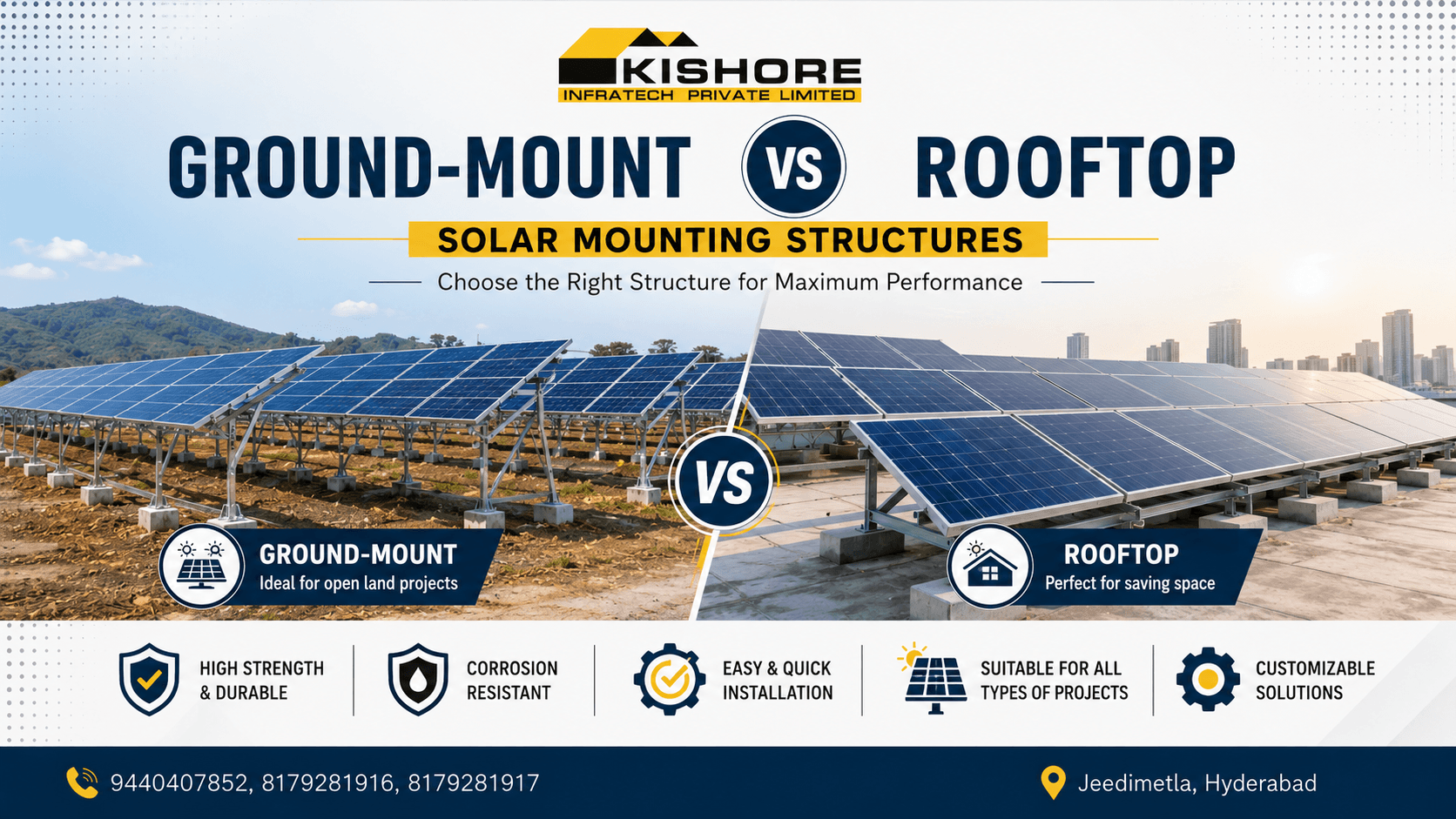
The ground-mount vs rooftop solar mounting structures decision shapes everything downstream in a solar project — the foundation type, the steel sections used, the galvanizing grade, the wind-load design, the maintenance access, and ultimately the cost per kilowatt and the energy yield over a 25-year life. This masterclass breaks down the structural engineering that separates a ground mount solar structure from a rooftop solar mounting structure: the load path from module to earth, foundation and anchoring options, tilt and inter-row spacing, the C and Z cold-formed sections each layout favours, wind-uplift behaviour per IS 875 Part 3, corrosion protection, O&M access, and a clear site-by-site decision framework so you choose the right structure for open land, an RCC terrace, a factory metal roof, a carport, or an agri / pump installation.
Quick Answer: A ground-mount solar structure is a free-standing steel table founded in the earth (RCC pedestal, driven pile, screw pile, or ballast) that carries its own column → rafter → purlin hierarchy, lets you set the optimum tilt (typically 10–30° to site latitude), and is built mostly from lapped Z rafters with C module rails — usually hot-dip galvanized (65–86 microns) because the steel sits at ground level. A rooftop solar mounting structure is a lighter framework fixed to an existing building roof — chemical-anchored or ballasted on an RCC terrace, or clamped to the purlins of a metal sheet roof — built largely from C purlins/rails at a low tilt (5–15°) that borrows the roof’s structure and so uses less steel and no land, but is limited by the roof’s strength, orientation, and shading. The simplest rule: use ground mount when you have open land and want maximum yield and serviceability; use rooftop when you want to use existing roof area, avoid land cost, and offset on-site consumption. For corrosion, ground mount generally needs hot-dip galvanizing in microns while rooftop is often adequately protected by 120–275 GSM pre-galvanized (GI) steel in inland climates.
Disclaimer: The structural members, foundation types, tilt ranges, coating grades, and spacing guidance in this article are based on cold-formed steel practice (IS 811, IS 801), galvanizing standards (IS 277, IS 4759), wind-load code (IS 875 Part 3), MNRE standard solar structure design references, and Kishore Infratech Private Limited’s solar mounting structure fabrication practice as of 2026. All tilts, spacings, loads, and section sizes are indicative — final structure design must be confirmed by a project-specific structural and electrical design for your module wattage, wind zone, terrain category, soil/roof condition, and array layout.
What Is a Ground-Mount Solar Structure?
A ground mount solar structure is a free-standing steel table erected on open land that carries PV modules at a designed tilt, independent of any building. It transfers every load — module self-weight, wind, and (rarely in India) snow — directly into the earth through its own foundation. The load path is a clean structural hierarchy: foundation (pedestal / pile) → column (post) → rafter (principal inclined beam) → purlin / module rail → module clamps → PV panel. Because nothing about the layout depends on a host building, the designer is free to set the optimum tilt, the optimum orientation (true south in India), and the optimum row spacing for maximum annual generation.
Structurally, a ground-mount table is the more demanding of the two layouts. The columns project out of the ground, so the full wind moment and uplift have to be resisted by the foundation; the rafters often span several columns, which is why lapped Z purlins (web 150–300 mm) are the workhorse rafter section; and the steel sits at ground level where splash, soil moisture, and — near the coast — chlorides attack it, so corrosion protection is taken seriously. Ground mounts scale cleanly from a few kilowatts on a farm to multi-megawatt arrays, and they give the best maintenance and cleaning access of any layout.
Key takeaway: A ground-mount structure is a self-supporting steel table that founds directly in the earth and carries its own column-rafter-purlin hierarchy. Its freedom to set ideal tilt and spacing gives the highest yield and best serviceability, but it must resist the full wind load through its own foundation and survive ground-level corrosion — which is why it is built from deeper, lapped Z rafters and is usually hot-dip galvanized.
What Is a Rooftop Solar Mounting Structure?
A rooftop solar mounting structure is a lighter steel framework that fixes PV modules to an existing building roof, borrowing that roof’s structure to carry the loads. Because the building already resists most of the dead load and transfers it to columns and foundations, the rooftop structure itself is far lighter than a ground mount — it is essentially a system of short rails and supports rather than a full free-standing table. There are two fundamentally different rooftop situations, and they call for different details.
On an RCC (flat concrete) roof, modules are raised on short steel legs to a fixed tilt, and the supports are fixed in one of two ways: ballasted (held down by concrete blocks or kerbs with no roof penetration, preserving waterproofing) or penetrating (chemical-anchored / bolted into the RCC slab for maximum uplift resistance, with the penetrations sealed). On a metal sheet roof (trapezoidal or standing-seam over a factory or warehouse), the structure is even lighter: C-purlin rails run parallel to or across the roof and are clamped or bolted down, and the most important rule is to align the fixings to the building’s existing roof purlins, not to the thin sheet — the sheet only spans between purlins and cannot carry concentrated module and wind-uplift loads on its own.
Key takeaway: A rooftop mounting structure is a lightweight rail-and-support system fixed to an existing roof — ballasted or penetrating on an RCC terrace, clamped to the existing purlins on a metal sheet roof. It uses minimal steel and no land, but its tilt, orientation, and capacity are constrained by the host roof, and every fixing must reach real structure (slab or roof purlin), never just the cladding sheet.
Ground-Mount vs Rooftop: Complete Comparison
Key takeaway: Ground mount and rooftop differ across roughly ten engineering parameters — foundation, load path, tilt freedom, structural members, wind exposure, galvanizing need, maintenance access, yield, area used, and the typical C/Z sections involved. Read the table as “ground mount for maximum yield, serviceability and scale on open land; rooftop for using existing roof area with the least steel and no land.”
| Parameter | Ground-Mount Structure | Rooftop Mounting Structure |
|---|---|---|
| Foundation type | RCC pedestal, driven pile, screw (helical) pile, or precast ballast in the earth | None of its own — fixes to RCC slab (anchor/ballast) or to existing roof purlins (clamps) |
| Load path | Module → purlin → rafter → column → foundation → soil (self-contained) | Module → rail → fixing → existing roof structure → building columns |
| Tilt & orientation | Free — set to optimum (≈ site latitude, true south); higher yield | Constrained by roof slope/orientation; low tilt to limit wind & shading |
| Typical tilt range | 10–30° fixed (latitude-tuned) | 5–15° on RCC roofs; near roof slope on metal roofs |
| Structural members / sections | Heavier table: columns + lapped Z rafters + C module rails | Lighter: mostly C purlins / rails + short legs or clamps |
| Wind exposure | Full open-terrain wind at low height; foundation resists overturning | Higher wind speed at roof height; severe edge/corner uplift zones |
| Galvanizing need | Hot-dip galvanized (65–86 microns) — ground-level & coastal corrosion | 120–275 GSM GI often sufficient inland; HDG near coast |
| Maintenance / cleaning access | Excellent — walk between rows, easy module cleaning & replacement | Restricted — roof access, fall-protection, tight walkways |
| Generation / yield factors | Higher — optimum tilt, no shading, rear ventilation cools modules | Slightly lower — fixed by roof, heat build-up, parapet/AC shading |
| Space used | Consumes land (≈ 4–5 acres per MW with row spacing) | Uses otherwise idle roof area; zero land cost |
| Typical members (C vs Z) | Lapped Z rafters for span + C purlins as module rails | C purlins / rails predominant; short spans, simple cleats |
In prose terms: a 1 MW ground mount might use lapped 200–250 mm Z rafters spanning between RCC-pedestal columns with 100 mm C rails carrying the modules at a 12–15° tilt across roughly 4–5 acres, all hot-dip galvanized; the same 1 MW spread across a factory’s metal roof would use mostly light C-purlin rails clamped to the existing roof purlins at near-roof tilt, with no land taken at all but with the yield and layout dictated by the building. The deeper engineering reason ground mount uses lapped Z rafters while rooftop leans on C rails is covered in our pillar guide on the difference between C purlin and Z purlin in solar mounting structures.
Foundation & Anchoring: Ground vs Rooftop
Key takeaway: The single biggest physical difference between the two layouts is how they get held down. A ground mount creates its own foundation in the soil — RCC pedestal, driven pile, screw pile, or ballast — chosen by soil type and uplift. A rooftop structure has no foundation of its own; it either chemically anchors into the RCC slab, sits on ballast blocks that preserve waterproofing, or clamps to the building’s existing roof purlins. Get the fixing wrong and the array becomes a sail in the first storm.
| Layout | Foundation / Fixing Option | Best Use / Notes |
|---|---|---|
| Ground mount | RCC pedestal / cast-in foundation | Most versatile; suits varied soils; resists uplift & overturning; needs concrete cure time |
| Ground mount | Driven (rammed) pile | Fast, low-concrete; needs adequately firm soil; galvanized section driven directly |
| Ground mount | Screw (helical) pile | High pull-out resistance; reversible; good for loose/expansive soils |
| Ground mount | Ballasted (precast blocks) | Rocky ground or where excavation is hard; relies on mass against uplift |
| Rooftop (RCC) | Chemical / mechanical anchors into slab | Maximum uplift resistance; penetrations must be sealed/waterproofed |
| Rooftop (RCC) | Ballast blocks / kerbs (non-penetrating) | Preserves waterproofing membrane; needs roof to carry added dead load |
| Rooftop (metal) | Clamps to existing roof purlins / standing seam | Must reach the purlin, not just the sheet; use sealed, galvanized fixings |
The choice on a ground mount is driven by a soil investigation: firm soils favour fast driven piles, loose or expansive soils favour screw piles or RCC pedestals, and rocky ground often forces ballast. On a rooftop, the choice is driven by the roof: an RCC slab with spare structural capacity can take ballast (and keep its waterproofing intact), while high-uplift coastal sites or lightweight roofs usually need penetrating anchors into real structure. On metal roofs, the cardinal rule repeats — every fixing must land on a purlin or rafter of the host building, because the trapezoidal sheet alone cannot carry the reversing wind-uplift loads.
Tilt, Orientation, GCR & Inter-Row Spacing
Key takeaway: Ground mount gives you full control of tilt and spacing, so the design optimises annual yield — tilt near the site latitude, true-south orientation, and inter-row spacing set so winter-morning shadows do not fall on the row behind. Rooftop trades that freedom for a low tilt (5–15°) that limits wind uplift and self-shading and respects the parapet — so its yield is slightly lower but its wind load and ballast demand are far smaller.
On a ground mount, the key spacing metric is the Ground Coverage Ratio (GCR) — the module area divided by the land area the array occupies. A higher tilt captures more energy per panel but casts longer shadows, forcing wider inter-row pitch (a lower GCR) to avoid inter-row shading near the winter solstice; a lower tilt packs rows closer (higher GCR, less land) at some loss of peak-season yield. Indian fixed-tilt ground mounts commonly land around 10–15° tilt with a GCR in the region of 0.4–0.5, balancing yield against land use — but the exact figures come from a shadow analysis at the site’s latitude. Orientation is almost always true south in India to maximise the day’s energy.
On a rooftop, tilt is kept deliberately low. A flat 5–15° tilt on an RCC terrace keeps the modules below the parapet’s wind shadow, cuts the uplift force on the lightweight structure, reduces the ballast or anchoring needed, and minimises self-shading so rows can sit closer and use more of the roof. On a metal sheet roof, panels are usually mounted close to the existing roof pitch (flush or with a small air gap) to keep the wind profile low and the rail length short. The result is that rooftop favours coverage and low wind load over peak tilt optimisation.
Structural Sections Used: Why Ground Mount Leans on Z and Rooftop on C
Key takeaway: The two layouts naturally select different cold-formed sections. A ground-mount table spans between widely spaced columns, so it uses lapped Z rafters (which overlap at supports for continuous-span efficiency) carrying lighter C purlin module rails across them. A rooftop structure has short spans aligned to the building’s existing purlins, so it leans on C purlins / rails connected with simple cleats — there is rarely a reason to lap.
The engineering logic is span and continuity. A Z purlin’s flanges point in opposite directions, so two of them nest and overlap at a support to form a continuous, double-thickness zone exactly where a continuous beam’s bending moment peaks — letting a ground-mount rafter span several columns and so reduce the number of foundations. A C purlin is mono-symmetric and cannot lap that way, but its flat flange is perfect for seating module clamps and it is ideal as a short, single-span module rail. That is why most efficient ground-mount tables use both: a deep lapped Z rafter as the principal beam and light C rails bolted across it. KIPL fabricates C purlins from 80–300 mm web and Z purlins from 150–300 mm web, both with 40–65 mm flanges, 10–25 mm lips, and 1.2–3 mm thickness. For the full cross-section, symmetry, lapping, and sizing breakdown, see our pillar post on C purlin vs Z purlin for solar mounting structures.
Wind Load: IS 875 Part 3, Uplift Reversal & Height Effects
Key takeaway: Wind, not gravity, usually governs solar structure design in India — and it acts very differently on the two layouts. A ground mount sees full open-terrain wind but at low height, with the overturning and uplift resolved by its foundation. A rooftop structure sees a higher wind speed because it sits at building height, plus severe localised suction at roof edges and corners — so its fixings, not its members, are often the critical design item.
Both layouts are designed to IS 875 Part 3, starting from the site’s basic wind speed (33–55 m/s by zone), then modified by terrain category, topography, and — critically for rooftop — height above ground. A tilted module behaves like an inclined sail: wind can press on the windward face and lift the leeward face, so the structure must be designed for load reversal, not just downward load. On a ground mount this reversal is carried by the rafter continuity (a reason lapped Z rafters earn their place in cyclone zones) and resisted at the foundation by pedestal mass or pile pull-out capacity.
On a rooftop, two extra effects dominate. First, the wind speed is higher because the array is elevated — IS 875 increases the design pressure with height. Second, roofs have intense edge and corner suction zones where local uplift can be several times the field value; arrays in these zones need extra ballast or anchors, or must be set back from the edge. This is why low tilt and a parapet wind-shadow help so much on RCC roofs, and why metal-roof fixings must transfer uplift into the building’s purlins rather than the sheet. In both cases the connection and fixing design — lap bolts, anchors, clamps — is where wind failures actually happen.
Galvanizing & Corrosion: Ground Level vs Roof Level
Key takeaway: A solar structure lives outdoors for 25+ years, so the zinc coating matters as much as the steel — and the two layouts face different corrosion environments. Ground mounts sit at ground level in splash, soil moisture, and (near the coast) chlorides, so they generally warrant hot-dip galvanizing measured in microns. Rooftop structures are drier and better ventilated, so 120–275 GSM pre-galvanized (GI) steel is often adequate inland, with hot-dip reserved for coastal or high-humidity sites.
| Coating Route | Typical Rating | Standard | Best Use by Layout |
|---|---|---|---|
| Pre-galvanized (GI), standard | 120 GSM (Z120) | IS 277 | Rooftop rails, dry inland climates, sheltered terraces |
| Pre-galvanized (GI), heavy | 275 GSM (Z275) | IS 277 | Exposed rooftop & light ground mount, humid inland areas |
| Hot-dip galvanized (HDG) | ~65–86 microns (≈ 460–610 g/m²) | IS 4759 | Ground-mount posts & rafters; all coastal / high-corrosion sites |
The two routes are specified in different units, and confusing them is the most common spec error in solar tenders: pre-galvanized GI coil is rated in GSM (grams per square metre, both sides) per IS 277, while batch hot-dip galvanizing applied after fabrication is rated in microns of thickness per IS 4759. The practical difference matters most at ground level: hot-dip coats cut edges, weld zones, and bolt holes that pre-galvanized coil leaves exposed, which is exactly where ground-mount posts rust first. For a rooftop C-rail in a dry inland city, Z275 GI is usually enough; for ground-mount rafters and posts, and anything within roughly 25 km of the coast, hot-dip at 70–86 microns is the safer call. The full GSM-versus-microns explanation is in our guide to hot-dip galvanizing for solar structures.
Maintenance, Cleaning & O&M Access
Key takeaway: Ground mount wins decisively on serviceability — technicians walk the inter-row aisles to clean modules, check connections, and swap panels with no height risk. Rooftop O&M is constrained by roof access, fall-protection, and tight walkways between rows, which raises the cost and difficulty of cleaning and repairs over the array’s life.
On a ground mount, the same row spacing that prevents shading also creates walkable aisles, so routine cleaning (important in dusty Indian conditions, where soiling can cost several percent of yield), thermographic inspection, fastener re-torquing, and module replacement are straightforward and safe. The structure’s height off the ground also keeps the lower module edge clear of splash and vegetation. On a rooftop, every visit means working at height: safe roof access, anchor points or guardrails, and care not to damage the waterproofing or step on the sheet between purlins. Walkways must be planned into the layout, and on metal roofs the cleaning crew must know where the load-bearing purlins run. None of this rules out rooftop — it simply means O&M planning is a bigger part of a rooftop design than a ground-mount one.
How to Choose: Decision Framework by Site Type
Key takeaway: The right structure is decided by the site, not by preference. Open land with a yield target points to ground mount; an idle RCC terrace or a large factory metal roof points to rooftop; a parking area points to a carport (a specialised elevated ground mount); and a farm pump points to a small C-purlin ground or pole structure. The table below maps the common Indian site types to the recommended layout and sections.
| Site Type | Recommended Layout | Sections & Why |
|---|---|---|
| Open land / farm field | Ground mount (fixed tilt) | Lapped Z rafters + C rails, HDG; optimum tilt and yield, easy O&M |
| RCC terrace (home / office) | Rooftop, low-tilt, ballast or anchor | C rails on short legs, 120–275 GSM GI; no land, uses idle roof |
| Factory / warehouse metal roof | Rooftop, clamped to roof purlins | C purlin rails aligned to existing purlins; near roof pitch, light steel |
| Parking / open yard (carport) | Elevated ground mount (carport) | Taller columns + Z rafters, HDG; generates power and provides shade |
| Agri / solar water-pump | Small ground / pole mount | C purlin single-span members, HDG; small panel count, simple assembly |
| Coastal site (any base) | Either, with upgraded coating | Hot-dip galvanizing (70–86 microns) + stainless/galvanized fasteners |
A simple way to apply this: if you have spare land and want the highest yield and the easiest maintenance, choose ground mount and accept the foundation and steel cost. If you want to use an existing roof, avoid land cost, and offset on-site consumption, choose rooftop and design carefully around the roof’s strength, orientation, and edge-uplift zones. Many industrial customers do both — a rooftop array on the shed plus a ground mount on adjacent land. For help shortlisting a fabricator and checking credentials, see our buyer’s guide to solar mounting structure manufacturers in Hyderabad.
Common Mistakes in Ground-Mount vs Rooftop Design
Key takeaway: Most field failures in both layouts trace back to a handful of avoidable errors — fixing rooftop arrays to the sheet instead of the purlin, under-coating ground-mount steel for a coastal site, ignoring wind-uplift reversal, skipping the soil/roof investigation, and packing rows too tight so they shade each other. Each is cheap to fix at design stage and expensive after erection.
- Fixing to the roof sheet, not the purlin: trapezoidal sheet cannot carry concentrated module and uplift loads — every metal-roof fixing must reach a real roof purlin or rafter.
- Under-coating ground-mount steel: using 120 GSM GI on coastal or ground-level posts where 70–86 micron hot-dip galvanizing is required leads to edge and weld-zone rust within a few monsoons.
- Ignoring wind-uplift reversal: sizing only for panel dead load and forgetting that tilted arrays see net uplift — members, lap bolts, anchors, and ballast must handle the reversed load per IS 875 Part 3.
- Skipping the soil or roof investigation: choosing a pile type without a soil test, or loading an RCC roof beyond its spare capacity, undermines the whole structure.
- Inter-row spacing too tight: chasing a high GCR on ground mount or packing rooftop rows causes winter inter-row shading and lost yield.
- Forcing C purlins to span long ground-mount bays: a C section cannot lap for continuity — use lapped Z rafters for the long spans and keep C for the module rails.
- Mixing bare and galvanized fasteners: non-galvanized bolts on galvanized steel trigger bimetallic corrosion at every joint, on roof and ground alike.
Ground-Mount or Rooftop Solar?
Get a Free Design & Quotation.
Share your site details — our engineers call you back within 24 hours with the right ground-mount or rooftop structure, C & Z section sizing, galvanizing recommendation, and a quotation.
- Ground-mount tables, rooftop & metal-roof structures
- Lapped Z rafters + C purlin module rails, engineered to IS 875
- Hot-dip galvanized & GI (80 / 120 / 275 GSM) finishes
- Wind-zone & MNRE-aligned structural design
- 45+ years steel fabrication, 700+ projects delivered
Prefer to speak directly? Call 9440407852
Thank You!
Our engineers will call you back shortly with your free ground-mount or rooftop solar mounting structure design and quotation.
Want a faster response?
📱 Chat with us on WhatsAppWhy KIPL for Solar Mounting Structures
Kishore Infratech Private Limited (KIPL), an ISO 9001:2015 certified PEB manufacturer headquartered in Hyderabad, Telangana, with 45+ years of steel fabrication experience and 700+ completed projects, manufactures and supplies galvanized C and Z purlin cold-formed sections and complete solar mounting structures for both ground-mount and rooftop projects. Based on our experience fabricating cold-formed sections and structural steel across South India, we engineer ground-mount tables and rooftop / metal-roof structures to customer specifications or align them with MNRE standard designs — selecting the foundation type, C versus Z sections, galvanizing grade, tilt, and connection details to suit the site, wind zone, and corrosion category of each project.
- Ground-mount tables, rooftop structures, direct-to-roof / sheet mounting, carports, and agri / solar-pump structures
- Cold-formed C purlins (web 80–300 mm) and Z purlins (web 150–300 mm), flange 40–65 mm, lip 10–25 mm, thickness 1.2–3 mm
- Galvanizing options: 80, 120 and 275 GSM pre-galvanized (GI) and hot-dip galvanized finishes per site corrosion category
- MS fabricated + galvanized and GI cold-form structures for high strength and long service life
- Foundation guidance — RCC pedestal, pile, screw pile, ballast for ground mount; anchored, ballasted, and purlin-clamped fixings for rooftop
- Engineered connections — Z-to-Z laps, C & Z junctions, end-clamp seating, base plates, and roof-purlin fixings
- Designs adhering to customer specifications or aligned with MNRE standard designs and IS 875 Part 3 wind loading
- Manufacturing base in Jeedimetla, Hyderabad, serving solar EPCs and developers across South India
Frequently Asked Questions
What is the difference between ground-mount and rooftop solar mounting structures?
A ground-mount structure is a free-standing steel table founded in the earth that carries its own column, rafter, and purlin hierarchy and can be set to the optimum tilt and orientation. A rooftop structure is a lighter framework fixed to an existing building roof, borrowing the roof’s structure to carry loads and using no land. Ground mount gives higher yield and easier maintenance on open land, while rooftop uses idle roof area with much less steel.
Which is better, ground-mount or rooftop solar?
Ground mount is better when you have open land and want maximum generation and the easiest cleaning and servicing, because you control tilt, orientation, and row spacing. Rooftop is better when you want to use an existing roof, avoid land cost, and offset on-site consumption. Many industrial sites use both, with a rooftop array on the shed and a ground mount on adjacent land.
What foundation types are used for ground-mount solar structures?
Common ground-mount foundations are RCC pedestals (most versatile), driven or rammed piles (fast, low-concrete, for firm soils), screw or helical piles (high pull-out resistance for loose or expansive soils), and precast ballast blocks (for rocky ground). The choice is made from a soil investigation that checks bearing capacity and uplift resistance for the design wind load.
How are rooftop solar structures fixed to the roof?
On an RCC terrace they are either ballasted with concrete blocks (no penetration, preserving waterproofing) or chemically anchored into the slab for maximum uplift resistance with sealed penetrations. On a metal sheet roof they are clamped or bolted to the building’s existing roof purlins, never to the thin cladding sheet, because the sheet alone cannot carry the concentrated module and wind-uplift loads.
What tilt angle is used for ground-mount versus rooftop solar?
Ground-mount arrays are usually set to a fixed tilt near the site latitude, commonly 10 to 30 degrees, facing true south for maximum annual yield. Rooftop arrays on RCC terraces use a lower tilt of about 5 to 15 degrees to limit wind uplift, ballast, and self-shading, and on metal roofs the panels follow close to the existing roof pitch.
Which steel sections are used for ground-mount and rooftop structures?
Ground-mount tables typically use lapped Z purlins as rafters spanning between columns, with C purlins as the module-mounting rails bolted across them. Rooftop structures rely mostly on C purlins and rails with simple bolted cleats because the spans are short and aligned to the building’s existing purlins. KIPL supplies C purlins from 80 to 300 mm web and Z purlins from 150 to 300 mm web.
What galvanizing is needed for ground-mount versus rooftop solar structures?
Ground-mount posts and rafters generally need hot-dip galvanizing of roughly 65 to 86 microns per IS 4759 because they sit at ground level in splash, soil moisture, and coastal chlorides. Rooftop structures are drier and better ventilated, so 120 to 275 GSM pre-galvanized GI steel per IS 277 is often sufficient inland, with hot-dip galvanizing reserved for coastal and high-humidity sites.
How does wind load differ between ground-mount and rooftop solar?
Both are designed to IS 875 Part 3, but a ground mount sees full open-terrain wind at low height with overturning resisted by its foundation, while a rooftop array sits at building height where the design wind speed is higher and roof edges and corners create severe local suction. Tilted modules also cause wind-uplift load reversal, so members, lap bolts, anchors, and ballast must all be designed for upward as well as downward load.
What is Ground Coverage Ratio and inter-row spacing in ground-mount solar?
Ground Coverage Ratio (GCR) is the module area divided by the land area the array occupies, and inter-row spacing is the gap between rows set so that winter shadows do not fall on the row behind. Indian fixed-tilt ground mounts often run around 10 to 15 degrees tilt with a GCR near 0.4 to 0.5, balancing energy yield against land use, with the exact figures from a site shadow analysis.
How much land is needed for a 1 MW ground-mount solar plant?
A 1 MW fixed-tilt ground-mount plant in India typically needs about 4 to 5 acres once inter-row spacing for shadow-free generation is included. The exact area depends on module efficiency, tilt angle, and the chosen Ground Coverage Ratio, so a higher tilt needs wider spacing and more land while a lower tilt packs rows closer.
Is rooftop or ground-mount solar easier to maintain?
Ground-mount solar is easier and safer to maintain because technicians walk the inter-row aisles to clean modules, inspect connections, and replace panels at low height. Rooftop O&M requires roof access and fall protection, with tight walkways and care not to damage the waterproofing or step on the sheet, which makes cleaning and repairs more difficult and costly.
Is a solar carport a ground-mount or rooftop structure?
A solar carport is a specialised elevated ground-mount structure, with taller columns and Z rafters founded in the earth so it both generates power and provides covered parking. It is hot-dip galvanized like other ground mounts because the steel is exposed, and it is designed for the same wind-uplift and overturning loads as a standard ground-mount table.
Can solar be mounted on a factory metal sheet roof?
Yes, factory and warehouse metal sheet roofs are well suited to rooftop solar using light C-purlin rails clamped to the building’s existing roof purlins at close to the roof pitch. The critical rule is that every fixing must transfer load into a roof purlin or rafter rather than the cladding sheet, and the fixings must be sealed and galvanized to prevent leaks and corrosion.
Who manufactures ground-mount and rooftop solar mounting structures in Hyderabad?
Kishore Infratech Private Limited (KIPL), based in Jeedimetla, Hyderabad, manufactures galvanized C and Z purlin cold-formed sections and complete ground-mount and rooftop solar mounting structures for projects across South India. KIPL brings 45+ years of steel fabrication experience and 700+ completed projects, designing each structure to the project’s site, wind zone, and corrosion category.
Data methodology: Structure types, foundation and fixing options, tilt and spacing guidance, and coating recommendations in this article are compiled from cold-formed steel design practice (IS 811 dimensions, IS 801 code of practice), galvanizing standards (IS 277 for pre-galvanized GI, IS 4759 for hot-dip galvanizing), wind-load code IS 875 Part 3, MNRE standard solar structure design references, and Kishore Infratech Private Limited’s solar mounting structure fabrication practice as of 2026 (45+ years steel fabrication, 700+ completed projects). All tilts, spacings, land-area figures, loads, and section sizes are indicative reference values — final structure selection must be confirmed by a project-specific structural and electrical design.
Conclusion
The ground-mount vs rooftop solar mounting structures decision is not about which is “better” in the abstract — it is dictated by the site. A ground mount solar structure is a self-supporting steel table that founds in the earth, sets its own optimum tilt and row spacing, and gives the highest yield and the easiest maintenance, at the cost of land, foundations, and heavier hot-dip galvanized steel built around lapped Z rafters. A rooftop solar mounting structure is a lighter rail-and-support system that borrows an existing roof, uses minimal steel and no land, and offsets on-site consumption — but it works within the roof’s strength, orientation, and edge-uplift limits and relies mostly on C-purlin rails fixed to real structure.
For most Indian buyers the path is clear: open land and a yield target point to a ground mount; an idle RCC terrace or a large factory metal roof points to rooftop; and many industrial sites do both. Whichever you choose, the engineering fundamentals are the same — design the foundation or fixing for the soil or roof, size the C and Z sections for span and load, design for wind-uplift reversal per IS 875 Part 3, match the galvanizing (GSM or microns) to the corrosion environment, and use galvanized fasteners throughout. Get those right and the structure carries its panels reliably for a 25-year design life on either ground or roof.
To design and supply ground-mount or rooftop solar mounting structures for your project, contact Kishore Infratech Private Limited at 9440407852 or visit kishoreindustries.in.