
Poultry farm shed cost in India depends almost entirely on two numbers: how many birds you intend to house, and whether you build a conventional open-sided shed or an environmentally controlled (EC) shed. For broilers in 2026, a conventional open-sided shed costs roughly ₹450–620 per sq ft all-in, while an EC shed costs ₹700–900 per sq ft — but the EC shed needs about 15% less floor area for the same bird count, which narrows the gap considerably once you work in rupees rather than rates.
Quick Answer: A 10,000-bird broiler shed costs approximately ₹45–62 lakh as a conventional open-sided shed (10,000 sq ft at 1.0 sq ft per bird) or ₹59.5–76.5 lakh as an environmentally controlled shed (8,500 sq ft at 0.85 sq ft per bird). For 5,000 birds the figures are ₹22.5–31 lakh and ₹29.8–38.3 lakh respectively. These are all-in costs covering the PEB structure, flooring, feeding and drinking systems, and for EC sheds the fans, cooling pads and controllers. The PEB structure alone is typically 55–60% of the total. EC sheds cost roughly 30% more but support higher stocking density, lower mortality and year-round placement, which is why most commercial operators above 10,000 birds now build EC.
Disclaimer: All costs are indicative 2026 ranges for South India and vary with steel prices, site conditions, soil type, equipment brand and automation level. Final pricing must be based on a site visit and detailed specification.
Poultry Shed Cost Calculator
Enter your bird count below to get the floor area, suggested shed dimensions and an indicative cost range for both conventional and EC construction. The calculator uses the same space standards and rates set out in the tables further down this page.
Poultry Farm Shed Size & Cost Calculator
Indicative 2026 rates for South India — conventional vs environmentally controlled
Common capacities: 5,000 10,000 20,000 25,000 50,000
Conventional open-sided shed
Environmentally controlled (EC) shed
All-in cost covers the PEB structure, concrete flooring, feeding and drinking systems, brooding, and for EC sheds the exhaust fans, evaporative cooling pads and controllers. It excludes land, boundary wall, borewell, power connection, generator and bird cost. Long sheds are usually split into multiple houses — the calculator shows total area, not a single continuous building.
Poultry Farm Shed Cost by Capacity (2026)
Key takeaway: Cost scales almost linearly with bird count, because poultry sheds are repetitive structures — doubling capacity roughly doubles cost. The one place you gain is width: above about 25,000 birds you can justify wider EC houses and better equipment utilisation, which pulls the per-bird cost down by 5–8%.
| Bird Capacity | Conventional Area | Conventional Cost | EC Area | EC Shed Cost |
|---|---|---|---|---|
| 5,000 birds | 5,000 sq ft | ₹22.5–31 lakh | 4,250 sq ft | ₹29.8–38.3 lakh |
| 10,000 birds | 10,000 sq ft | ₹45–62 lakh | 8,500 sq ft | ₹59.5–76.5 lakh |
| 20,000 birds | 20,000 sq ft | ₹90 lakh – ₹1.24 crore | 17,000 sq ft | ₹1.19–1.53 crore |
| 25,000 birds | 25,000 sq ft | ₹1.13–1.55 crore | 21,250 sq ft | ₹1.49–1.91 crore |
| 50,000 birds | 50,000 sq ft | ₹2.25–3.10 crore | 42,500 sq ft | ₹2.98–3.83 crore |
| Basis | 1.0 sq ft/bird | ₹450–620/sq ft | 0.85 sq ft/bird | ₹700–900/sq ft |
Stated plainly: a 10,000-bird EC shed at roughly ₹68 lakh costs about 27% more than the equivalent conventional shed at ₹53.5 lakh, but houses the same flock in 1,500 sq ft less building. At 50,000 birds the same comparison is ₹3.40 crore against ₹2.68 crore. These figures are consistent with the investment ranges in our poultry farming business cost guide for Telangana, which covers the operating and revenue side of the same project.
Floor Space Standards per Bird
Key takeaway: Space per bird is the number that drives everything else. Broilers need about 1.0 sq ft each in an open-sided shed but only 0.85 sq ft in a controlled environment, because managed airflow removes the heat and ammonia that would otherwise force lower density. Layers in cages need the least floor area, deep-litter layers the most.
| Bird Type / System | Open-Sided Shed | EC Shed | Notes |
|---|---|---|---|
| Broiler (deep litter) | 1.0 sq ft/bird | 0.80–0.90 sq ft/bird | Reduce density in peak summer if ventilation is marginal |
| Layer (cage system) | 0.55 sq ft/bird | 0.45 sq ft/bird | Floor-area equivalent; cages are stacked 3–6 tiers |
| Layer (deep litter) | 1.80 sq ft/bird | 1.55 sq ft/bird | Highest area per bird; needs nest boxes and perches |
| Breeder / parent stock | 2.0–2.5 sq ft/bird | 1.8–2.2 sq ft/bird | Strict biosecurity separation from commercial flocks |
| Brooding (0–2 weeks) | 0.3–0.4 sq ft/chick | 0.3 sq ft/chick | Partitioned within the main shed, not a separate building |
EC Shed vs Conventional Open-Sided Shed
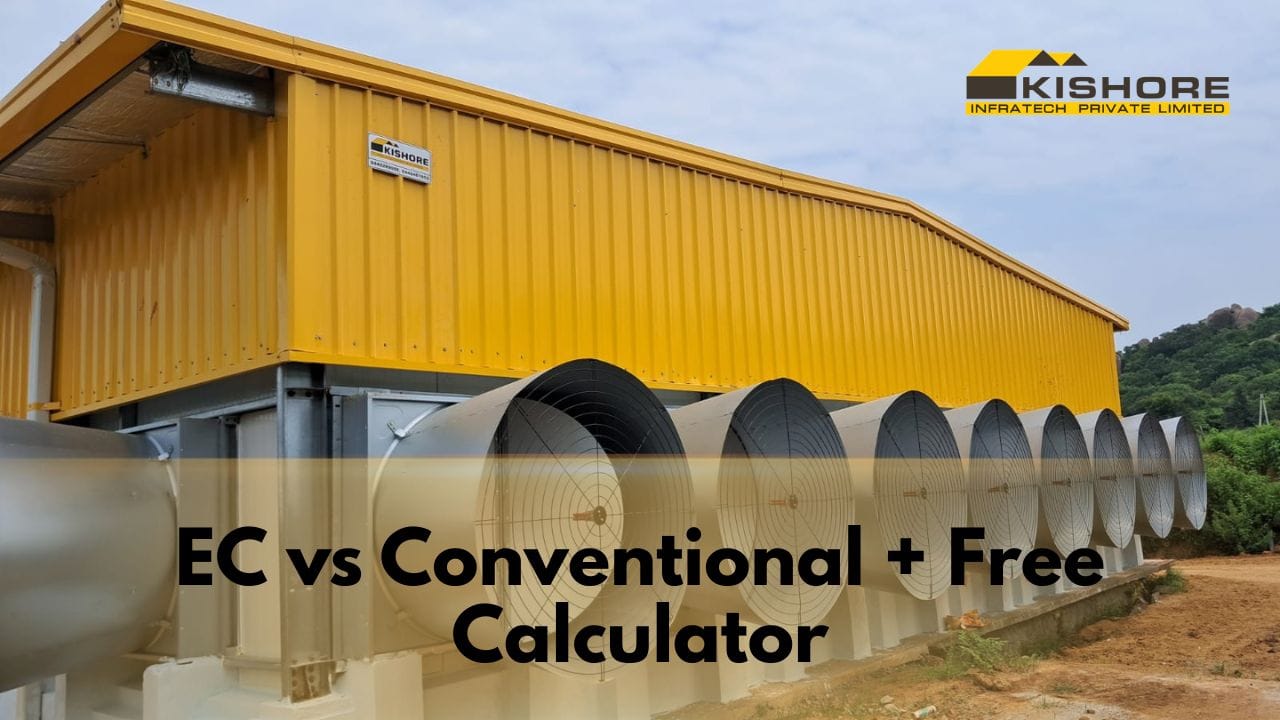
This is the decision that determines your capital cost, and it is worth being honest about the trade-off. An EC shed is not simply a better shed — it is a different operating model. It costs more to build, costs more to run in electricity, and fails badly if power is unreliable and there is no generator backup. What it buys is control: consistent bird weight, lower mortality in summer, higher stocking density and the ability to place flocks year-round instead of losing the hot months.
Key takeaway: EC sheds cost roughly 27–30% more to build but support 15–18% higher stocking density and materially lower summer mortality. The crossover point for most South Indian commercial operators sits around 10,000 birds — below that the capital and power overhead is hard to justify, above it the economics favour EC clearly.
| Factor | Conventional Open-Sided | Environmentally Controlled |
|---|---|---|
| All-in cost per sq ft | ₹450–620 | ₹700–900 |
| Typical shed width | 30–33 ft (natural cross-flow limit) | 40–44 ft (fan-driven airflow) |
| Sidewalls | Open with wire mesh and curtains | Sealed insulated panels, cooling pad wall |
| Roof insulation | Optional; often bare sheet | Essential — PUF or equivalent |
| Power dependency | Low — survives outages | Critical — generator backup mandatory |
| Summer mortality risk | High in peak heat | Substantially reduced |
| Placements per year | Often reduced in summer | Year-round placement possible |
| Best suited to | Under 10,000 birds, mild climates, weak grid | 10,000+ birds, hot zones, contract farming |
Our detailed treatment of controlled-environment design is in the EC poultry sheds guide, and the insulation logic that makes an EC shed work is covered in our PUF panels guide and insulated shed guide.
What the Cost Actually Breaks Down Into
Key takeaway: The PEB structure is 55–60% of an all-in poultry shed cost. For a 10,000-bird EC shed at roughly ₹68 lakh, that means about ₹37–41 lakh of steel, sheeting, insulation and erection, with the balance in flooring, equipment and the environmental control system.
| Cost Component | Conventional | EC Shed | What Drives It |
|---|---|---|---|
| PEB structure & sheeting | 40–45% | 38–42% | Steel price, span, wind zone, coating class |
| Insulation (roof & walls) | 0–5% | 14–18% | PUF thickness and panel quality |
| Foundation & flooring | 14–18% | 12–15% | Soil bearing capacity, plinth height |
| Feeding & drinking systems | 22–28% | 16–20% | Manual vs automatic pan feeding |
| EC system (fans, pads, controls) | — | 14–18% | Fan count, pad area, controller sophistication |
| Brooding & misc. | 8–12% | 6–10% | Brooder type, litter, lighting |
Seven Things That Move Your Quote
- Site soil and bearing capacity. Black cotton soil can add 8–15% to foundation cost against firm red soil. Get the soil test before accepting any per-sq-ft quote.
- Wind zone. Coastal Andhra and Odisha sites need heavier sections and closer purlin spacing than inland Telangana for the same shed.
- Coating class. Poultry interiors are ammonia-rich and permanently humid. AZ150 Galvalume as a minimum, with hot-dip galvanized secondary members, is what separates a 25-year shed from a 12-year one.
- Plinth height. A 600–900 mm raised plinth keeps steel out of the wet litter zone and keeps rodents and surface water out of the shed.
- Automation level. Automatic pan feeding and nipple drinking cost more upfront but cut labour materially at 20,000+ birds.
- Number of houses. Two 10,000-bird houses cost more than one 20,000-bird house, but give you flock separation and staggered placement. Most integrators prefer the former.
- Steel price at order date. Structural steel is the largest single input and moves with the market, so quotes are typically valid for a limited window.
If you want to sanity-check a per-square-foot number against general industrial construction, our industrial shed cost calculator and factory construction cost breakdown cover the same components for non-livestock buildings.
Planning a Poultry Farm Shed?
Get a Free Quote for Your Bird Count.
Tell us your capacity and site — our engineers call you back within 24 hours with a shed layout and transparent quotation for conventional or EC construction.
- Broiler sheds from 16,000 birds upward
- EC and conventional open-sided sheds
- AZ150 Galvalume and hot-dip galvanized secondary steel
- Foundation design for black cotton and red soils
- 45+ years steel fabrication, 700+ projects delivered
Prefer to speak directly? Call 9440407852
Thank You!
Our PEB engineers will call you back shortly with your free poultry shed layout and quotation.
Want a faster response?
📱 Chat with us on WhatsAppWhy Kishore Infratech for Poultry Shed Construction
Kishore Infratech Private Limited (KIPL), an ISO 9001:2015 certified PEB manufacturer headquartered in Hyderabad, Telangana, with 45+ years of steel fabrication experience and 700+ completed projects, builds both conventional open-sided and fully environmentally controlled poultry sheds across South India and Odisha.
Based on our experience delivering poultry and livestock sheds across Telangana, Andhra Pradesh, Karnataka and Tamil Nadu, the sheds that hold up are the ones where corrosion class and plinth detailing were specified correctly at the start. A poultry interior is one of the harshest environments a steel building faces — ammonia, permanent humidity and wet litter — and it is the single most common reason a cheap shed becomes expensive within a decade.
- Capacity-matched design — sheds sized to your exact bird count, rearing system and placement schedule rather than a standard catalogue size.
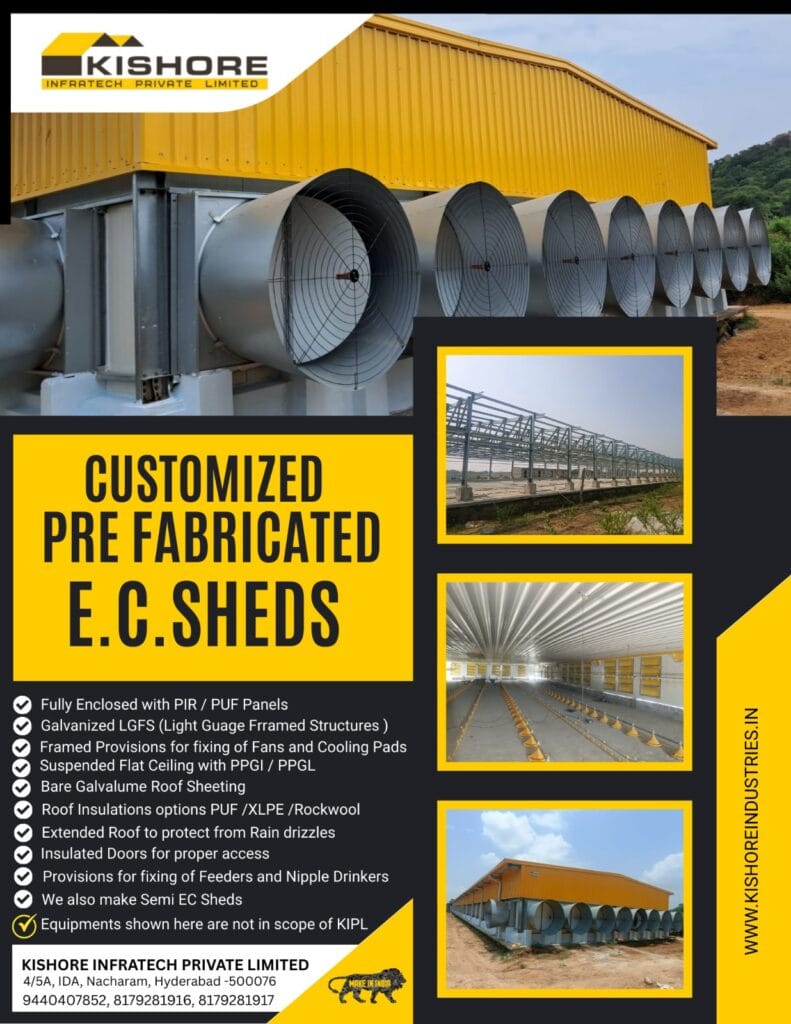
- EC and conventional capability — from open-sided curtain sheds to fully sealed insulated houses with fan banks, cooling pads and controllers.
- Corrosion specification for livestock — AZ150 Galvalume minimum, hot-dip galvanized secondary members and raised plinth detailing as standard.
- 17 advanced fabrication machines under one roof — including CNC and automatic H-beam lines, giving direct control over lead time and section quality.
- Multi-house campus planning — shed spacing, biosecurity separation and staggered placement designed as one layout.
Frequently Asked Questions
What is the cost of a poultry farm shed for 10,000 birds?
A 10,000-bird broiler shed costs approximately 45 to 62 lakh rupees as a conventional open-sided shed, requiring 10,000 sq ft at 1.0 sq ft per bird. As an environmentally controlled shed it costs approximately 59.5 to 76.5 lakh rupees for 8,500 sq ft at 0.85 sq ft per bird. Both figures are all-in, covering structure, flooring, feeding and drinking systems, and for EC sheds the fans, pads and controllers.
What is the cost of a poultry farm shed for 5,000 birds?
A 5,000-bird broiler shed needs 5,000 sq ft conventionally and costs approximately 22.5 to 31 lakh rupees. An EC shed for the same flock needs 4,250 sq ft and costs approximately 29.8 to 38.3 lakh rupees. At this capacity most operators choose conventional open-sided construction, since the capital and power overhead of an EC system is harder to justify below 10,000 birds.
How much space is required per bird in a poultry shed?
Broilers need about 1.0 sq ft per bird in an open-sided shed and 0.80 to 0.90 sq ft in an environmentally controlled shed. Layers in a cage system need about 0.55 sq ft floor-area equivalent conventionally and 0.45 sq ft in EC, while deep-litter layers need 1.80 and 1.55 sq ft respectively. Breeder stock needs the most at 2.0 to 2.5 sq ft per bird.
How much more does an EC poultry shed cost than a conventional shed?
An EC shed costs roughly 27 to 30 percent more than a conventional open-sided shed at the midpoint of typical rate ranges. Conventional sheds run 450 to 620 rupees per sq ft all-in, EC sheds 700 to 900 rupees per sq ft. However the EC shed needs about 15 percent less floor area for the same flock, which narrows the gap in absolute rupees.
Is an EC poultry shed worth the extra cost?
Above roughly 10,000 birds in a hot climate, generally yes. EC sheds support 15 to 18 percent higher stocking density, substantially reduce summer mortality and allow year-round placement instead of losing the hottest months. Below 10,000 birds, or where the power supply is unreliable and generator backup is not viable, conventional open-sided construction usually makes more sense.
What is the standard width of a poultry shed?
Conventional open-sided poultry sheds are typically 30 to 33 ft wide, because natural cross-ventilation cannot effectively serve a wider building. Environmentally controlled sheds are usually 40 to 44 ft wide since fan-driven airflow removes that constraint. Length is then set by the bird count, with sheds usually split into separate houses beyond about 400 ft.
What steel coating should a poultry shed use?
Use AZ150 Galvalume as a minimum for roof and wall sheeting, with hot-dip galvanized secondary members. Poultry interiors combine ammonia, permanent high humidity and wet litter, which attacks ordinary coatings quickly. Combined with a 600 to 900 mm raised concrete plinth that keeps steel out of the litter zone, this is the difference between a 25-year shed and a 12-year one.
How much land is needed for a 10,000-bird poultry farm?
A 10,000-bird broiler unit typically needs about 1 to 1.5 acres. The shed itself occupies 8,500 to 10,000 sq ft, with the balance covering shed spacing for ventilation and biosecurity, approach roads, feed storage, a generator and water infrastructure, and a buffer from the boundary.
How long does it take to build a poultry shed?
A single 10,000-bird shed typically takes 8 to 12 weeks from design freeze to handover, including foundation work, steel erection, sheeting and equipment installation. EC sheds sit at the longer end because of insulation, sealing and the fan and cooling pad installation. Multi-house projects run partly in parallel, so a four-house campus does not take four times as long.
Is it better to build one large shed or two smaller ones?
Two 10,000-bird houses cost more than one 20,000-bird house because you duplicate end walls, doors and services. However most commercial operators and integrators prefer separate houses, because flock separation limits disease spread and staggered placement smooths cash flow. The extra capital is generally treated as biosecurity insurance.
What is not included in a per-square-foot poultry shed quote?
A per-sq-ft quote normally covers the structure, flooring, feeding and drinking systems and, for EC sheds, the environmental control equipment. It typically excludes land, boundary wall, borewell and water infrastructure, power connection and generator, approach roads, and the birds and feed themselves. Always confirm the inclusion list before comparing two quotes.
Data methodology: Cost figures are based on Kishore Infratech Private Limited’s poultry and livestock shed project data across Telangana, Andhra Pradesh, Karnataka and Tamil Nadu, current 2026 market rates for SAIL and JSW structural steel and Galvalume sheeting, and prevailing equipment pricing for feeding, drinking and environmental control systems. Space standards follow established Indian commercial poultry housing practice. All figures are indicative estimates — actual costs vary with site conditions, steel prices at order date, equipment brand and automation level.
Conclusion
Poultry farm shed cost comes down to two decisions taken before anyone quotes you a rate: your bird count, which fixes floor area, and your choice between conventional and environmentally controlled construction, which fixes the rate applied to that area. Everything else — soil, wind zone, automation, coating class — moves the number by 10–20% around that base.
The mistake that costs most is comparing two per-square-foot quotes without checking what each includes. One contractor’s ₹520 per sq ft may exclude flooring and equipment that another’s ₹680 includes. Ask for the inclusion list first, then compare, and check the coating class and plinth height before you compare on price at all — because in a poultry interior those two specifications determine whether you are buying a 12-year building or a 25-year one.
Planning a poultry shed? Tell Kishore Infratech Private Limited your bird count and site location for a free layout and transparent quotation covering conventional or EC construction. Call 9440407852 or visit kishoreindustries.in.