
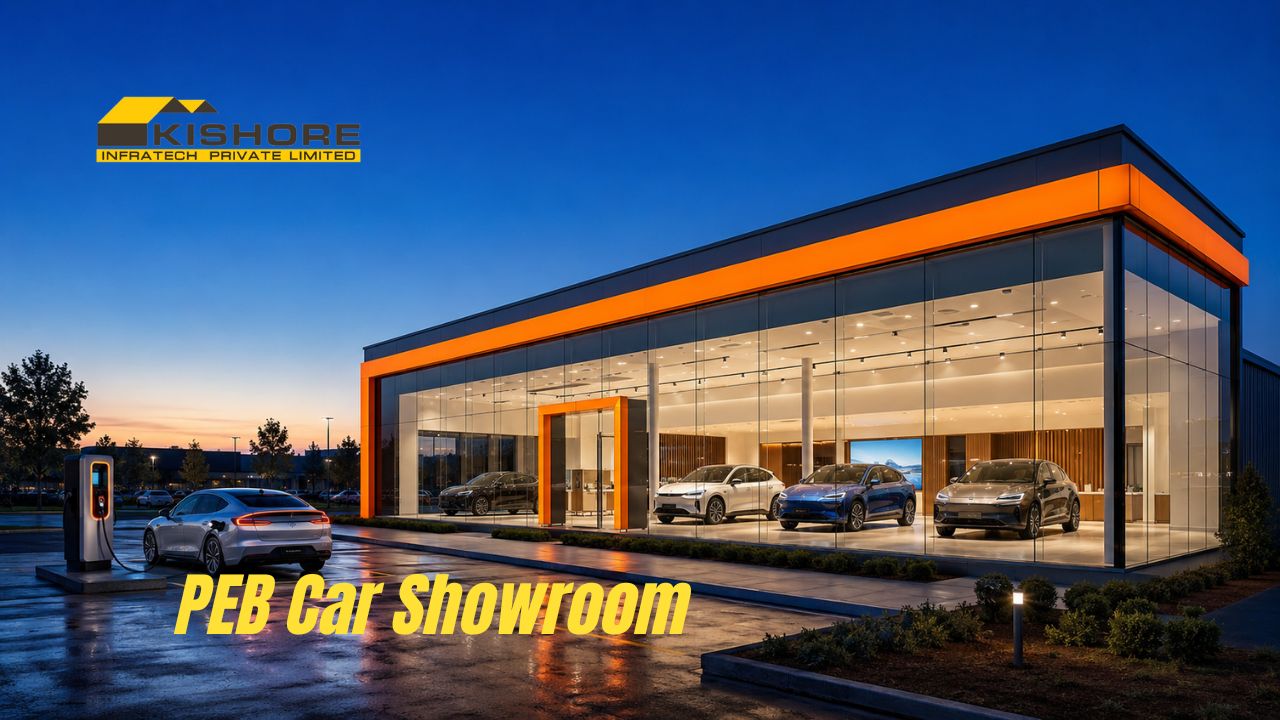
A PEB car showroom is the fastest, most cost-efficient way to build a modern automobile dealership or EV experience centre in India — a pre-engineered steel structure delivers the wide, column-free display floor, full-height glazed frontage, and brand-specified facade that car OEMs demand, in roughly half the time of conventional RCC construction. As Indian auto retail expands and dozens of new EV brands open experience centres across tier-1 and tier-2 cities, dealers and franchise partners are increasingly choosing pre-engineered buildings for their showroom, service workshop, and back-office blocks. This guide covers the structural, glazing, display-lighting, electrical, and fire-safety engineering that goes into a compliant, OEM-ready car showroom.
Quick Answer: A PEB car showroom uses clear-span steel rigid frames (typically 18–40 m column-free) with 6–10 m eave heights to create an open display floor behind a frameless or structurally-glazed glass facade. Showroom display lighting needs 500–750 lux general and 1,000–2,000 lux on feature vehicles at CRI ≥ 90 (R9 high) so paint colours render true. An EV experience centre adds AC (7.4–22 kW) and DC fast-charging (30–60 kW) demonstration points, an upgraded HT/transformer supply, and cable trenching. A turnkey single-brand showroom of 8,000–15,000 sq ft is typically erected in 3–5 months versus 8–12 months for RCC.
Disclaimer: The specifications, lux levels, spans, and indicative figures in this guide are engineering reference ranges based on Kishore Infratech project experience, Indian standards (IS 800, IS 875, IS 3646, NBC 2016), and typical automobile OEM corporate-identity (CI) requirements. Exact specifications must be confirmed against your specific brand CI manual, site conditions, and a project-specific structural design.
Why PEB Is the Standard for Car Showrooms & EV Experience Centres
An automobile showroom is, structurally, a glazed display hall: it must present vehicles with zero visual obstruction, carry a brand-mandated glass-and-ACP facade, and integrate a service workshop and mezzanine offices behind it. Pre-engineered steel buildings answer all four needs better than RCC. The rigid-frame system removes internal columns so the display floor is fully flexible; tapered built-up sections keep steel tonnage (and cost) down; the secondary framing is purpose-designed to carry curtain-wall and ACP loads; and the whole shell is fabricated in-shop and bolted on site, compressing the programme dramatically. The same logic that makes PEB the backbone of EV manufacturing plants and battery assembly units applies at the retail end of the auto value chain.
Key takeaway: A PEB showroom shell is typically erected in 6–10 weeks and a full turnkey dealership in 3–5 months, versus 8–12 months for RCC — letting a dealer start earning showroom revenue one full sales season earlier.
| Parameter | PEB Car Showroom | Conventional RCC Showroom |
|---|---|---|
| Display floor | Column-free 18–40 m clear span | Internal columns every 6–8 m obstruct display |
| Construction time (turnkey) | 3–5 months | 8–12 months |
| Facade / glazing support | Secondary steel engineered for curtain wall & ACP | Needs separate framing, heavier dead load |
| Future expansion / relocation | Bolt-on bays; dismountable | Demolition required |
| Roof for branding / parapet | Low-slope or mono-slope with fascia for signage | Flat slab, heavier, slower |
Space Program: Showroom, Workshop & Office Blocks
A complete dealership (“3S” — Sales, Service, Spares) is rarely a single box. It is a coordinated PEB campus where each block has a different span, height, and floor-loading requirement. Getting the space program right at design stage is what keeps the OEM CI auditor satisfied and the workshop productive.
Key takeaway: Plan the display hall at 6–10 m eave for double-height glazing, but design the service workshop separately at 7–9 m clear to clamp two-post/four-post lifts and a raised vehicle, with a mezzanine only over the office/lounge zone.
| Block | Typical Clear Span | Eave Height | Floor Live Load |
|---|---|---|---|
| Display showroom | 18–40 m | 6–10 m | 5 kN/m² |
| Service workshop | 15–30 m | 7–9 m | 5–7.5 kN/m² + lift pits |
| Mezzanine office / lounge | As needed | 3.0–3.5 m clear | 3–4 kN/m² |
| Spares / accessories store | 12–20 m | 4–6 m | 5 kN/m² (racking) |
The mezzanine office and customer lounge are best executed as an independent steel mezzanine floor structure tied into the main frame, so the display floor below stays clear and the upper level can be reconfigured as sales volumes grow.
Clear-Span & Frame Design for the Display Floor
The single most important showroom decision is span. A premium single-brand showroom displaying 6–10 cars usually needs an 18–24 m clear span; a multi-brand or SUV/commercial-vehicle showroom benefits from 30–40 m so large vehicles and a turntable can sit anywhere on the floor without a column in the sightline. PEB clear-span rigid frames comfortably reach these widths, and built-up tapered sections place steel only where the bending moment demands it, keeping the structure light and economical even at 40 m.
Key takeaway: For a glazed showroom frontage, design lateral stability with rigid frames and rod/portal bracing kept to the rear and side walls — never the glass facade line — so the full-height glazing stays uninterrupted.
| Showroom Type | Recommended Span | Why |
|---|---|---|
| Compact single-brand (hatchback/sedan) | 18–24 m | Displays 6–10 cars with clear circulation |
| Premium / luxury experience centre | 24–35 m | Turntable, hospitality zone, brand wall |
| SUV / commercial vehicle | 30–40 m | Large vehicle footprints, higher eave |
| Multi-brand used-car / EV mall | 30–50 m | Maximum flexibility, zero columns |
Glazed Facade & ACP Integration
The glass frontage is where automobile CI standards are strictest. Most OEMs mandate a floor-to-soffit glazed elevation so vehicles are visible from the road, framed by brand-coloured aluminium composite panel (ACP) bands and signage. The PEB design must therefore provide the mullion-support steel, wind-load-rated secondary framing, and precise tolerances that a curtain wall demands. Common systems are frameless (spider/patch-fitting) glazing with 10–12 mm toughened glass, semi-unitised curtain wall, and structural silicone glazing using double-glazed units (DGUs) to control solar heat gain.
Key takeaway: Specify double-glazed, low-E units (SHGC ≈ 0.25–0.35) on the showroom frontage — single glazing looks identical on day one but pushes the air-conditioning load up 20–35% for the life of the building.
| Facade Element | Typical Specification | PEB Design Implication |
|---|---|---|
| Showroom glazing | 10–12 mm toughened / DGU low-E | Mullion steel + wind bracing off facade line |
| Brand ACP cladding | 4 mm FR-grade, PVDF coated | Girts spaced for panel module & fascia |
| Parapet / signage fascia | Backlit brand totem & logo | Edge beam & cantilever framing for signage |
| Entrance canopy | Cantilevered steel + ACP soffit | Moment connection at frame column |
Coordinating the glazing, ACP, rolling shutters at the workshop, and signage with the steel frame is specialist work — see our guide to ACP works, glazing and finishing solutions for PEB.
Display Lighting: Lux Levels & Colour Rendering
Lighting is what sells the car. A vehicle’s paint, chrome, and interior must look exactly as the customer expects, which makes colour rendering as important as raw brightness. The illuminance hierarchy layers a comfortable general level across the floor with high-intensity accent lighting on feature vehicles and the brand wall. Crucially, the light source must have a high Colour Rendering Index — CRI (Ra) ≥ 90 with a strong R9 (deep-red) value — so metallic reds, blues, and whites render faithfully. This is the same illuminance-engineering discipline we cover for indoor sports arena lux levels under BIS standards, applied to retail display.
Key takeaway: Use 500–750 lux general and 1,000–2,000 lux accent on feature cars, all at CRI ≥ 90 and 4000K neutral white (or the OEM-specified colour temperature) — and design the roof/soffit to carry track and feature lighting on the structure, not as an afterthought.
| Zone | Illuminance (lux) | CRI / CCT |
|---|---|---|
| General display floor | 500–750 | ≥ 90 / 4000K |
| Feature / hero vehicle | 1,000–2,000 | ≥ 90 (R9 high) / 3500–4000K |
| Customer lounge / sales desk | 300–500 | ≥ 85 / 3000–4000K |
| Service workshop bays | 500–750 | ≥ 80 / 4000–5000K |
| Facade / night visibility | Vertical accent on glass line | Brand-specified |
EV Experience Centre: Charging & Electrical Engineering
An EV experience centre is a car showroom plus a working demonstration of charging. That single addition changes the electrical design profile of the building. You need live AC chargers (7.4–22 kW) for slow/destination charging demos and at least one DC fast charger (30–60 kW, sometimes 120 kW+) for the “10-minute top-up” story. This pushes the connected load well beyond a conventional showroom, often requiring a dedicated HT supply, a transformer and LT panel room, deeper cable trenches, and earthing designed for EV safety. The PEB layout must reserve a ventilated electrical room and route cable trays cleanly through the steel structure.
Key takeaway: Size the incoming supply and transformer for the DC fast charger plus HVAC and lighting from day one — retrofitting an HT connection after the slab is poured is the most common and expensive EV-showroom mistake.
| Charging Point | Typical Rating | Building Provision |
|---|---|---|
| AC slow charger (demo) | 7.4–22 kW | Wall/pedestal mount, dedicated MCB circuit |
| DC fast charger | 30–60 kW (up to 120 kW+) | HT supply, transformer, LT panel, trenching |
| Battery / display floor loading | EVs 1.8–2.5 t+ | Floor slab rated for heavier kerb weights |
| Electrical room | Ventilated, fire-rated | Reserved bay in PEB layout |
HVAC, Comfort & the Glazing Trade-off
A large glass frontage is beautiful and brutal on the cooling load. Solar gain through the showroom glazing, combined with heat from display lighting and customer footfall, drives the air-conditioning tonnage. The design levers are double-glazed low-E glass to cut solar heat gain, roof insulation (PUF or rockwool sandwich panels) to stop roof gain, and a correctly zoned HVAC system that handles the high-glazing perimeter separately from the deeper floor. Done well, a showroom holds a comfortable 24–25 °C even with a fully glazed south or west elevation.
Key takeaway: Insulate the PEB roof with 50–80 mm PUF sandwich panels and zone the HVAC so the glazed perimeter has dedicated capacity — this prevents the “hot near the glass, cold at the back” complaint that plagues under-designed showrooms.
Fire Safety, NBC 2016 & OEM CI Compliance
A car showroom is a mercantile occupancy under the National Building Code (NBC 2016), with a service workshop carrying additional fire risk from fuels, oils, and — for EVs — lithium battery handling. The design must provide adequate exit widths for the calculated occupant load, fire extinguishers and (above the area threshold) sprinklers and hydrants, smoke management, and clear egress from the mezzanine. EV demonstration and charging zones warrant specific battery-fire precautions and isolation. On top of statutory compliance sits the OEM corporate-identity (CI) manual, which fixes facade proportions, brand colours, lighting temperature, signage, and even floor tile — and is audited before the dealership is allowed to open.
Key takeaway: Engage the structural, MEP, and CI requirements together at concept stage — a PEB designed only to the CI drawing but not to NBC egress, or vice-versa, gets caught at audit and delays the dealer’s launch.
Indicative Investment for a PEB Car Showroom
Showroom budgets vary widely with brand tier, glazing extent, and interior fit-out, so treat the figures below as engineering ballparks rather than quotations. The structural steel shell is a modest share of the total; glazing, ACP, lighting, HVAC, and brand interiors dominate a premium build.
| Scope | Indicative Range (₹ / sq ft) |
|---|---|
| PEB structural shell (steel + roofing) | ₹1,800–2,800 |
| + Glazed facade, ACP, flooring | ₹1,000–2,200 |
| + MEP, HVAC, display lighting | ₹700–1,400 |
| Turnkey showroom (brand-ready) | ₹3,500–6,000 |
Comparison sentence for clarity: a 10,000 sq ft turnkey single-brand PEB showroom typically lands in the ₹3.5–6 crore range depending on glazing extent and brand interior spec, with the structural steel shell itself accounting for only about a third of that — yet it is the part that determines span, sightlines, and how fast the dealership opens.
Planning a Car Showroom or EV Experience Centre?
Get a Free Proposal & Quotation.
Share your requirement — our engineers call you back within 24 hours with an OEM-ready PEB showroom design for your site, brand CI, and frontage.
- Column-free 18–40 m display floors with glazed frontage
- OEM corporate-identity (CI) facade & ACP compliance
- 3S layout: showroom, service workshop & mezzanine offices
- EV charging, HT supply & electrical-room provisioning
- 45+ years steel fabrication, 700+ projects delivered
Prefer to speak directly? Call 9440407852
Thank You!
Our PEB engineers will call you back shortly with your free car showroom proposal and quotation.
Want a faster response?
📱 Chat with us on WhatsAppWhy Build Your Car Showroom with Kishore Infratech
Kishore Infratech Private Limited (KIPL), an ISO 9001:2015 certified PEB manufacturer headquartered in Hyderabad, Telangana, with 45+ years of steel fabrication experience and 700+ completed projects, designs and builds car showrooms and EV experience centres as complete turnkey PEB campuses. Based on our experience delivering commercial and industrial PEB structures across Telangana, Andhra Pradesh, Karnataka, Tamil Nadu and Odisha, we engineer the showroom shell, glazed facade, service workshop, and mezzanine offices as one coordinated package — so the OEM CI auditor and the structural engineer are satisfied at the same time.
- Clear-span display floors — column-free 18–40 m frames engineered for uninterrupted vehicle sightlines.
- Facade-ready secondary steel — mullion and girt design coordinated with curtain wall, glazing and ACP from the start.
- Full 3S campus — showroom, service workshop with lift pits, spares store and mezzanine offices.
- EV-ready electrical layout — provisioning for HT supply, transformer room, and AC/DC charging demos.
- In-house fabrication — certified materials and quality control across every member.
- Speed to opening — turnkey showrooms erected in 3–5 months so you launch a season early.
Our commercial PEB portfolio spans formats from pre-engineered restaurants to microbreweries and brewpubs, and our regional reach is detailed in our guide to the types of PEB structures across South India. New to PEB procurement? Start with how to choose the right PEB manufacturer in India.
Why are pre-engineered buildings used for car showrooms?
PEB rigid frames create a column-free display floor (18–40 m clear span) so vehicles are visible with no obstruction, and the secondary steel is engineered to carry the glazed facade and ACP that OEMs mandate. A PEB showroom is also erected in roughly half the time of RCC, letting a dealer open a season earlier.
What clear span does a car showroom need?
A compact single-brand showroom needs an 18–24 m clear span, a premium or luxury experience centre 24–35 m, and SUV, commercial-vehicle or multi-brand showrooms 30–40 m or more. PEB clear-span frames reach all these widths economically using tapered built-up sections.
What eave height is ideal for a showroom?
Display showrooms are typically designed at 6–10 m eave height to allow a double-height glazed frontage and feature lighting, while service workshops need 7–9 m clear to operate two-post and four-post lifts with a raised vehicle.
How many lux are needed in a car showroom?
Use 500–750 lux across the general display floor and 1,000–2,000 lux of accent lighting on feature vehicles, all at a Colour Rendering Index (CRI) of 90 or higher with strong R9, so paint and chrome render true. Customer lounges work at 300–500 lux.
What does an EV experience centre need that a normal showroom does not?
An EV experience centre adds live AC chargers (7.4–22 kW) and at least one DC fast charger (30–60 kW or more) for demonstrations. This usually requires a dedicated HT supply, a transformer and LT panel room, deeper cable trenching, and EV-rated earthing, all of which must be provisioned in the PEB layout from day one.
What glazing is used for a showroom frontage?
Most showrooms use 10–12 mm toughened glass in frameless (spider) or structural silicone glazing, increasingly as double-glazed low-E units (SHGC about 0.25–0.35) to cut solar heat gain. The PEB provides mullion-support steel and wind-rated secondary framing for the curtain wall.
How much does a PEB car showroom cost in India?
As an engineering ballpark, the PEB structural shell runs about ₹1,800–2,800 per sq ft, and a brand-ready turnkey showroom (with glazing, ACP, MEP, HVAC and display lighting) typically ₹3,500–6,000 per sq ft. A 10,000 sq ft single-brand showroom therefore often falls in the ₹3.5–6 crore range depending on brand spec. Exact cost depends on glazing extent, interiors and site conditions.
How long does it take to build a car showroom?
A PEB showroom shell is usually erected in 6–10 weeks, and a complete turnkey dealership in 3–5 months, compared with 8–12 months for conventional RCC construction.
Can the showroom, service workshop and offices be one PEB project?
Yes. A full 3S dealership is best built as a coordinated PEB campus where the display hall, service workshop (with lift pits and higher floor loading), spares store, and mezzanine offices each get the right span, height and floor rating while sharing one structural and MEP design.
What fire and code requirements apply to a car showroom?
A showroom is a mercantile occupancy under NBC 2016 and needs adequate exit widths for its occupant load, fire extinguishers, and sprinklers/hydrants above the area threshold, plus clear mezzanine egress. EV charging and service areas warrant additional battery- and fuel-fire precautions.
Does a PEB showroom meet OEM corporate-identity (CI) standards?
Yes. The PEB is designed to the brand’s CI manual — facade proportions, glass and ACP modules, signage fascia, lighting colour temperature and floor finishes — while also meeting structural and NBC requirements, so it clears the OEM audit before launch.
How is air-conditioning handled with a large glass frontage?
The large glazing drives solar heat gain, so the design uses double-glazed low-E glass, insulated PUF/rockwool roof panels, and a zoned HVAC system that gives the glazed perimeter dedicated cooling. This keeps the showroom at a comfortable 24–25 °C without hot spots near the glass.
Data methodology: Specifications and indicative figures are based on Kishore Infratech Private Limited’s commercial PEB project experience across South India and Odisha, Indian standards (IS 800, IS 875, IS 3646/SP 72, NBC 2016), and typical automobile OEM corporate-identity requirements current to 2026. Lux, span, and load values are engineering reference ranges; all cost figures are estimates that vary by brand specification, glazing extent, interiors and site conditions.
Conclusion
A PEB car showroom gives automobile dealers and EV brands exactly what modern auto retail demands: a wide, column-free display floor; a full-height glazed, CI-compliant frontage; integrated service and office blocks; and a build programme short enough to capture the next selling season. The engineering that matters happens early — choosing the right span for the brand, designing the secondary steel for the curtain wall, fixing display lighting at CRI 90+, and provisioning the electrical supply for EV charging before the slab is cast.
As India’s EV experience-centre boom accelerates across tier-1 and tier-2 cities, the dealers who win are the ones who treat the building as a brand asset and a revenue engine, not just a roof. Get the structural, glazing, lighting, and electrical design coordinated from concept stage, and the showroom opens on time, passes its OEM audit, and sells cars from day one.
Ready to build your car showroom or EV experience centre? Call Kishore Infratech on 9440407852 or visit kishoreindustries.in for a free, OEM-ready PEB showroom proposal and quotation tailored to your brand and site.