
Hot-dip galvanizing for solar structures is the single coating decision that decides whether a mounting structure survives its full 25-year design life or starts rusting at the cut edges within a few monsoons. Yet most solar tenders confuse two completely different zinc-coating routes — pre-galvanized GI coil rated in GSM and batch hot-dip galvanizing (HDG) rated in microns — and end up specifying the wrong protection for the site. This masterclass clears up the GSM-vs-microns confusion once and for all: what each unit measures, how they convert, which surfaces each route actually coats, how coating life maps to the ISO 9223 corrosivity of your site, and exactly how to specify galvanizing in a tender so you get the corrosion protection you paid for.
Quick Answer: Hot-dip galvanizing for solar structures refers to dipping the fabricated steel part in molten zinc after welding and drilling (per IS 4759 / ISO 1461), giving a thick coating rated in microns — typically 65–86 microns for structural members — that covers every surface including cut edges, welds, and bolt holes. Pre-galvanized GI is different: zinc is applied to the flat coil before roll-forming (per IS 277) and rated in GSM (grams per square metre, counting both sides) as grades Z80, Z120, or Z275, leaving cut edges and weld zones bare. The two units are not interchangeable: GSM is a mass over both coil surfaces, while microns is a thickness on each surface of the dipped part — roughly 1 micron of zinc ≈ 7.14 g/m² per side, so ~85 microns ≈ ~610 g/m² per side. As a rule, use Z275 GI for sheltered inland rooftop rails and full hot-dip galvanizing at 70–86 microns for ground-mount posts/rafters and any site within ~25 km of the coast.
Disclaimer: The coating grades, micron and GSM values, conversion factors, and service-life ranges in this article are based on Indian and international galvanizing standards (IS 277, IS 4759, ISO 1461), atmospheric corrosivity classification (ISO 9223), and Kishore Infratech Private Limited’s solar mounting structure fabrication practice as of 2026. All conversions are approximate and all service-life figures are indicative estimates — actual coating life depends on the specific microclimate, pollution, salinity, and detailing of your site and must be confirmed against a project-specific corrosion assessment.
Why Corrosion Protection Decides Solar Structure Life
A solar mounting structure is a steel frame that stands outdoors, unpainted and unsheltered, for a design life of 25 years or more — the same lifespan as the PV modules it carries. Unlike a building frame protected inside cladding, every purlin, rafter, post, and bolt on a solar table is permanently exposed to rain, dew, UV, temperature cycling, airborne salt, and industrial pollutants. Bare mild steel left in this environment loses measurable thickness every year and would be structurally compromised long before the panels reach end of life. The only practical, maintenance-free way to give steel a 25-year outdoor life is a sacrificial zinc coating — galvanizing — and the amount and coverage of that zinc is what separates a structure that lasts the full term from one that fails early.
Zinc protects steel two ways. First, it forms a physical barrier between the steel and the atmosphere. Second, and more importantly, zinc is anodic to steel, so even where the coating is scratched or a cut edge is exposed, the surrounding zinc corrodes preferentially and protects the steel — this is cathodic (sacrificial) protection. Because the zinc is consumed over time, coating life is, to a first approximation, proportional to the mass of zinc present and inversely proportional to the corrosion rate of the environment. Double the zinc and you roughly double the life; move from a dry inland site to a coastal one and the same coating is consumed several times faster. This single principle underlies every specification decision in this guide.
Key takeaway: Because a solar structure is exposed outdoors for its entire 25-year design life and zinc is consumed sacrificially over time, coating life is governed by how much zinc is on the steel and how aggressive the site is — so the corrosion specification is not a finishing detail, it is a structural-life decision as important as the steel section itself. For how section choice and coating work together, see our guide to C purlin vs Z purlin solar mounting structures.
Pre-Galvanized GI Explained: IS 277, GSM and the Bare-Edge Problem
Pre-galvanized steel — commonly called GI (galvanized iron) — is made by passing a flat steel coil continuously through a molten zinc bath at the steel mill before any fabrication. The coil emerges with a thin, uniform, well-bonded zinc layer on both faces and is then coiled up and shipped. When a fabricator later roll-forms this coil into a C or Z purlin, the zinc that was already on the flat surfaces simply follows the bend, so the formed section arrives pre-coated without any further dipping. This is the route the KIPL flyer refers to as “GI cold-form” and “galvanized cold-form” sections.
Pre-galvanized coil is governed in India by IS 277 and is rated by the zinc coating mass in GSM (grams per square metre), expressed as a total over both surfaces of the sheet. The standard coating classes are written as a “Z” number — Z80, Z120, and Z275 — meaning 80, 120, and 275 g/m² of zinc counting both sides combined. So a Z275 coil carries about 275 g/m² total, or roughly 137 g/m² on each face. Higher GSM means more zinc and longer life, which is why Z275 is the heaviest common grade for outdoor solar use and Z80 is reserved for sheltered or indoor work.
The critical limitation of GI is what happens after the coil is fabricated. The moment a pre-galvanized section is cut to length, punched, drilled, notched, or welded, fresh bare steel is exposed at every cut edge, every bolt hole, and every weld zone — and that exposed steel has no zinc of its own. On a thin sheet the small cut edge is partly protected by the sacrificial action of the adjacent zinc, which is acceptable in mild, dry environments. But on a heavily fabricated ground-mount structure with many holes, welds, and end cuts, those bare zones become the first places corrosion starts, especially in humid or coastal air. This “bare-edge problem” is the fundamental reason GI is best for simpler, sheltered, inland members and not for aggressive sites.
Key takeaway: Pre-galvanized GI (IS 277) is zinc applied to the coil before forming and is rated in GSM as Z80/Z120/Z275 (mass over both sides) — it is economical and uniform on the formed surfaces, but cut edges, holes, and welds made after fabrication are left bare, which limits GI to sheltered and inland applications.
Hot-Dip Galvanizing Explained: IS 4759 / ISO 1461, Microns and Full Coverage
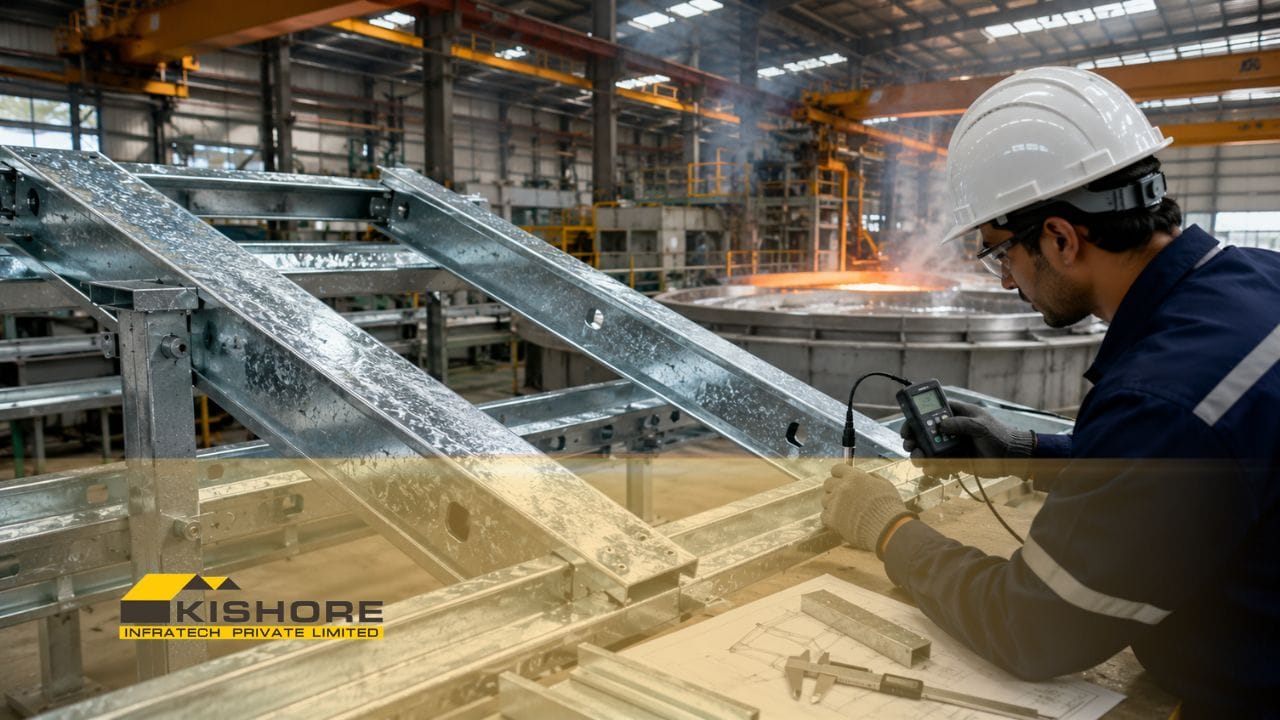
Hot-dip galvanizing (HDG) reverses the order of operations. The steel is first fabricated completely — cut, drilled, welded, and assembled into the finished member — and only then is the whole part dipped into a bath of molten zinc at around 450 °C. The molten zinc reacts metallurgically with the steel surface to form a series of tough zinc-iron alloy layers bonded to the steel, topped by a layer of pure zinc. Because the part is fully immersed, the zinc flows into and coats every surface the metal touches — outside faces, inside corners, cut edges, weld zones, and the inside of every bolt hole. This is batch (after-fabrication) galvanizing and is what the KIPL flyer calls “MS fabricated + galvanizing”.
Hot-dip galvanizing is governed by IS 4759 in India and ISO 1461 internationally, and — crucially — it is specified and measured in microns of coating thickness, not GSM. For structural members, typical HDG coating thickness is in the range of 65–86 microns, and outdoor ground-mount solar members are often specified around 70–86 microns. Because the coating is so much thicker than a pre-galvanized layer and covers the edges and welds that GI leaves bare, hot-dip galvanizing delivers far longer service life in aggressive environments — at the cost of being a separate batch process applied after fabrication.
One important practical point: because HDG is applied after fabrication, the design must allow for it. Sections need vent and drain holes so molten zinc can flow in and air can escape, assemblies must fit the galvanizing bath, and very thin cold-formed sections can distort if not detailed for dipping. This is why heavy ground-mount posts, rafters, base plates, and brackets are the natural candidates for hot-dip galvanizing, while thin light-gauge module rails are often left as pre-galvanized GI. For how this maps to ground versus rooftop layouts, see our ground-mount vs rooftop solar mounting structures guide.
Key takeaway: Hot-dip galvanizing (IS 4759 / ISO 1461) dips the finished, fabricated part in molten zinc after all cutting, welding, and drilling, so it coats every surface — including cut edges, welds, and bolt holes — with a thick layer measured in microns (typically 65–86, often 70–86 for outdoor ground mount), giving the longest corrosion life for aggressive sites.
GSM vs Microns: The Unit Confusion, Cleared Up
The most common error in solar coating specifications is treating GSM and microns as if they measure the same thing. They do not. GSM is a mass of zinc per unit area, quoted over both surfaces of a coil (because pre-galvanizing coats a flat sheet on both sides at once). Microns is a thickness of zinc on a single surface of a dipped part (because hot-dip galvanizing builds a coating on each face independently). One is “how many grams of zinc, counting both sides”; the other is “how thick is the layer on this face”. Comparing them directly without converting is meaningless — a “275 GSM” GI and an “85 micron” HDG are described in different currencies.
To compare them, use the density of zinc. One micron of zinc weighs approximately 7.14 g/m² per side. So a hot-dip coating of about 85 microns carries roughly 85 × 7.14 ≈ 610 g/m² on each surface — and since both faces are coated, that is on the order of 1,200 g/m² of zinc total on the part. Compare that to a Z275 GI coil at 275 g/m² total over both sides (≈ 137 g/m² per side, ≈ 19 microns per side), and the difference is stark: a typical hot-dip coating puts several times more zinc per surface on the steel than even the heaviest common GI grade — which, combined with covering the cut edges and welds, is exactly why HDG lasts so much longer in corrosive air.
Key takeaway: GSM measures zinc mass over both sides of a coil (GI) while microns measures coating thickness on each surface of a dipped part (HDG); to compare, use ~7.14 g/m² per micron per side — so ~85 microns ≈ ~610 g/m² per side versus Z275 GI’s ~137 g/m² per side, meaning hot-dip galvanizing carries several times more zinc per surface. The table below converts the common grades; treat all conversions as approximate.
| Coating Type | Rating Unit | Typical Value | Approx. Zinc Mass | What It Coats |
|---|---|---|---|---|
| Pre-galvanized GI, light (Z80) | GSM (both sides) | 80 GSM | ≈ 40 g/m² per side (≈ 5.6 microns/side) | Formed faces only; cut edges, holes, welds left bare |
| Pre-galvanized GI, standard (Z120) | GSM (both sides) | 120 GSM | ≈ 60 g/m² per side (≈ 8.4 microns/side) | Formed faces only; cut edges, holes, welds left bare |
| Pre-galvanized GI, heavy (Z275) | GSM (both sides) | 275 GSM | ≈ 137 g/m² per side (≈ 19 microns/side) | Formed faces only; cut edges, holes, welds left bare |
| Hot-dip galvanized (HDG), structural | Microns (per surface) | 65–86 microns | ≈ 460–610 g/m² per side | All surfaces incl. cut edges, welds, inside of holes |
Read this table as a translation guide, not a precision specification: the conversions use ~7.14 g/m² per micron per side and are rounded for clarity. The headline message is in the last column — every GI grade protects only the formed faces and leaves bare steel at edges and welds, while hot-dip galvanizing wraps the entire fabricated part in a thick zinc envelope. That coverage difference matters as much as the raw zinc mass when you move to a corrosive environment.
Coating Life by Environment: ISO 9223 Corrosivity Categories
Because zinc is consumed at a rate set by the atmosphere, the same coating lasts very different amounts of time in different places. The international standard ISO 9223 classifies atmospheric corrosivity into categories from C1 (very low — dry, clean, indoor) through C2 (low — rural inland), C3 (medium — urban/light-industrial, moderate humidity), C4 (high — industrial or near-coastal), to C5 (very high — heavy industrial and coastal/marine). Each step up roughly multiplies the zinc consumption rate, so a coating that lasts decades inland may last only a few years on an unprotected coastal site. Matching the coating to the ISO 9223 category of your site is the single most reliable way to specify galvanizing correctly.
Key takeaway: Coating life scales with zinc mass and inversely with the site’s corrosion rate, so the right specification depends on the ISO 9223 category — Z120–Z275 GI is fine for C1–C3 inland sites, but C4–C5 coastal and industrial sites need full hot-dip galvanizing at 70–86 microns to reach a 25-year life. The figures below are indicative estimates to first time-to-significant-rust, not guarantees.
| ISO 9223 Category | Typical Site | Recommended Coating | Indicative Life |
|---|---|---|---|
| C1 — Very low | Dry, heated indoor; sheltered carport underside | Z80–Z120 GI | Very long; coating rarely governs |
| C2 — Low | Rural inland, low pollution (e.g. interior Telangana, Karnataka plateau) | Z120–Z275 GI | 25+ years for HDG; long for Z275 GI on faces |
| C3 — Medium | Urban / light-industrial, humid inland cities | Z275 GI (rails) + HDG (posts/rafters) | HDG 25+ yrs; Z275 faces moderate, edges shorter |
| C4 — High | Industrial zones, near-coastal (5–25 km), high humidity | Hot-dip galvanized 70–86 microns | ~20–25 yrs HDG; GI not recommended |
| C5 — Very high | Coastal/marine (<5 km), heavy industrial (AP, TN, Odisha coast) | HDG 85+ microns + stainless fasteners (consider AZ150) | ~10–20 yrs HDG; needs heaviest coating |
These ranges are deliberately conservative and indicative. Real coating life depends on local microclimate — proximity to surf, prevailing wind carrying salt inland, nearby industry, and whether water can pool on horizontal members. The practical takeaway is the trend: as you move from C1 toward C5, GI grades become inadequate and hot-dip galvanizing at increasing micron thickness becomes essential to keep the structure standing for the full 25-year module life.
Where to Use Which Coating in Solar Structures
Key takeaway: Most well-specified solar projects mix coatings by member and environment — pre-galvanized GI for light rooftop rails in dry inland sites, and full hot-dip galvanizing for ground-mount posts and rafters and for anything coastal — because that matches zinc cost to where corrosion actually attacks. The table below is the quick selection reference.
| Application | Recommended Coating | Why |
|---|---|---|
| Rooftop module rails (inland, dry) | Z275 GI (pre-galvanized) | Short light members, few welds, sheltered by roof; GSM coating on faces is sufficient |
| Ground-mount posts (driven/concreted) | Hot-dip galvanized 70–86 microns | Ground-line zone is highly corrosive; full edge and surface coverage essential |
| Ground-mount rafters / principal beams | Hot-dip galvanized 70–86 microns | Welded, drilled and lapped members; HDG coats welds and bolt holes |
| Base plates, cleats, brackets | Hot-dip galvanized | Heavily welded connection items with many exposed cut faces |
| Any site within ~25 km of coast | HDG 85+ microns + stainless fasteners | Salt-laden air (C4–C5) consumes thin coatings fast; GI edges rust early |
| Agri / solar-pump structures (rural, dry) | Z120–Z275 GI | Small, simple, single-span members in low-corrosivity inland air |
Coastal & High-Humidity Sites: When Only Hot-Dip Will Do
The coastal belts of Andhra Pradesh, Tamil Nadu, and Odisha are among the most demanding environments for steel anywhere in India. Onshore winds carry chloride aerosols several kilometres inland, and chlorides dramatically accelerate zinc consumption. As a working rule, any solar site within roughly 25 km of the coast should be treated as ISO 9223 category C4 or C5 and specified accordingly — which in practice means full hot-dip galvanizing at the upper end of the micron range (around 85 microns or more) rather than any pre-galvanized GI, because GI’s bare cut edges and welds would begin to rust within a few seasons in salt air.
For the lightest module rails and roof sheeting in such locations, an aluminium-zinc alloy coated steel — galvalume, commonly AZ150 (an Al-Zn-coated coil) — offers good atmospheric resistance on the formed faces and is widely used for roofing in coastal zones. However, galvalume shares the GI limitation that fabricated cut edges and holes are not coated by the dipping process, so it is a coil-coating choice for sheltered light members, not a substitute for hot-dip galvanizing on heavily fabricated structural posts and rafters. In genuinely marine exposure, the safest combination is hot-dip galvanized structural members plus stainless steel fasteners, so that the highest-corrosion points — the bolted joints — are protected by the most corrosion-resistant components.
Key takeaway: Within ~25 km of the AP, TN, or Odisha coast, treat the site as C4–C5 and specify hot-dip galvanizing at ~85+ microns with stainless fasteners; AZ150 galvalume is useful for sheltered light rooftop members but does not protect fabricated cut edges, so it is not a replacement for HDG on structural posts and rafters.
Fasteners & Bimetallic Corrosion
The bolts that hold a solar structure together are its most vulnerable corrosion points: a joint traps moisture, concentrates stress, and often pairs two different metals. The cardinal rule is to never use bare (black) mild-steel bolts on galvanized members. A bare bolt in a galvanized purlin sets up a galvanic couple in which the larger zinc-coated area drives accelerated consumption around the connection, and the unprotected bolt itself rusts quickly, loses preload, and can fail under wind reversal. Always use hot-dip galvanized or zinc-plated bolts on galvanized members, or stainless steel fasteners in coastal environments.
Bimetallic (galvanic) corrosion occurs whenever two dissimilar metals are in electrical contact in the presence of moisture — the more “active” metal corrodes preferentially. Zinc-coated steel against zinc-coated steel is compatible; stainless against galvanized is generally acceptable when the stainless (the small fastener) is the more noble metal and the galvanized area is large; but bare carbon steel against galvanized, or aluminium module frames in direct hard contact with bare steel, invite trouble. Where aluminium framing meets steel, the module clamp system normally provides the correct interface, but the steel it bolts to must still be galvanized and the bolts compatible. Getting fasteners right is cheap at design stage and very expensive to retrofit across thousands of joints in the field.
Key takeaway: Use galvanized or stainless fasteners on galvanized members and never bare bolts — a bare bolt in a galvanized joint triggers bimetallic corrosion that rusts the connection, loosens preload, and becomes a wind-uplift failure point long before the members themselves corrode.
How to Specify Galvanizing Correctly in a Tender
Most coating disputes on solar projects come from vague or mismatched specifications. The fix is to specify the right unit for the right process and to demand documentary proof. If you want pre-galvanized GI, specify it in GSM with the IS 277 class — for example, “C-purlin module rails: pre-galvanized to IS 277, Z275 (275 GSM minimum, both sides)”. If you want hot-dip galvanizing, specify it in microns with the IS 4759 / ISO 1461 standard — for example, “Ground-mount posts and rafters: hot-dip galvanized after fabrication to IS 4759, minimum mean coating thickness 80 microns”. Never write “275 GSM hot-dip galvanized” — that mixes two incompatible systems and is the classic tender error this guide exists to correct.
Key takeaway: Specify GI in GSM to IS 277 (Z120/Z275) and HDG in microns to IS 4759/ISO 1461, state whether galvanizing is before or after fabrication, and always require coating certificates — a mill test certificate for GI coil and a galvanizing certificate plus on-site coating-thickness gauge readings for HDG.
- Name the process and unit together: “pre-galvanized GI to IS 277, Z275 (GSM)” or “hot-dip galvanized to IS 4759, 80 microns minimum” — never blend the two.
- State before or after fabrication: HDG must be “after fabrication” so cut edges, welds, and holes are coated.
- Set a minimum, not nominal: specify minimum mean coating thickness in microns (and local minimum) per IS 4759 for the member’s steel thickness.
- Demand certificates: mill test certificate (MTC) for GI coil GSM; galvanizing certificate for HDG batches.
- Require verification: ask for elcometer / magnetic coating-thickness gauge readings on delivered HDG members at random points.
- Specify matching fasteners: galvanized or stainless bolts to suit the member coating and the ISO 9223 site category.
- Tie coating to environment: reference the site’s corrosivity category so the bidder cannot quote a thin coating to win on price.
Common Galvanizing Mistakes in Solar Projects
Key takeaway: Nearly every premature corrosion failure on a solar table traces to a small list of avoidable specification mistakes — mixing GSM and micron units, using GI where HDG was needed, ignoring bare cut edges, under-coating coastal sites, or pairing bare bolts with galvanized steel. Each is free to fix at design stage and very costly after erection.
- Writing “GSM” for hot-dip galvanizing: HDG is measured in microns; quoting it in GSM makes the spec unverifiable and invites the cheapest interpretation.
- Using GI on a coastal or industrial (C4–C5) site: the bare cut edges and welds of pre-galvanized sections rust within a few monsoons in salt or polluted air.
- Forgetting the bare-edge problem: assuming a “galvanized” GI member is fully protected after it has been cut, drilled, and welded.
- Under-specifying micron thickness: accepting 45–55 microns where 80+ microns is needed for a 25-year coastal life.
- Mixing bare and galvanized fasteners: bare bolts in galvanized members trigger bimetallic corrosion at every joint.
- No vent/drain holes for HDG: sealed sections trap air or zinc in the bath, causing incomplete coating or distortion.
- No certificates or gauge checks: accepting “galvanized” on faith with no MTC, galvanizing certificate, or coating-thickness readings.
Planning a Solar Mounting Structure?
Get a Free Design & Quotation.
Share your requirement — our engineers call you back within 24 hours with the right galvanizing specification (GSM or microns), section sizing, and a quotation for your rooftop or ground-mount project.
- Hot-dip galvanized (IS 4759, 70–86 microns) & GI (80 / 120 / 275 GSM) finishes
- Coating matched to your ISO 9223 site corrosivity category
- C & Z purlin cold-formed sections (80–300 mm, 1.2–3 mm)
- Rooftop, ground-mount, coastal & agri / pump structures
- 45+ years steel fabrication, 700+ projects delivered
Prefer to speak directly? Call 9440407852
Thank You!
Our engineers will call you back shortly with your free solar mounting structure design and quotation.
Want a faster response?
📱 Chat with us on WhatsAppWhy KIPL for Solar Mounting Structures
Kishore Infratech Private Limited (KIPL), an ISO 9001:2015 certified PEB manufacturer headquartered in Hyderabad, Telangana, with 45+ years of steel fabrication experience and 700+ completed projects, manufactures and supplies galvanized C and Z purlin cold-formed sections and complete solar mounting structures with the coating matched to each site’s corrosion category. Based on our experience fabricating and coating structural steel across South India, we advise clients on the correct galvanizing route — pre-galvanized GI in GSM grades for sheltered inland members, and hot-dip galvanizing in microns for ground-mount posts, rafters, and coastal exposure — and supply the certificates and coating-thickness verification that a serious tender demands.
- Galvanizing options: 80, 120 and 275 GSM pre-galvanized (GI) coil-coated sections and hot-dip galvanized finishes per site corrosion category
- Hot-dip galvanizing to IS 4759 / ISO 1461 (typically 70–86 microns) covering cut edges, welds, and bolt holes
- Coating specified against ISO 9223 corrosivity category (C1 inland to C5 coastal/industrial)
- Cold-formed C purlins (web 80–300 mm) and Z purlins (web 150–300 mm), flange 40–65 mm, lip 10–25 mm, thickness 1.2–3 mm
- MS fabricated + galvanized and GI cold-form structures for high strength and long service life
- Galvanized and stainless fastener options to prevent bimetallic corrosion at joints
- Rooftop, ground-mount, coastal, and agri / solar-pump structures designed to customer specs or aligned with MNRE standard designs
- Manufacturing base in Jeedimetla, Hyderabad, serving solar EPCs and developers across South India
For a buyer’s checklist on selecting a supplier, see our guide to solar mounting structure manufacturers in Hyderabad.
Frequently Asked Questions
What is hot-dip galvanizing for solar structures?
Hot-dip galvanizing is the process of dipping a fully fabricated steel part in molten zinc at around 450 degrees Celsius after all cutting, welding, and drilling is done, per IS 4759 and ISO 1461. Because the part is fully immersed, the zinc coats every surface including cut edges, weld zones, and the inside of bolt holes, giving a thick coating measured in microns, typically 65 to 86 microns for structural solar members. This full coverage is why hot-dip galvanizing outlasts pre-galvanized GI on aggressive sites.
What is the difference between GSM and microns in galvanizing?
GSM (grams per square metre) measures the mass of zinc on pre-galvanized GI coil per IS 277 and is counted over both sides of the sheet, with common grades Z80, Z120, and Z275. Microns measure the thickness of zinc applied per surface by hot-dip galvanizing after fabrication per IS 4759. They are different processes and different units, so a tender for hot-dip galvanizing should specify microns and a tender for GI should specify GSM.
How do you convert microns of zinc to GSM?
One micron of zinc weighs approximately 7.14 grams per square metre on one surface. So a hot-dip coating of about 85 microns equals roughly 610 grams per square metre per side, while a Z275 GI coil carries about 275 grams per square metre total over both sides, which is roughly 137 grams per square metre per side or about 19 microns per side. The conversion is approximate and should be used only to compare, not to substitute one specification for another.
Is Z275 GI the same as hot-dip galvanizing?
No. Z275 is a pre-galvanized GI grade carrying about 275 grams per square metre of zinc total over both sides of the coil, applied before the section is formed, and it leaves cut edges and welds bare after fabrication. Hot-dip galvanizing is a separate process that dips the finished part in molten zinc and is rated in microns, typically 65 to 86, coating every surface. Hot-dip galvanizing carries several times more zinc per surface than Z275 and protects the edges that GI does not.
What galvanizing is best for coastal solar sites?
For sites within roughly 25 km of the coast in Andhra Pradesh, Tamil Nadu, or Odisha, the air is salt-laden and classified as ISO 9223 category C4 to C5, so hot-dip galvanizing at around 85 microns or more with stainless steel fasteners is recommended. Pre-galvanized GI is not suitable because its bare cut edges and welds rust within a few seasons in chloride-rich air. Galvalume such as AZ150 can be used for sheltered light rooftop members but does not coat fabricated edges.
How long does galvanizing last on a solar structure?
Coating life depends on the amount of zinc and the site corrosivity per ISO 9223. In dry inland C1 to C3 environments, hot-dip galvanizing at 70 to 86 microns can comfortably exceed the 25-year design life, and heavy Z275 GI lasts a long time on its formed faces. In high-corrosion C4 to C5 coastal or industrial sites, even hot-dip galvanizing life shortens to roughly 10 to 25 years, which is why the heaviest coatings are specified there. All figures are indicative estimates.
What does GSM mean in galvanized steel?
GSM stands for grams per square metre and refers to the mass of zinc on pre-galvanized GI coil per IS 277, counted over both surfaces of the sheet combined. Common grades are Z80 (80 GSM), Z120 (120 GSM), and Z275 (275 GSM). A higher GSM means more zinc and longer corrosion life on the formed faces of the section.
How many microns of galvanizing are needed for ground-mount solar?
Ground-mount posts and rafters are typically specified for hot-dip galvanizing of 70 to 86 microns per IS 4759, because they are heavily welded and drilled and sit in the corrosive ground-line zone. For coastal ground-mount sites, 85 microns or more is recommended along with stainless or galvanized fasteners. The exact thickness should be set against the site corrosivity category and confirmed by coating-thickness gauge readings.
Why do cut edges rust on pre-galvanized GI structures?
Pre-galvanized GI has zinc applied to the flat coil before forming, so when a section is later cut, drilled, or welded, fresh bare steel is exposed at the edges, holes, and weld zones with no zinc of its own. In dry inland air the adjacent zinc partly protects these small bare areas sacrificially, but in humid or coastal air they corrode first. Hot-dip galvanizing avoids this because it coats the part after fabrication, covering every edge and weld.
Can you use bare bolts on galvanized solar structures?
No. Bare mild-steel bolts in galvanized members create a bimetallic galvanic couple where the bolt corrodes rapidly, loses preload, and can fail under wind uplift. Always use hot-dip galvanized or zinc-plated bolts on galvanized members, and stainless steel fasteners in coastal environments, so that the connections last as long as the members.
What are ISO 9223 corrosivity categories for solar sites?
ISO 9223 classifies atmospheric corrosivity from C1 (very low, dry indoor) and C2 (low, rural inland) through C3 (medium, urban or humid inland) to C4 (high, industrial or near-coastal) and C5 (very high, coastal-marine or heavy industrial). Each step roughly multiplies the rate at which zinc is consumed, so the coating must be heavier as the category rises. Inland sites suit GI grades, while C4 and C5 sites need hot-dip galvanizing.
How do you specify galvanizing correctly in a solar tender?
Specify pre-galvanized GI in GSM with the IS 277 class, for example Z275, and specify hot-dip galvanizing in microns with the IS 4759 or ISO 1461 standard, for example 80 microns minimum after fabrication. Never write GSM for hot-dip galvanizing because it mixes two incompatible systems. Always require a mill test certificate for GI coil, a galvanizing certificate for hot-dip batches, and coating-thickness gauge readings on delivery.
What is the difference between IS 277 and IS 4759?
IS 277 is the Indian standard for pre-galvanized GI sheet and coil, where zinc is applied to the flat coil before forming and rated in GSM grades such as Z120 and Z275. IS 4759 is the Indian standard for hot-dip galvanized coatings on fabricated iron and steel articles, applied after fabrication and rated in microns of coating thickness. They cover two different galvanizing processes and use two different measurement units.
Is galvalume better than galvanized for solar structures?
Galvalume, such as AZ150, is steel coil coated with an aluminium-zinc alloy that resists atmospheric corrosion well on its formed faces and is popular for roofing in coastal areas. However, like GI it is a coil coating, so fabricated cut edges and bolt holes are not coated, which makes it suitable for sheltered light rooftop members but not a substitute for hot-dip galvanizing on heavily fabricated structural posts and rafters.
Who supplies hot-dip galvanized solar mounting structures in Hyderabad?
Kishore Infratech Private Limited (KIPL), based in Jeedimetla, Hyderabad, supplies galvanized C and Z purlin cold-formed sections and complete solar mounting structures with coatings matched to the site, including pre-galvanized GI in 80, 120, and 275 GSM and hot-dip galvanized finishes per IS 4759, for rooftop, ground-mount, and coastal projects across South India, backed by 45+ years of steel fabrication and 700+ completed projects.
Data methodology: Coating routes, GSM and micron values, conversion factors, and service-life guidance in this article are compiled from Indian and international galvanizing standards (IS 277 for pre-galvanized GI, IS 4759 and ISO 1461 for hot-dip galvanizing), the ISO 9223 atmospheric corrosivity classification, and Kishore Infratech Private Limited’s solar mounting structure fabrication and coating practice as of 2026 (45+ years steel fabrication, 700+ completed projects). The conversion of ~7.14 g/m² per micron per side and all coating-life ranges are approximate, indicative estimates — final coating specification must be confirmed against a project-specific corrosion assessment of the actual site.
Conclusion
Hot-dip galvanizing for solar structures is not interchangeable with pre-galvanized GI, and the GSM-vs-microns confusion at the heart of so many tenders comes from treating them as if they were. Pre-galvanized GI applies zinc to the coil before forming, is rated in GSM as Z80/Z120/Z275 over both faces, and leaves cut edges and welds bare — making it a sound, economical choice for sheltered inland rooftop rails. Hot-dip galvanizing dips the finished part in molten zinc after fabrication, is rated in microns of thickness on each surface, and coats every edge, weld, and hole — making it the correct choice for ground-mount posts and rafters and for any coastal or industrial exposure.
The discipline that ties it all together is matching the coating to the site. Use the ISO 9223 corrosivity category to decide: GI grades for C1–C3 inland members, and hot-dip galvanizing at 70–86 microns (85+ for marine) for C4–C5 sites, always with galvanized or stainless fasteners to avoid bimetallic corrosion. Specify the right unit for the right process — GSM to IS 277, microns to IS 4759 / ISO 1461 — and demand certificates and gauge readings to prove what was delivered. Get those decisions right and the zinc will outlast the panels; get them wrong and the rust starts at the first bare edge in the first monsoon.
For a solar mounting structure with the galvanizing correctly specified for your site — GSM-rated GI for sheltered inland work or hot-dip galvanizing in microns for ground-mount and coastal projects — the engineering and the certificates matter as much as the price. KIPL designs, fabricates, and coats to match.
To specify and supply correctly galvanized solar mounting structures — GI in GSM or hot-dip galvanizing in microns — for your rooftop, ground-mount, or coastal project, contact Kishore Infratech Private Limited at 9440407852 or visit kishoreindustries.in.