
Choosing among solar mounting structure manufacturers in Hyderabad is a 25-year decision disguised as a purchasing one — the section quality, galvanizing specification, structural design capability, and fabrication discipline of whoever rolls your C and Z purlins determine whether your array survives two decades of monsoons and 50 m/s gusts or starts twisting, deflecting, and rusting within a few years. This buyer’s checklist gives you a structured, technically credible way to evaluate a solar mounting structure manufacturer in Hyderabad or across Telangana: how to read purlin gauge and dimension consistency, how to demand the right galvanizing grade and certificate, how to confirm wind-zone and load-design capability, and exactly which questions to ask — and which red flags to walk away from — before you place an order.
Quick Answer: The best solar mounting structure manufacturers in Hyderabad are judged on five things, not price alone: (1) section quality — cold-formed C purlins (web 80–300 mm) and Z purlins (web 150–300 mm) at 1.2–3 mm gauge, roll-formed to consistent dimensions; (2) galvanizing specification — pre-galvanized GI in 80/120/275 GSM per IS 277 for rooftop, and hot-dip galvanizing at roughly 65–86 microns per IS 4759 for ground-mount and coastal sites, backed by a mill or galvanizing certificate; (3) structural design capability — load and deflection design to IS 875 Part 3 wind zones, to customer specification or aligned with MNRE standard designs; (4) fabrication and quality — ISO 9001:2015, sound welding, and proper connection detailing (Z-to-Z laps, C-and-Z junctions, base plates); and (5) local service — a Hyderabad / Jeedimetla base that cuts lead time, freight, and gives real site support across South India. Always demand a transparent bill of materials, a galvanizing certificate, and a project-specific design before ordering.
Disclaimer: The evaluation criteria, dimension ranges, coating grades, and design references in this article are based on cold-formed steel practice (IS 811, IS 801), galvanizing standards (IS 277, IS 4759), wind-load code (IS 875 Part 3), MNRE standard solar structure design references, and Kishore Infratech Private Limited’s solar mounting structure fabrication practice as of 2026. All section sizes, coatings, and lead times are indicative — final specification, sizing, and warranty terms must be confirmed against a project-specific structural design and a written quotation from your chosen manufacturer.
Why the Manufacturer Decides 25-Year Structure Life, Not Just Price
A solar mounting structure is the only part of a PV plant that has no moving parts, generates no revenue directly, and yet quietly governs the safety and uptime of every panel on it for the entire project life. That is exactly why it is the wrong place to optimise on first cost. The lowest quote almost always hides a thinner gauge, a lighter zinc coating, a generic “standard” design that ignores your wind zone, or undocumented steel — savings that evaporate the first time a poorly galvanized rafter rusts at a weld or an under-designed purlin deflects and loosens module clamps.
When you compare solar mounting structure manufacturers in Hyderabad, you are really comparing four things that price tags rarely reveal: the steel section’s strength and dimensional consistency, the corrosion life built into the coating, the engineering behind the load and wind design, and the fabrication quality of every weld and bolted joint. A manufacturer that gets these right delivers a structure that quietly carries its panels for 25 years; one that does not delivers a liability that fails member by member.
Key takeaway: The cheapest solar mounting structure is rarely the lowest total cost of ownership. A 5–10% saving on first price that comes from thinner gauge or lighter galvanizing can cost far more in early corrosion, panel-clamp failures, and replacement steel — so evaluate manufacturers on section quality, coating, design, and fabrication first, then compare price on a like-for-like specification.
Section Quality: Purlin Gauge, Dimensions & Roll-Forming Consistency
The cold-formed C and Z purlins are the structural backbone of any mounting structure, so a serious manufacturer must be able to state — and prove — the exact section sizes they roll. The two profiles do very different jobs: a mono-symmetric C purlin is the natural module-mounting rail and short single-span member, while a point-symmetric Z purlin can lap at supports to act as a continuous rafter spanning multiple columns. If you want the full engineering behind this choice, see our C purlin vs Z purlin solar mounting structures guide. A capable Hyderabad manufacturer rolls C purlins with a web depth of 80–300 mm and Z purlins of 150–300 mm, both with 40–65 mm flanges, 10–25 mm lips, and 1.2–3 mm thickness.
Beyond the catalogue numbers, ask how consistent the roll-forming is. Cold-formed sections are only as good as the coil they start from and the roll-forming line that shapes them: inconsistent web depth, wavy flanges, out-of-tolerance lips, or variable thickness all reduce the real section modulus and make module clamps seat unevenly. A quality manufacturer holds tight dimensional tolerances, uses certified steel coil of a stated grade, and can show you sample sections to measure.
Key takeaway: Demand the exact section schedule — web depth, flange, lip, thickness, and steel grade — for both the C-purlin module rails and the Z-purlin rafters. The flange must be 40–65 mm to seat standard 40/50 mm module clamps, and thickness should match the role: 1.2–1.5 mm for rooftop rails, 2–3 mm for ground-mount rafters and high-wind sites.
Galvanizing Specification: GI GSM vs Hot-Dip Microns — Demand Certificates
A solar mounting structure lives outdoors for 25+ years, so the zinc coating matters as much as the steel itself — and this is where the largest hidden quality gap between manufacturers appears. There are two distinct coating routes, specified in different units, and they are routinely confused in tenders. Pre-galvanized (GI) coil is rated in GSM (grams per square metre, total both sides) per IS 277 — typically 80, 120, or 275 GSM. Batch hot-dip galvanizing (HDG) applied after fabrication is rated in microns of coating thickness per IS 4759. Our hot-dip galvanizing for solar structures guide explains the difference in depth.
| Coating Route | Typical Rating | Standard | Best Use & Certificate to Demand |
|---|---|---|---|
| Pre-galvanized (GI), light | 80 GSM | IS 277 | Sheltered rooftop rails, mild dry climates; mill GI test certificate |
| Pre-galvanized (GI), standard | 120 GSM (Z120) | IS 277 | General rooftop mounting, moderate inland Telangana climate; mill certificate |
| Pre-galvanized (GI), heavy | 275 GSM (Z275) | IS 277 | Exposed rooftop & light ground mount, humid inland areas; mill certificate |
| Hot-dip galvanized (HDG) | ~65–86 microns (≈ 460–610 g/m²) | IS 4759 | Ground-mount posts & rafters, coastal AP/TN/Odisha sites; galvanizing thickness report |
Key takeaway: Never accept “galvanized” as a specification — ask for the number and the unit. For inland Hyderabad rooftop rails, Z275 GI is usually adequate; for ground-mount rafters and posts, especially within ~25 km of the coast in Andhra Pradesh, Tamil Nadu, or Odisha, insist on hot-dip galvanizing at 70–86 microns after fabrication, because it coats the cut edges, welds, and bolt holes that pre-galvanized coil leaves bare. Demand a mill GI certificate or a galvanizing thickness report for the actual batch — a manufacturer who cannot produce one cannot prove the coating.
Structural Design Capability: Wind Zone, Load & Deflection
A pile of correctly galvanized purlins is not a structure — it becomes one only when an engineer sizes the members for the actual loads at your site. The dominant load on most Indian ground-mount tables is wind, calculated per IS 875 Part 3 from the site’s basic wind speed (33–55 m/s depending on zone), terrain category, topography, and the array’s tilt and height. Tilted modules behave like inclined sails: wind can press down on the windward face and lift the leeward face, so purlins, rafters, and their connections must be designed for load reversal, not just downward dead load. Deflection is typically limited to about span/150 to span/180 so panels stay planar and clamps do not loosen.
Ask whether the manufacturer can design to your customer specification or align the structure with MNRE standard designs, and whether they will issue a project-specific structural design rather than reusing one generic layout for every site. A genuine engineering capability shows up in details: the choice between rooftop and ground-mount layouts (covered in our ground-mount vs rooftop solar mounting structures guide), the lapped-Z rafter spans chosen to reduce column and foundation count, and the purlin spacing (typically 1.0–1.4 m) set so each module is supported near its clamp zones.
Key takeaway: A credible manufacturer designs to IS 875 Part 3 for your specific wind zone and terrain, accounts for wind uplift reversal on tilted arrays, limits deflection to roughly span/150–span/180, and will state whether the design follows your customer specification or an MNRE standard layout. If they cannot tell you your wind zone or show a load-and-deflection basis, they are selling steel, not a designed structure.
Fabrication & Quality: ISO 9001:2015, Welding & Connection Detailing
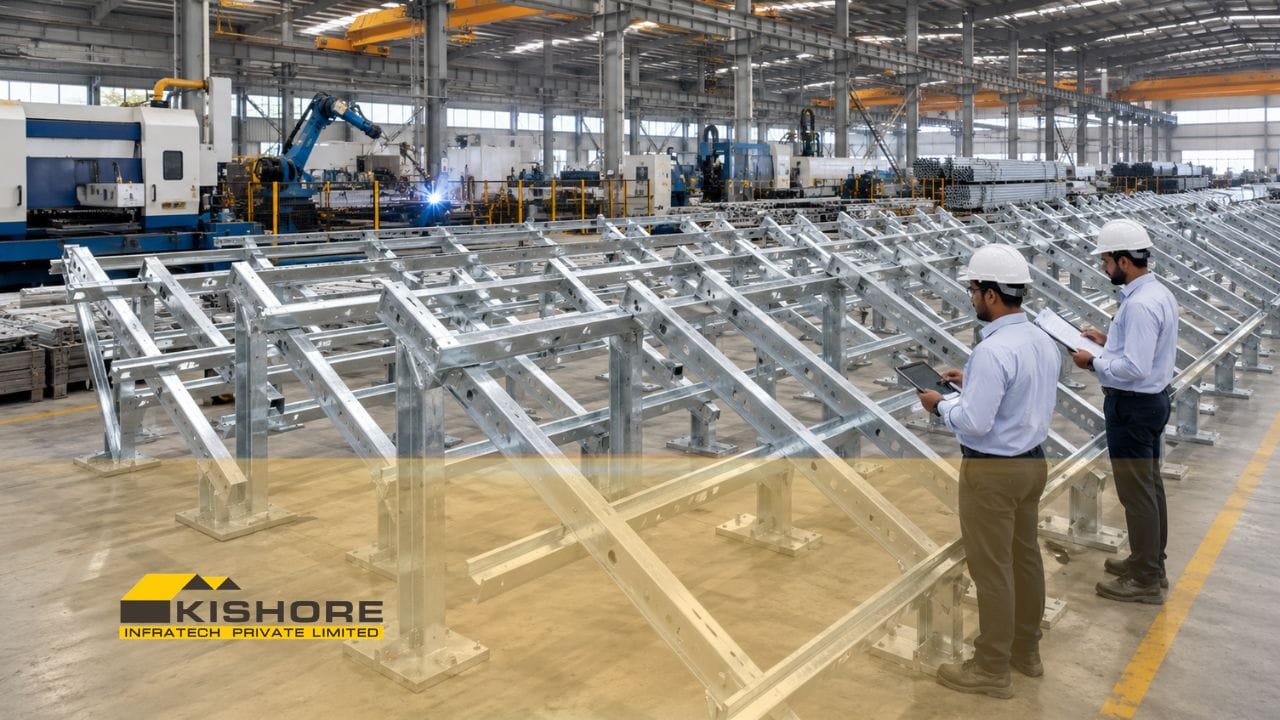
The section is only as good as its connections, and the connections are only as good as the fabrication discipline behind them. Look for an ISO 9001:2015 certified manufacturer with documented quality processes for coil inspection, roll-forming tolerances, welding, and galvanizing. Four connection details define a reliable solar mounting structure: the Z-to-Z lap over each rafter (bolted through the webs to develop continuity), the C-and-Z junction where the C-purlin rail crosses the Z rafter, the end and mid clamps that grip the module frames on the C-purlin flange, and the base plate that anchors the column foot to an RCC pedestal sized for uplift and overturning.
Each of these joints is a place a poorly fabricated structure fails first. Welds must be sound and then protected — ideally hot-dip galvanized after welding so the heat-affected zone is coated — and every bolt should be galvanized or stainless to avoid bimetallic corrosion at the joint. A manufacturer with 45+ years of steel fabrication behind them treats cleats, lap lengths, bolt counts, and base-plate details as engineered items, not afterthoughts.
Key takeaway: Connection detailing — not just section choice — separates a 25-year structure from a 5-year one. Verify ISO 9001:2015 certification, sound and protected welds, engineered Z-to-Z laps and base plates, and galvanized or stainless fasteners throughout. Ask to see the standard connection drawings; a quality fabricator has them ready.
The Buyer’s Checklist: 12 Criteria to Evaluate a Manufacturer
Key takeaway: Use this 12-point checklist to score any solar mounting structure manufacturer in Hyderabad on a like-for-like basis. The “What to ask / verify” column turns each criterion into a concrete request — section schedules, certificates, drawings, and references — so you compare documented capability, not sales claims.
| Evaluation Criterion | What to Ask / Verify |
|---|---|
| 1. Section dimension range | Can they roll C purlins 80–300 mm and Z purlins 150–300 mm, flange 40–65 mm, lip 10–25 mm? Ask for the section schedule. |
| 2. Steel grade & thickness | Stated steel grade and gauge (1.2–3 mm); thicker (2–3 mm) for ground-mount rafters. Ask for the mill test certificate. |
| 3. Galvanizing grade & certificate | GSM (80/120/275, IS 277) or microns (IS 4759) stated in writing; demand the GI mill or galvanizing thickness certificate. |
| 4. Structural design support | Do they issue a project-specific design with load and deflection basis? Ask for a sample design or calculation summary. |
| 5. Wind-zone / IS 875 compliance | Can they design to your site’s wind zone and terrain per IS 875 Part 3, including uplift reversal on tilted arrays? |
| 6. MNRE / spec alignment | Will the structure follow your customer specification or align with MNRE standard solar structure designs? Get it in writing. |
| 7. Fastener specification | Galvanized or stainless bolts and clamps to avoid bimetallic corrosion; confirm fastener grade and coating. |
| 8. BOM transparency | Itemised bill of materials — section sizes, weights, coating, fasteners, clamps — not a single lump-sum line. |
| 9. Delivery lead time | Committed dispatch schedule in writing; a Hyderabad base typically shortens lead time and freight for South India. |
| 10. Site & erection support | Drawings, marking, and erection guidance; ability to support sites across Telangana, AP, Karnataka, Tamil Nadu, Odisha. |
| 11. Warranty terms | Written warranty tied to the galvanizing grade and design life; clarify what is and is not covered. |
| 12. References & track record | Years in steel fabrication, number of completed projects, and reachable references for similar solar work. |
Questions to Ask Before Ordering
Key takeaway: The fastest way to separate a real solar mounting structure manufacturer from a steel trader is to ask a few pointed technical questions and listen for specific, documented answers. Vague replies (“we use good steel and standard galvanizing”) are themselves the answer.
| Question to Ask | Why It Matters | A Good Answer Sounds Like |
|---|---|---|
| What exact section sizes and thickness will you supply? | Thin or under-sized sections fail strength and deflection checks. | “C 100 mm x 1.5 mm rails, Z 250 mm x 2.5 mm lapped rafters, here is the schedule.” |
| Is the coating GSM or microns, and can I see the certificate? | Coating governs corrosion life; the unit reveals the process used. | “275 GSM GI per IS 277 for rooftop, 80-micron HDG per IS 4759 for ground mount; certificate attached.” |
| What wind zone and design loads will you use? | Confirms the design is site-specific, not a generic reused layout. | “Your site is wind zone X at 44 m/s, terrain category 2; we design for uplift reversal per IS 875 Part 3.” |
| Will you issue a project-specific structural design? | A design ties the steel to your panels, tilt, and spans. | “Yes — to your specification or aligned with MNRE standard designs, with a calculation summary.” |
| Can I see an itemised BOM and quotation? | Transparency lets you compare quotes like for like and spot shortcuts. | “Here is the line-by-line BOM: sections, weights, coating, clamps, fasteners.” |
| What is your lead time and how do you handle delivery? | Lead time and freight affect project cost and schedule risk. | “From our Hyderabad / Jeedimetla plant, dispatch in X weeks; we deliver across South India.” |
| What warranty and after-sales support do you offer? | Accountability after dispatch is part of the purchase, not an extra. | “Written warranty tied to the galvanizing grade, with drawings and erection support.” |
Application Coverage: Rooftop, Ground-Mount, Agri/Pump & Carport
Key takeaway: A capable Hyderabad manufacturer should supply structures for the full range of solar applications — not just one — because each uses a different mix of C and Z sections and galvanizing grades. The table below maps the four common application types to the section approach and the typical coating.
| Application | Section Approach | Typical Coating |
|---|---|---|
| Rooftop / sheet mounting | C-purlin rails on short spans, bolted to existing roof purlins with cleats | 120–275 GSM GI (inland); HDG near coast |
| Ground-mount tables | Lapped Z-purlin rafters spanning columns + C-purlin module rails | Hot-dip galvanized posts & rafters (~70–86 microns) |
| Agri / solar-pump structures | C-purlin single-span members, small panel count, easy site assembly | GI or HDG per local exposure |
| Solar carport | Deeper Z rafters for clear span over vehicles + C module rails | Hot-dip galvanized for exposed long-life service |
Geo & Service Area: Hyderabad Base, South India Reach
Hyderabad is a strong sourcing base for solar mounting structures because it combines a mature steel-fabrication ecosystem with central access to the South Indian solar market. A manufacturer based in Jeedimetla, Hyderabad — one of the city’s established industrial belts — can roll, fabricate, and galvanize sections in-house and dispatch them across Telangana (Hyderabad, Warangal, Karimnagar, Nizamabad), Andhra Pradesh (Vijayawada, Visakhapatnam, Tirupati, Kurnool), Karnataka (Bengaluru, Hubballi), Tamil Nadu (Chennai, Coimbatore), and Odisha (Bhubaneswar, Cuttack) with manageable freight and lead time.
Key takeaway: Sourcing locally in Hyderabad versus from a distant supplier is not just convenience — it changes lead time, freight cost, and site support. Compared with shipping galvanized sections 1,000+ km from a North or West India supplier, a Hyderabad / Jeedimetla manufacturer typically offers shorter dispatch times, lower per-tonne freight to South Indian sites, easier coordination on drawings and revisions, and the ability to send people to site when a connection detail or erection query comes up. For Telangana and neighbouring-state projects, that local proximity often outweighs a marginally lower ex-works quote from far away, because freight and delay can erase the saving.
When you compare a solar structure supplier in Telangana against an out-of-region manufacturer, weigh the delivered cost and total schedule, not just the section price: a local supplier’s quote already reflects realistic freight to your site, whereas a distant supplier’s low ex-works price can balloon once long-haul transport, damage risk in transit, and slower issue resolution are added.
Red Flags to Avoid
Key takeaway: Most disappointing solar mounting structure purchases trace back to a handful of warning signs that are visible before you order. If you see several of these, walk away — the cost of a failed structure dwarfs any first-price saving.
- “Galvanized” with no number: a manufacturer who will not state GSM or microns, or cannot produce a coating certificate, is hiding the corrosion life of the structure.
- One generic design for every site: reusing a single layout regardless of your wind zone, panel, tilt, or terrain means no real IS 875 Part 3 design behind it.
- No itemised BOM: a single lump-sum quote with no section sizes, weights, or coating makes it impossible to compare like for like — and easy to substitute thinner steel.
- Vague or missing certificates: no mill test certificate for the steel and no galvanizing report is a sign of undocumented or unverified material.
- Mixed or bare fasteners: non-galvanized bolts on galvanized sections trigger bimetallic corrosion at every joint within a few monsoons.
- No track record or references: unwillingness to share years of experience, completed-project count, or contactable references for similar solar work.
- Price far below the rest: a quote dramatically under every other manufacturer almost always means thinner gauge, lighter coating, or undocumented steel.
Sourcing a Solar Mounting Structure in Hyderabad?
Get a Free Design & Quotation.
Share your requirement — our engineers call you back within 24 hours with C & Z purlin section sizing, galvanizing recommendation, and a transparent quotation for your rooftop or ground-mount project.
- C & Z purlin cold-formed sections (80–300 mm, 1.2–3 mm)
- Hot-dip galvanized & GI (80 / 120 / 275 GSM) finishes with certificates
- Rooftop, ground-mount, agri / pump & carport structures
- Wind-zone & MNRE-aligned structural design
- 45+ years steel fabrication, 700+ projects across South India
Prefer to speak directly? Call 9440407852
Thank You!
Our engineers will call you back shortly with your free solar mounting structure design and quotation.
Want a faster response?
📱 Chat with us on WhatsAppWhy KIPL for Solar Mounting Structures
Kishore Infratech Private Limited (KIPL), an ISO 9001:2015 certified PEB manufacturer headquartered in Hyderabad, Telangana, with 45+ years of steel fabrication experience and 700+ completed projects, manufactures and supplies galvanized C and Z purlin cold-formed sections and complete solar mounting structures for rooftop and ground-mount projects. From our manufacturing base in Jeedimetla, Hyderabad, we roll, fabricate, and galvanize sections in-house and serve solar EPCs and developers across South India — designing each structure to customer specifications or aligning it with MNRE standard designs, with the section sizing, galvanizing grade, and connection details matched to the panel, wind zone, and corrosion category of the site. To discuss your project, call our team on 9440407852, 8179281916, or 8179281917.
- Cold-formed C purlins (web 80–300 mm) and Z purlins (web 150–300 mm), flange 40–65 mm, lip 10–25 mm, thickness 1.2–3 mm
- Galvanizing options: 80, 120 and 275 GSM pre-galvanized (GI) and hot-dip galvanized finishes per site corrosion category, with certificates
- MS fabricated + galvanized and GI cold-form structures for high strength and long service life
- Rooftop mounting, direct-to-roof / sheet mounting, ground-mount tables, agri / solar-pump structures, and carports
- Engineered connections — Z-to-Z laps, C & Z junctions, end-clamp seating, and anchored base plates
- Structural design to IS 875 Part 3 wind zones — to customer specifications or aligned with MNRE standard designs
- Transparent itemised BOM and quotation, with delivery and erection support across Telangana, AP, Karnataka, Tamil Nadu and Odisha
- Manufacturing base in Jeedimetla, Hyderabad, with 45+ years of fabrication experience and 700+ completed projects
Frequently Asked Questions
Who manufactures solar mounting structures in Hyderabad?
Kishore Infratech Private Limited (KIPL), based in Jeedimetla, Hyderabad, manufactures galvanized C and Z purlin cold-formed sections and complete solar mounting structures for rooftop and ground-mount projects across South India. KIPL is ISO 9001:2015 certified with 45+ years of steel fabrication experience and 700+ completed projects, and supplies structures designed to customer specifications or aligned with MNRE standard designs.
How do I choose a solar mounting structure manufacturer in Hyderabad?
Evaluate manufacturers on five things, not price alone: section quality (C and Z purlin gauge and dimensions), galvanizing grade with a certificate, structural design capability to IS 875 Part 3 wind zones, fabrication quality with ISO 9001:2015 and sound connection detailing, and local service from a Hyderabad base. Always ask for an itemised bill of materials, a galvanizing certificate, and a project-specific design before ordering.
What galvanizing should I ask a solar structure supplier for?
Ask for the coating in the correct unit: pre-galvanized GI is rated in GSM (80, 120 or 275 GSM per IS 277) and suits rooftop rails in inland climates, while hot-dip galvanizing is rated in microns (roughly 65 to 86 microns per IS 4759) and is recommended for ground-mount posts, rafters, and coastal sites. Always demand a mill GI certificate or a galvanizing thickness report for the actual batch.
Should I buy C purlin or Z purlin sections for my solar project?
C purlins are mono-symmetric channels best used as module-mounting rails and short single-span members, while Z purlins are point-symmetric and can lap at supports to act as continuous rafters spanning multiple columns. Most efficient ground-mount tables use both: lapped Z rafters carrying the span and C purlins as the module rails bolted across them.
What C and Z purlin sizes do solar mounting structures use?
Typical C purlins have a web depth of 80 to 300 mm and Z purlins 150 to 300 mm, both with flanges of 40 to 65 mm, lips of 10 to 25 mm, and thickness of 1.2 to 3 mm. Lighter 1.2 to 1.5 mm sections suit rooftop rails, while 2 to 3 mm sections are used for ground-mount rafters and high-wind sites.
Does the manufacturer need to design for my wind zone?
Yes. Solar mounting structures must be designed to IS 875 Part 3 using your site’s basic wind speed (33 to 55 m/s by zone), terrain category, and the array’s tilt and height, and they must account for wind uplift reversal on tilted arrays. A manufacturer who cannot state your wind zone or show a load-and-deflection basis is supplying steel, not a designed structure.
Can a Hyderabad manufacturer supply MNRE-aligned solar structures?
Yes. Solar mounting structures can be fabricated to your customer specification or aligned with MNRE standard solar structure designs. KIPL supplies C and Z purlin cold-formed sections and complete structures designed to the project’s panel type, wind zone, and corrosion category, matching either your engineering schedule or the applicable MNRE standard layout.
What is the lead time for a solar mounting structure from Hyderabad?
Lead time depends on project size, section schedule, and galvanizing route, and a committed dispatch schedule should be given in writing. Sourcing from a Hyderabad or Jeedimetla base typically shortens lead time and freight for sites across Telangana, Andhra Pradesh, Karnataka, Tamil Nadu, and Odisha compared with shipping sections from a distant North or West India supplier.
How is the price of a solar mounting structure decided?
Price depends on the total steel tonnage (section sizes and thickness), the galvanizing route (GI GSM versus hot-dip microns), fasteners and clamps, structural design, and delivered freight to your site. Compare quotes on a like-for-like specification using an itemised bill of materials rather than a single lump-sum figure, since a low price often reflects thinner gauge or lighter coating.
Is it better to buy locally in Hyderabad or from a distant supplier?
A local Hyderabad supplier usually offers shorter lead time, lower freight to South Indian sites, easier coordination on drawings and revisions, and the ability to support the site directly. A distant supplier’s low ex-works price can be erased by long-haul freight, transit damage risk, and slower issue resolution, so compare delivered cost and total schedule, not just the section price.
Do rooftop and ground-mount projects need different structures?
Yes. Rooftop solar typically uses C-purlin rails on short spans bolted to existing roof purlins, while ground-mount tables use lapped Z-purlin rafters spanning columns with C-purlin module rails. Ground-mount posts and rafters generally need hot-dip galvanizing for ground-level corrosion protection, whereas inland rooftop rails are often supplied in 120 to 275 GSM GI.
What certificates should I demand from a solar structure manufacturer?
Ask for the steel mill test certificate confirming grade and gauge, the GI mill certificate or hot-dip galvanizing thickness report confirming the coating, and confirmation of ISO 9001:2015 certification. Together with an itemised bill of materials and a project-specific structural design, these documents let you verify the structure you are paying for.
Which areas does a Hyderabad solar structure manufacturer serve?
A Hyderabad and Jeedimetla based manufacturer can serve solar projects across South India, including Telangana (Hyderabad, Warangal, Karimnagar), Andhra Pradesh (Vijayawada, Visakhapatnam, Tirupati), Karnataka (Bengaluru, Hubballi), Tamil Nadu (Chennai, Coimbatore), and Odisha (Bhubaneswar, Cuttack). Central access to the South Indian market keeps freight and lead time manageable.
What are the red flags when choosing a solar structure supplier?
Walk away from suppliers who state galvanizing without a number or certificate, reuse one generic design regardless of wind zone, refuse an itemised bill of materials, lack mill and galvanizing certificates, mix bare and galvanized fasteners, have no track record or references, or quote dramatically below everyone else. Each is a sign of thinner gauge, lighter coating, or undocumented steel.
Data methodology: The evaluation criteria, section dimension ranges, and coating guidance in this article are compiled from cold-formed steel design practice (IS 811 dimensions, IS 801 code of practice), galvanizing standards (IS 277 for pre-galvanized GI, IS 4759 for hot-dip galvanizing), wind-load code IS 875 Part 3, MNRE standard solar structure design references, and Kishore Infratech Private Limited’s solar mounting structure fabrication practice as of 2026 (45+ years steel fabrication, 700+ completed projects). All section sizes, coatings, lead times, and warranty terms are indicative reference values — final specification must be confirmed against a project-specific structural design and a written quotation.
Conclusion
Choosing among solar mounting structure manufacturers in Hyderabad comes down to verifying capability, not chasing the lowest quote. The structure that quietly carries your panels for 25 years is built from correctly gauged C and Z purlins, coated to the right galvanizing grade for the site, designed to your wind zone per IS 875 Part 3, and fabricated with sound welds and engineered connections under an ISO 9001:2015 system. Every one of those attributes is documentable — through section schedules, mill and galvanizing certificates, a project-specific design, and an itemised bill of materials — so a buyer who asks for the paperwork is already filtering out the suppliers most likely to disappoint.
Use the 12-point checklist and the questions table in this guide as your evaluation framework, and treat the red flags as deal-breakers: galvanizing with no number, one generic design for every site, no BOM, missing certificates, or a price far below the rest. For Telangana and wider South Indian projects, weigh a local Hyderabad solar structure supplier’s shorter lead time, lower freight, and real site support against a distant supplier’s headline ex-works price — the delivered cost and total schedule usually favour sourcing close to the project.
A manufacturer based in Jeedimetla, Hyderabad with decades of steel-fabrication experience can roll, galvanize, design, and deliver complete rooftop and ground-mount structures across the region while standing behind the specification in writing. That combination of technical depth and local proximity is what a buyer’s checklist is ultimately trying to find.
To source C & Z purlin solar mounting structures for your rooftop or ground-mount project in Hyderabad or anywhere across South India, contact Kishore Infratech Private Limited at 9440407852 or visit kishoreindustries.in.