
Getting sports court dimensions right is the single most unforgiving decision in indoor sports facility construction — a hall built even one metre short cannot be stretched later, and a federation inspector will not certify a court with inadequate run-off. This reference guide consolidates the official court dimensions, run-off (safety margin) requirements, and minimum ceiling heights for every major indoor sport played in India — badminton (BWF), basketball (FIBA), volleyball (FIVB), table tennis (ITTF), squash (WSF), tennis (ITF), padel (FIP), pickleball, futsal (FIFA) and cricket practice nets — plus the PEB hall sizes needed to house them.
Quick Answer: Standard sports court dimensions are: badminton 13.4 × 6.1 m (needs ~17.4 × 10.1 m with run-off, 9 m height), basketball 28 × 15 m (32 × 19 m total, 7 m height), volleyball 18 × 9 m (24 × 15 m total), padel 20 × 10 m enclosed (6 m height minimum), pickleball 13.41 × 6.10 m (18.3 × 9.1 m total), and futsal 40 × 20 m (4 m height minimum). A standard 4-court badminton multi-sport hall measures approximately 34.5 × 20 m with 7.6 m clear height — comfortably achievable as a single clear-span PEB structure.
Disclaimer: Dimensions below are compiled from published federation standards (BWF, FIBA, FIVB, ITTF, WSF, ITF, FIP, USA Pickleball, FIFA Futsal Laws) current as of 2026. Federations revise technical regulations periodically — always confirm against the latest official rulebook before building a court intended for sanctioned competition.
Master Reference Table: All Sports Court Dimensions at a Glance
Key takeaway: The court marking is never the space you need to build. Run-off zones add 20–60% to the footprint: a 13.4 × 6.1 m badminton court needs a 17.4 × 10.1 m obstruction-free envelope, and a 28 × 15 m basketball court needs 32 × 19 m. Ceiling height is the most common design failure — badminton needs 9 m and volleyball 7 m minimum, which many standard industrial sheds cannot provide.
| Sport (Federation) | Court Size (m) | Run-Off / Free Zone | Total Footprint (m) | Min Clear Height |
|---|---|---|---|---|
| Badminton (BWF) | 13.4 × 6.1 | 2.0 m ends & sides (rec.) | ~17.4 × 10.1 | 9 m intl. / 12 m majors / 7.6 m club |
| Basketball (FIBA) | 28 × 15 | 2.0 m all around | 32 × 19 | 7 m |
| Volleyball (FIVB) | 18 × 9 | 3 m min. (5–8 m FIVB world events) | 24 × 15 min. | 7 m (12.5 m FIVB world) |
| Table Tennis (ITTF) | Table 2.74 × 1.525 | Playing space per table | 14 × 7 (intl.) / 9 × 4.5 (club) | 5 m intl. / 3.5 m club |
| Squash (WSF) | 9.75 × 6.4 (internal) | Fully enclosed court | 9.75 × 6.4 + access | 5.64 m |
| Tennis (ITF) | 23.77 × 10.97 | 6.4 m back / 3.66 m side (club min.) | 36.6 × 18.3 | ~9.1 m at net (indoor rec.) |
| Padel (FIP) | 20 × 10 (enclosed) | Enclosed — 4 m walls | 20 × 10 + access | 6 m min. / 8 m rec. |
| Pickleball (USA Pickleball) | 13.41 × 6.10 | To 30 × 60 ft envelope min. | 18.3 × 9.1 min. / 19.5 × 10.4 pref. | 5.5–6.1 m rec. |
| Futsal (FIFA) | 40 × 20 (intl.) | 1–2 m to barriers | ~44 × 24 | 4 m |
| Cricket Practice Nets (indoor) | Pitch 20.12; lane 3.66 wide | Bowler run-up behind crease | ~30 × 3.66 per lane | 6 m+ rec. |
In prose terms: a badminton court measures 13.4 m long by 6.1 m wide but requires roughly a 17.4 × 10.1 m envelope, while a FIBA basketball court is more than four times larger at 28 × 15 m with a 32 × 19 m envelope. Padel (20 × 10 m) and pickleball (13.41 × 6.10 m) — India’s two fastest-growing racquet sports — are among the most space-efficient courts you can build, which is a big part of why they are booming commercially.
Badminton Court Dimensions (BWF)
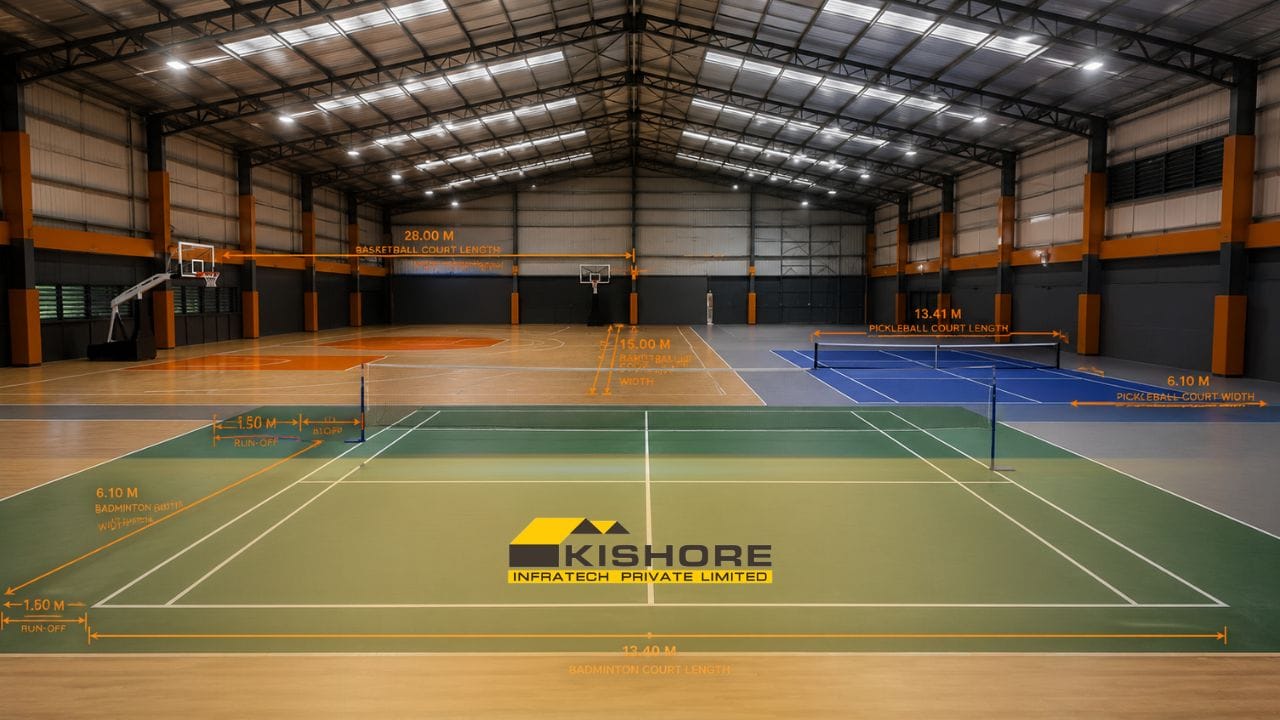
Key takeaway: A badminton court is 13.4 × 6.1 m for doubles (5.18 m wide for singles) — exactly 44 × 20 ft. BWF requires 12 m clear height for major championships, 9 m for international events, while club and academy play typically works at 7.6 m. Recommended run-off is 2 m from any wall and 2 m between adjacent courts.
| Parameter | Metric | Feet |
|---|---|---|
| Court length | 13.4 m | 44 ft |
| Court width (doubles) | 6.1 m | 20 ft |
| Court width (singles) | 5.18 m | 17 ft |
| Net height (centre / posts) | 1.524 m / 1.55 m | 5 ft / 5 ft 1 in |
| Run-off to walls (recommended) | 2.0 m | 6.6 ft |
| Gap between adjacent courts | 2.0 m | 6.6 ft |
| Total envelope per court | ~17.4 × 10.1 m | ~57 × 33 ft |
| Clear height — club / academy | 7.6 m | 25 ft |
| Clear height — international | 9 m | 29.5 ft |
| Clear height — BWF major events | 12 m | 39 ft |
Height is measured to the lowest obstruction — a light fixture, purlin, cable tray, or ceiling fan hanging below the roof line defines your effective clear height, not the roof sheeting. This is why lighting layout must be designed together with the structure; see our detailed guide on lux level standards for indoor sports arenas (BIS, BWF, FIBA requirements).
Basketball Court Dimensions (FIBA)
Key takeaway: A FIBA basketball court is 28 × 15 m with a mandatory 2 m obstruction-free zone on all sides — a 32 × 19 m total envelope — and 7 m minimum clear height over the playing surface. The backboard overhangs 1.2 m into the court from the endline, and rim height is 3.05 m worldwide.
| Parameter | FIBA Standard | Recreational / 3×3 |
|---|---|---|
| Court size | 28 × 15 m | 3×3: 15 × 11 m |
| Run-off (all sides) | 2 m minimum | 1.5–2 m |
| Total envelope | 32 × 19 m | ~18 × 14 m |
| Rim height | 3.05 m | 3.05 m |
| Backboard overhang into court | 1.2 m from endline | 1.2 m |
| Minimum clear height | 7 m | 6.1 m (20 ft) |
Volleyball Court Dimensions (FIVB)
Key takeaway: A volleyball court is 18 × 9 m with a minimum 3 m free zone on all sides (24 × 15 m envelope) for national play. FIVB world and official competitions demand far more: 5 m from sidelines, 8 m behind end lines, and 12.5 m of clear height. Net height is 2.43 m for men and 2.24 m for women.
| Parameter | National / Club | FIVB World / Official |
|---|---|---|
| Court size | 18 × 9 m | 18 × 9 m |
| Free zone — sidelines | 3 m min. | 5 m min. |
| Free zone — end lines | 3 m min. | 8 m min. |
| Total envelope | 24 × 15 m | 34 × 19 m |
| Net height (men / women) | 2.43 m / 2.24 m | 2.43 m / 2.24 m |
| Minimum clear height | 7 m | 12.5 m |
Table Tennis Playing Space (ITTF)
Key takeaway: The table is only 2.74 × 1.525 m, but ITTF international events require a 14 × 7 m playing space per table with 5 m clear height. Club and recreational play works in roughly 9 × 4.5 m per table at 3.5 m height — meaning a modest 20 × 15 m PEB hall can host 6–8 recreational tables but only 2 international-standard show courts.
| Level of Play | Playing Space per Table | Min Height |
|---|---|---|
| International / World events | 14 × 7 m | 5 m |
| National tournaments | 12 × 6 m | 4 m |
| Club / district | 10 × 5 m | 3.5 m |
| Recreational minimum | 9 × 4.5 m | 3 m |
Squash Court Dimensions (WSF)
Key takeaway: A WSF singles squash court is exactly 9.75 × 6.4 m internally with a minimum clear height of 5.64 m to the lowest obstruction. The front wall out-line sits at 4.57 m, descending to 2.13 m on the back wall. Because the court is a sealed plaster-and-glass box, wall flatness tolerance and climate control matter more than in any other indoor sport.
| Parameter | WSF Singles |
|---|---|
| Internal length × width | 9.75 × 6.4 m |
| Front wall out-line height | 4.57 m |
| Back wall out-line height | 2.13 m |
| Tin (lower playing boundary) | 0.48 m (0.43 m pro events) |
| Minimum clear height | 5.64 m |
Tennis Court Dimensions (ITF)
Key takeaway: A doubles tennis court is 23.77 × 10.97 m, but run-off dominates the footprint: club play needs at least 6.4 m behind each baseline and 3.66 m at each side — a total of about 36.6 × 18.3 m (the classic 120 × 60 ft envelope). Indoor tennis is the most height-hungry racquet sport after badminton, needing roughly 9 m of clear height over the net for quality play.
| Parameter | Club Minimum | International Events |
|---|---|---|
| Court (doubles) | 23.77 × 10.97 m | 23.77 × 10.97 m |
| Run-back behind baseline | 5.5–6.4 m | 8.23 m |
| Side run-off | 3.05–3.66 m | 4.57 m |
| Total envelope | ~34.8 × 17.1 m | ~40.2 × 20.1 m |
| Indoor clear height at net | ~9.1 m recommended | 10.7–12.2 m |
Padel Court Dimensions (FIP)
Key takeaway: A padel court is 20 × 10 m, fully enclosed by 4 m high back walls (3 m tempered glass + 1 m steel mesh) with a minimum 6 m clear height over the entire court — 8 m recommended for new indoor builds. Because the glass walls are structural playing surfaces, wind load and impact engineering are critical for covered courts.
We’ve published a full construction deep-dive on this sport — glass-wall load engineering, surfacing systems, and PEB roofing options — in our guide to padel and pickleball court construction in India.
Pickleball Court Dimensions
Key takeaway: A pickleball court is 13.41 × 6.10 m (44 × 20 ft) — identical in footprint to a badminton court — with a 2.13 m non-volley zone (“kitchen”) on each side of the net. Minimum total playing envelope is 9.14 × 18.29 m (30 × 60 ft); tournament-preferred is 10.36 × 19.51 m (34 × 64 ft). This footprint equivalence means existing badminton halls convert to pickleball with nothing more than resurfacing and new nets.
| Parameter | Metric | Feet |
|---|---|---|
| Court size (singles & doubles) | 13.41 × 6.10 m | 44 × 20 ft |
| Non-volley zone (each side) | 2.13 m | 7 ft |
| Net height (centre / posts) | 0.86 m / 0.91 m | 34 in / 36 in |
| Minimum total envelope | 18.29 × 9.14 m | 60 × 30 ft |
| Tournament-preferred envelope | 19.51 × 10.36 m | 64 × 34 ft |
| Recommended indoor clear height | 5.5–6.1 m | 18–20 ft |
Futsal & Indoor Cricket Practice Nets
Key takeaway: An international futsal pitch is 40 × 20 m (national minimum 25 × 16 m) with only 4 m minimum clear height, making futsal one of the easiest large-format sports to house in a PEB. Indoor cricket practice lanes need a 20.12 m pitch plus bowler run-up — plan roughly 30 m × 3.66 m per lane at 6 m+ clear height; there is no single federation standard for India’s popular commercial “box cricket” format, which typically runs 27–37 m long × 12–18 m wide.
| Format | Playing Area | Min Height |
|---|---|---|
| Futsal — international (FIFA) | 40 × 20 m | 4 m |
| Futsal — national minimum | 25 × 16 m | 4 m |
| Cricket practice lane (indoor) | ~30 × 3.66 m per lane | 6 m+ rec. |
| Box cricket (commercial, non-federation) | 27–37 × 12–18 m typical | 7.5–9 m netting |
Run-Off Zones: The 5 Rules Facility Planners Get Wrong
Key takeaway: Run-off is a safety zone, not spare floor — it must be free of columns, door swings, seating, equipment, and even floor-level changes. Adjacent courts may share a run-off corridor (two badminton courts need 2 m between them, not 2 m each), which is why efficient multi-court layouts save 15–20% of floor area versus naive per-court math.
- Obstruction-free means everything: columns, radiators, fire extinguishers, protruding door handles, and divider-net winch posts all violate run-off. In a clear-span PEB there are no internal columns to manage — this is the core structural argument for PEB sports halls.
- Shared run-off between courts is allowed: the gap between two parallel badminton courts is 2 m total, serving both courts. Plan court batteries, not isolated courts.
- Walls in run-off zones need impact padding behind basketball baselines and futsal goals — NBC 2016 and federation guidance both expect energy-absorbing padding where the envelope meets a wall.
- Floor surface must continue through the run-off: the sports floor system (and its shock absorption class) extends to the full envelope, not just the marked court.
- Height applies over the whole envelope, not just the court — a roof haunch or lighting truss dipping into the run-off zone still fails inspection for sanctioned events.
Ceiling Height Comparison: Which Sports Fit Under Which Roof
Key takeaway: Clear height is the cheapest thing to get right on day one and the most expensive thing to fix later. At 4 m you can play futsal and recreational table tennis; at 7 m you add basketball and club volleyball; at 9 m you unlock competitive badminton and tennis; only at 12+ m do you satisfy BWF majors and FIVB world events.
| Clear Height Built | Sports Enabled (Competition-Legal) |
|---|---|
| 4 m | Futsal, recreational table tennis, gym/fitness zones |
| 5.64 m | + Squash, national table tennis, recreational pickleball |
| 6–6.5 m | + Padel (FIP minimum), tournament pickleball, cricket nets |
| 7 m | + FIBA basketball, national volleyball |
| 7.6 m | + Club/academy badminton (standard multi-sport hall spec) |
| 9 m | + International badminton, quality indoor tennis, padel (recommended) |
| 12–12.5 m | + BWF major championships, FIVB world/official volleyball, broadcast arenas |
PEB Hall Sizing: From Court Count to Steel Structure
Key takeaway: A 4-court badminton hall — the workhorse of Indian sports academies — needs approximately 34.5 × 20 m at 7.6–9 m clear height, which a PEB delivers as a single 20 m clear-span frame with zero internal columns. Larger formats scale linearly: a 6-court hall runs ~34.5 × 29.5 m, and a FIBA show court with seating needs 40 m+ spans, all well within standard PEB capability.
| Facility Type | Hall Size (approx.) | Clear Height | PEB Clear Span |
|---|---|---|---|
| 2-court badminton / 2-court pickleball | 18.5 × 17.5 m | 7.6 m | 18–20 m |
| 4-court badminton multi-sport hall | 34.5 × 20 m | 7.6–9 m | 20 m |
| 6-court badminton academy | 34.5 × 29.5 m | 9 m | 29.5–30 m |
| Twin padel courts (covered) | 22 × 24 m | 8 m | 24 m |
| Futsal / box cricket arena | 44 × 24 m | 7.5–9 m | 24 m |
| FIBA basketball show court + gallery seating | 45 × 32 m+ | 9–12.5 m | 32–45 m |
The structural logic is straightforward: every sport above demands column-free floor plates, and pre-engineered steel buildings deliver clear spans of 20–60 m as standard tapered-frame designs per IS 800. Eave height is a simple frame parameter — building 9 m instead of 7.6 m adds marginal steel tonnage, while retrofitting height into an existing hall is effectively impossible. For how such a building comes together on site, see our step-by-step PEB erection process guide and typical PEB construction timelines.
Planning a Sports Facility?
Get a Free PEB Design & Quotation.
Share your requirement — our engineers call you back within 24 hours with a court-ready clear-span hall design sized to federation standards.
- Clear-span PEB halls from 18 m to 60 m — zero internal columns
- Court layouts & run-off planning to BWF / FIBA / FIP standards
- Eave heights engineered for badminton, padel & basketball
- Lighting, ventilation & flooring-ready structural detailing
- 45+ years steel fabrication, 700+ projects delivered
Prefer to speak directly? Call 9440407852
Thank You!
Our PEB engineers will call you back shortly with your free sports hall proposal and quotation.
Want a faster response?
📱 Chat with us on WhatsAppWhy Build Your Sports Facility with KIPL
Kishore Infratech Private Limited (KIPL), an ISO 9001:2015 certified PEB manufacturer headquartered in Hyderabad, Telangana, with 45+ years of steel fabrication experience and 700+ completed projects, engineers clear-span sports halls where the dimensions in this guide are baked into the structural design from day one — span, eave height, purlin layout, and lighting mounting zones are all sized around the courts you intend to run, not adapted afterwards.
Based on our experience delivering industrial and commercial clear-span structures across South India, the projects that succeed are the ones where court geometry drives the steel design — not the other way around. Compared to conventional RCC construction, a PEB sports hall reaches a 20 m column-free span with lighter foundations, faster erection, and an eave height that can be specified to the exact federation requirement at marginal extra cost.
- Clear spans of 18–60 m as standard tapered-frame designs per IS 800
- Eave heights engineered to 7.6 m, 9 m, or 12 m per target sport level
- Wind and seismic design per IS 875 Part 3 and IS 1893 for tall halls
- Purlin and truss layouts coordinated with court-aligned lighting rows
- Translucent roof sheeting options for daylighting without court glare
- Mezzanine galleries, canteens, and admin blocks integrated in the same structure
What are the standard badminton court dimensions in meters?
A badminton court is 13.4 m long and 6.1 m wide for doubles (5.18 m wide for singles) — exactly 44 × 20 ft. With the recommended 2 m run-off on all sides, the total obstruction-free envelope per court is approximately 17.4 × 10.1 m.
What is the minimum ceiling height for an indoor badminton court?
Club and academy badminton typically requires 7.6 m (25 ft) clear height, BWF international events require 9 m, and BWF major championships require 12 m. Height is measured to the lowest obstruction — lights, purlins, or cable trays — not the roof sheeting.
What are FIBA basketball court dimensions including run-off?
A FIBA basketball court is 28 × 15 m with a minimum 2 m obstruction-free run-off on all sides, giving a total envelope of 32 × 19 m. Minimum clear height is 7 m and rim height is 3.05 m.
How much free space is needed around a volleyball court?
A volleyball court is 18 × 9 m and needs a minimum 3 m free zone on all sides for national play — a 24 × 15 m total envelope. FIVB world and official competitions require 5 m from the sidelines, 8 m behind the end lines, and 12.5 m clear height.
What are padel court dimensions in India?
A padel court is 20 × 10 m, enclosed by 4 m high back walls (3 m tempered glass plus 1 m steel mesh). FIP requires a minimum 6 m clear height over the whole court, with 8 m recommended for new covered courts in India.
What is the total space needed for a pickleball court?
The pickleball court itself is 13.41 × 6.10 m (44 × 20 ft), but the minimum total playing envelope is 18.29 × 9.14 m (60 × 30 ft), with 19.51 × 10.36 m (64 × 34 ft) preferred for tournaments. Recommended indoor clear height is 5.5–6.1 m.
Is a pickleball court the same size as a badminton court?
Yes — both are exactly 44 × 20 ft (13.4 × 6.1 m). This means an existing badminton hall can convert to pickleball with only resurfacing and new nets at 0.91 m post height, which is why many Indian badminton academies now run dual-sport programming.
What size PEB shed is needed for a 4-court badminton academy?
A 4-court badminton hall needs approximately 34.5 × 20 m of floor area at 7.6–9 m clear eave height. As a PEB this is a single 20 m clear-span structure of about 7,400 sq ft with no internal columns interrupting courts or run-off zones.
What is the minimum height for an indoor futsal court?
FIFA futsal laws require a minimum 4 m clear height, the lowest of any major indoor sport. An international futsal pitch is 40 × 20 m, while the national-level minimum pitch is 25 × 16 m, making futsal well suited to converted industrial PEB sheds.
What are squash court dimensions as per WSF?
A WSF singles squash court measures 9.75 × 6.4 m internally with a minimum 5.64 m clear height. The front wall out-line is at 4.57 m, the back wall out-line at 2.13 m, and the tin at 0.48 m (0.43 m for professional events).
How long should an indoor cricket practice lane be?
An indoor cricket practice lane should be about 30 m long — a 20.12 m pitch plus bowler run-up — and 3.66 m (12 ft) wide per lane, with 6 m or more of clear height. Commercial box cricket arenas in India typically run 27–37 m long by 12–18 m wide with 7.5–9 m netting.
Can one hall host both basketball and badminton courts?
Yes — a standard 34.5 × 20 m multi-sport hall fits one recreational basketball court (28 × 15 m plus run-off) overlaid across four badminton courts, using different line colours per sport. The governing constraint is height: build 7.6–9 m so both sports remain competition-legal.
Why do sports halls need clear-span construction?
Federation rules require run-off zones to be completely obstruction-free, so internal columns anywhere in the court envelope fail inspection. Clear-span PEB frames deliver 20–60 m column-free widths per IS 800, which is why virtually all modern Indian sports halls are pre-engineered steel buildings.
Data methodology: Dimensional data compiled from published technical regulations of the BWF, FIBA, FIVB, ITTF, WSF, ITF, FIP, USA Pickleball, and the FIFA Futsal Laws of the Game, cross-referenced with Kishore Infratech Private Limited’s clear-span PEB design practice across South India. Federation regulations are revised periodically — verify against the current official rulebook before constructing courts for sanctioned competition.
Conclusion
Every successful indoor sports facility starts with the same three numbers: court size, run-off envelope, and clear height. Get those right — 17.4 × 10.1 m per badminton court, 32 × 19 m for basketball, 20 × 10 m enclosed for padel, 6.1 × 13.4 m plus envelope for pickleball — and everything downstream, from flooring to lighting to certification, falls into place. Get them wrong and no amount of finishing budget can rescue the building.
Bookmark this page as your working reference, and when you’re ready to move from sports court dimensions on paper to steel on site, bring us the sports you want to host — we’ll engineer the clear span, eave height, and structure around them.
Planning a sports hall, academy, or arena? Call Kishore Infratech at 9440407852 or visit kishoreindustries.in for a free consultation and court-ready PEB design proposal.