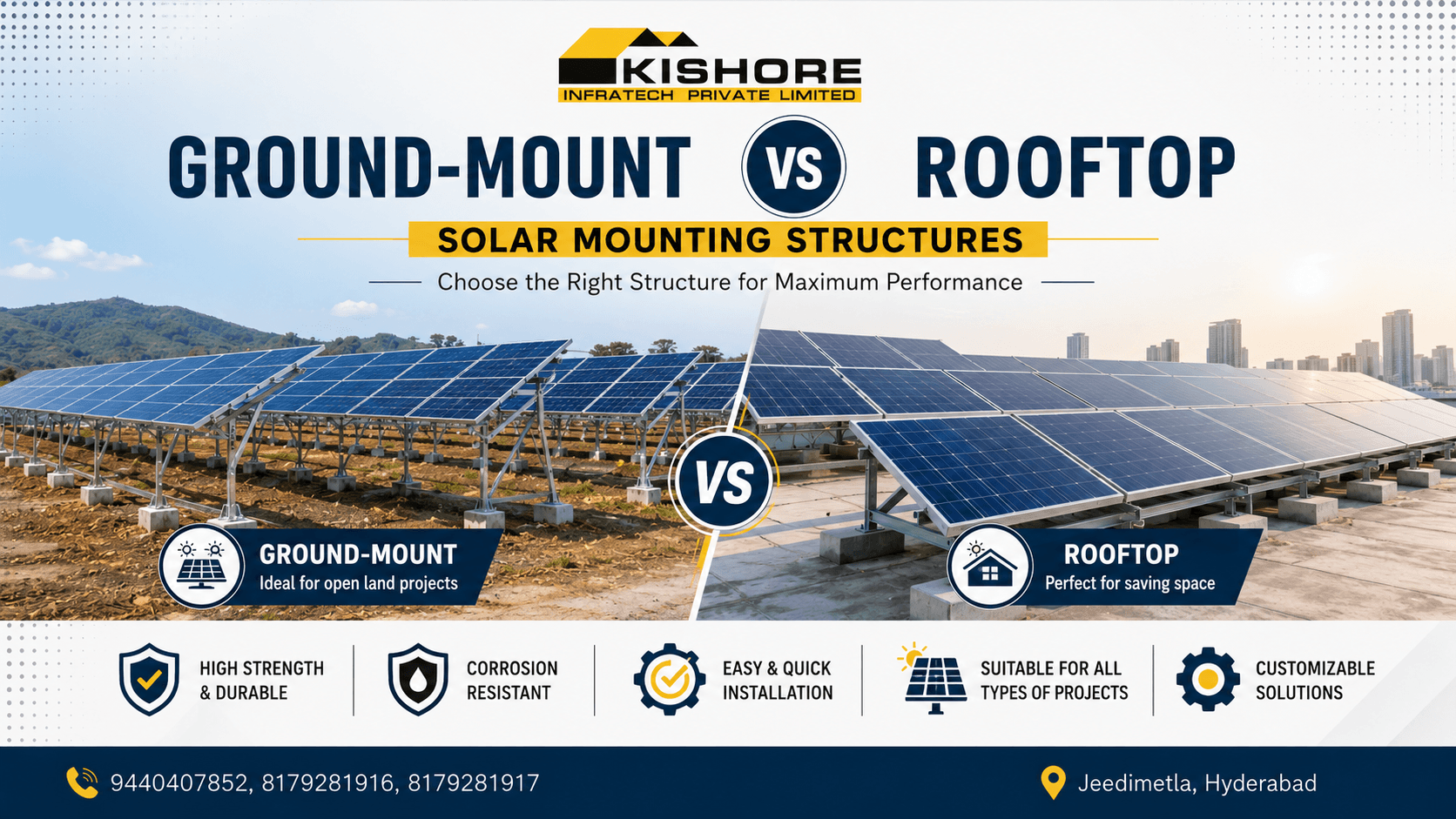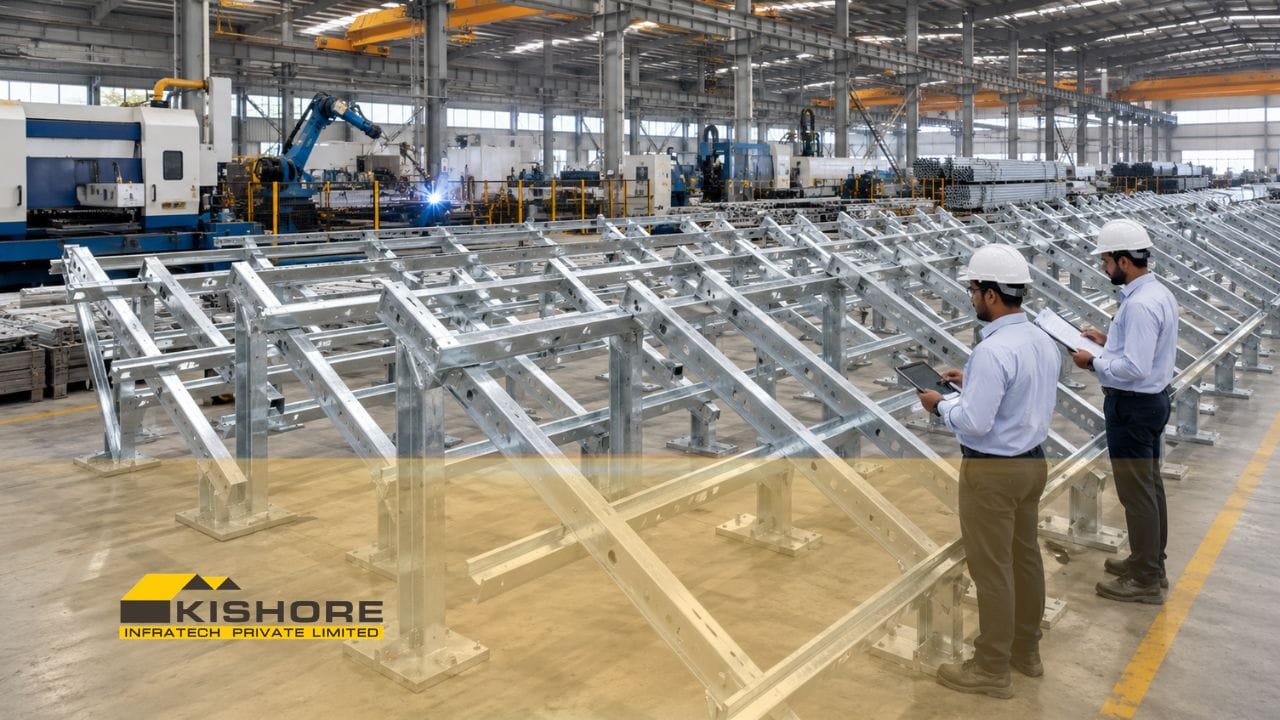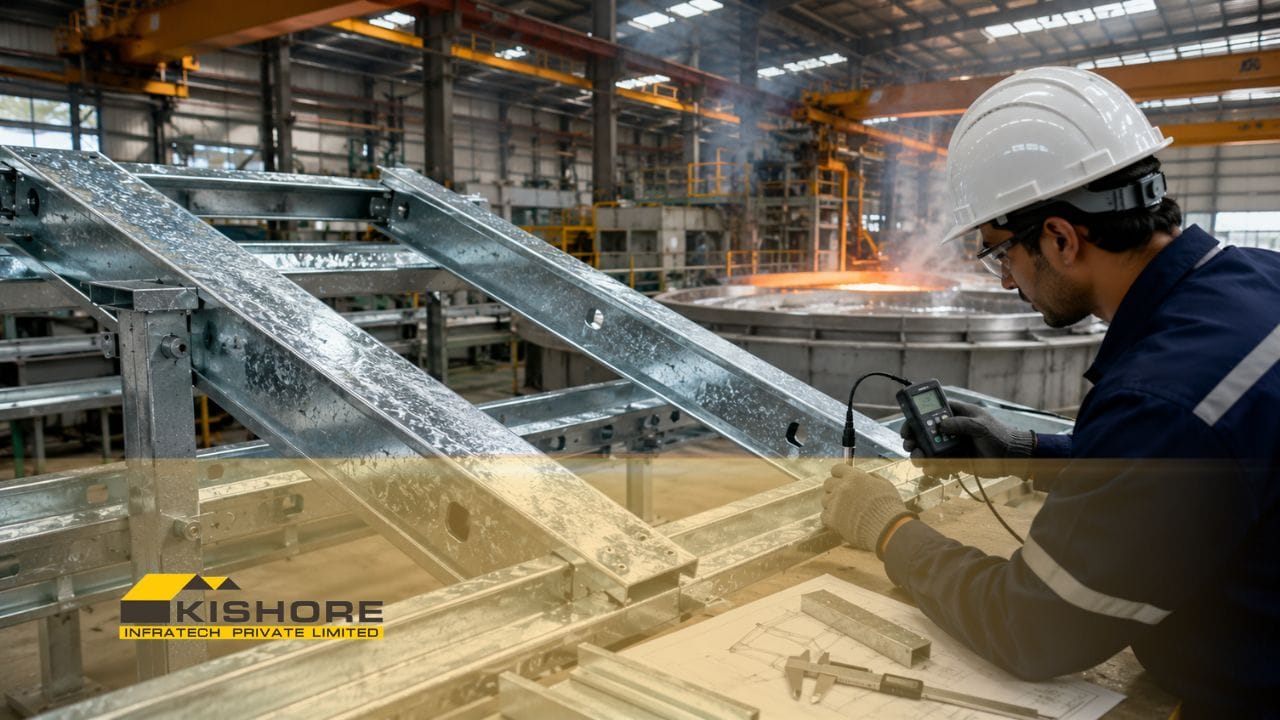

Choosing between a C purlin vs Z purlin is the single most important section-design decision in any solar mounting structure — it determines how far the structure can span, how much wind and module load it carries, how the members connect at rafters and supports, and how long the galvanized steel survives in the field. This masterclass breaks down the structural engineering behind C-section and Z-section cold-formed purlins specifically for rooftop and ground-mount solar projects: cross-section geometry, symmetry and torsion behaviour, lapping and continuous-span capacity, dimension ranges, galvanizing grades, load and deflection design, connection detailing, and a clear selection framework for module-mounting rails versus rafters.
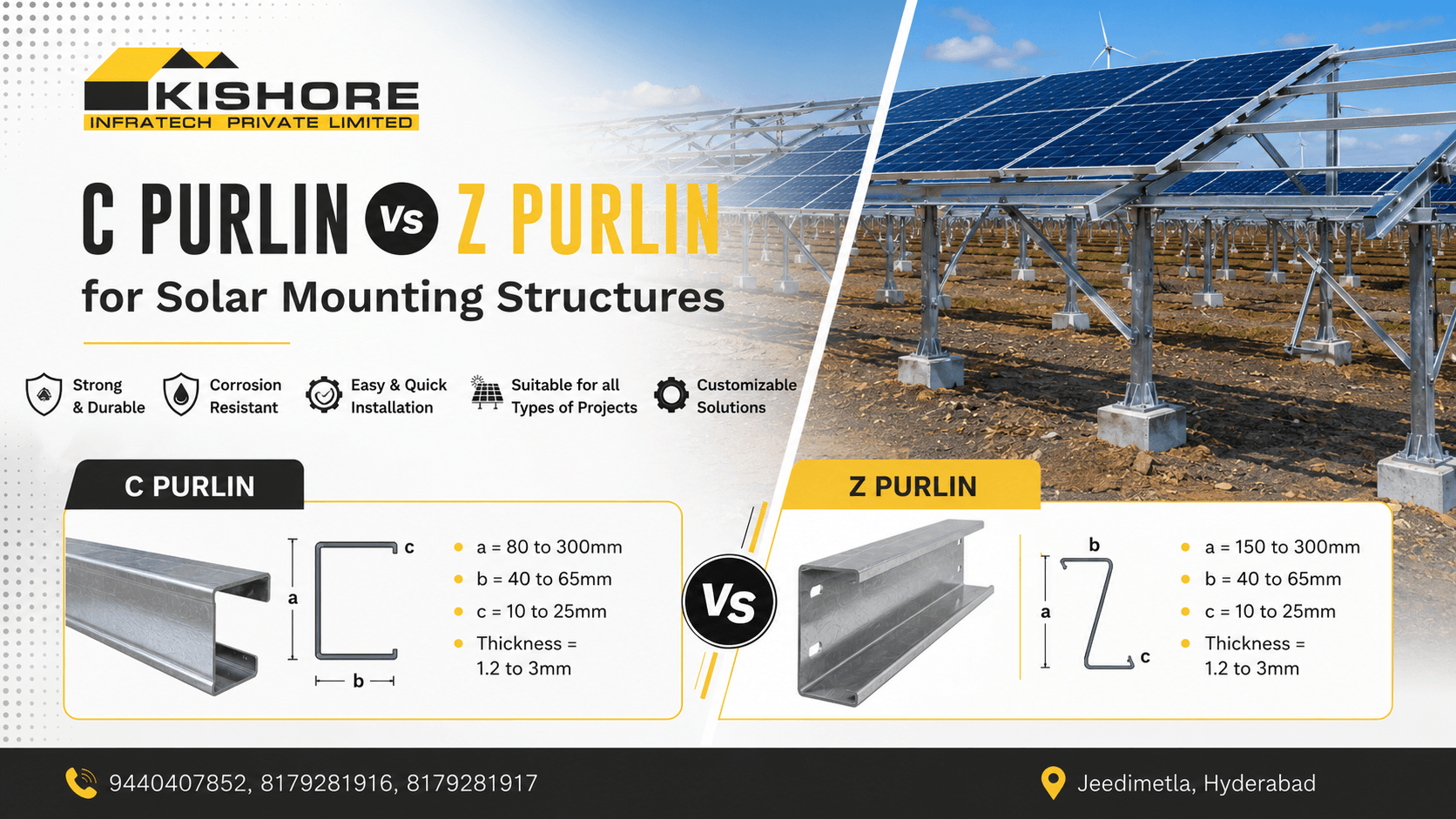
Quick Answer: In solar mounting structures, a C purlin is a mono-symmetric channel section (web 80–300 mm, flange 40–65 mm, lip 10–25 mm, thickness 1.2–3 mm) best used for module-mounting rails, shorter single spans, end bays, and rooftop sheet-mounting. A Z purlin is a point-symmetric zed section (web 150–300 mm, flange 40–65 mm, lip 10–25 mm, thickness 1.2–3 mm) whose sloped flanges allow purlins to overlap (lap) at supports — giving continuous multi-span behaviour, higher load capacity, and longer spans, making it the preferred choice for rafters and main support members in large ground-mount solar tables. The simplest rule: use Z purlins where you need to lap members over multiple supports for span and stiffness, and C purlins where members are single-span, edge, or directly carry modules. Both should be hot-dip galvanized or pre-galvanized (GI) per coating life required — Z275 / 275 GSM GI for moderate environments and 80-micron hot-dip galvanizing for coastal and long-life ground-mount installations.
Disclaimer: The section properties, dimension ranges, coating grades, and span guidance in this article are based on cold-formed steel practice (IS 811, IS 801), galvanizing standards (IS 277, IS 4759), wind-load code (IS 875 Part 3), and Kishore Infratech Private Limited’s solar mounting structure fabrication practice as of 2026. All spans, loads, and section sizes are indicative — final purlin sizing must be confirmed by a structural design specific to your panel wattage, tilt, wind zone, terrain category, and support spacing.
What Are Purlins in a Solar Mounting Structure?
In a solar module mounting structure (MMS), purlins are the cold-formed steel members that span between columns or rafters and ultimately carry the PV modules. A typical ground-mount table is built in a hierarchy: foundation → column (post) → rafter (principal inclined beam) → purlin / rail (module-bearing member) → module clamps → PV panel. The purlin is the member the module’s end clamps and mid clamps bolt onto, so its strength, stiffness, and corrosion life directly govern panel safety against wind uplift, snow, and self-weight over a 25-year design life.
Cold-formed purlins are roll-formed from galvanized steel coil into two dominant profiles — the C-section (channel) and the Z-section (zed). They look similar in a catalogue, but their cross-section geometry produces very different structural behaviour. Getting the C-versus-Z choice right is what separates a mounting structure that holds 50 m/s gusts for two decades from one that twists, deflects, or corrodes within a few monsoons.
Key takeaway: A purlin is not just a “rail to bolt panels onto” — it is a bending member loaded by gravity (panel weight, snow) downward and by wind uplift upward, often with a torsional component because the load does not pass through the section’s shear centre. C and Z sections handle that torsion and span very differently, which is the entire basis for choosing between them.
C Purlin Explained: Geometry, Symmetry & Behaviour
A C purlin (lipped channel) is shaped like the letter C — a vertical web with two flanges projecting from the same side, each turned in with a short stiffening lip. Geometrically it is mono-symmetric: it has one axis of symmetry running horizontally through the mid-height of the web. This single-axis symmetry is the defining feature that drives both its strengths and its limitations in solar applications.
Because both flanges point the same way, the C-section’s shear centre lies outside the section, on the open side away from the web. When a panel load is applied through the web (as it usually is), the load does not pass through the shear centre, so the section tends to twist. In a roof this is restrained by the cladding; on a solar table it must be restrained by the module clamps, purlin cleats, and bracing. C purlins are therefore ideal where members are single-span, relatively short, at the edge or eave, or directly carrying modules with frequent clamp restraint.
Key takeaway: C purlins nest tightly for transport (they stack inside one another), connect simply with cleats and bolts, and excel as module-mounting rails and short single-span members — but because they are mono-symmetric and cannot overlap at supports, they are less efficient than Z purlins for long, continuous, multi-support runs.
Z Purlin Explained: Geometry, Symmetry & Lapping Advantage
A Z purlin (lipped zed) has its two flanges pointing in opposite directions, giving the section its characteristic Z shape. Geometrically it is point-symmetric (centro-symmetric): rotate it 180° about its centroid and it maps onto itself, but it has no axis of symmetry. Its principal axes are inclined to the web. This sounds like a disadvantage, but it unlocks the single biggest structural benefit in solar and PEB roofing — lapping.
Because the flanges face opposite ways, two Z purlins can overlap (nest) at a support, bolting through their webs to create a double-thickness zone exactly over the rafter or column where the bending moment is highest in a continuous beam. This turns a series of simple spans into a continuous multi-span member, which dramatically reduces mid-span deflection and increases load capacity for the same section size. C purlins cannot do this — their identical flange direction prevents clean nesting. This is why Z purlins are the preferred section for rafters and principal members in long ground-mount solar tables with multiple support points.
Key takeaway: The lapping ability of the Z-section is its superpower. A lapped, continuous Z purlin can span roughly 20–35% farther than an equivalent simple-span C purlin of the same depth, because the overlapped double-section at the supports carries the peak negative moment efficiently — directly reducing the number of columns and foundations a solar table needs.
C Purlin vs Z Purlin: Complete Comparison
Key takeaway: C and Z purlins differ on eleven engineering parameters that matter for solar — symmetry, torsion behaviour, lapping, span type, load efficiency, depth range, transport, connection, and ideal role. The table below is the core decision reference: read it as “Z for long continuous spans and rafters; C for module rails, short single spans, and edges.”
| Parameter | C Purlin (Channel) | Z Purlin (Zed) |
|---|---|---|
| Cross-section shape | Web with both flanges on the same side, lipped | Web with flanges on opposite sides, lipped |
| Symmetry | Mono-symmetric (one horizontal axis of symmetry) | Point-symmetric (no axis; inclined principal axes) |
| Shear centre / torsion | Shear centre outside section; twists unless restrained | Shear centre near web; tends to deflect sideways, needs sag rods on long runs |
| Lapping at supports | Cannot nest/lap cleanly; sleeved joints only | Overlaps (laps) at supports — enables continuity |
| Span behaviour | Best as simple (single) span | Best as continuous (multi) span |
| Load efficiency | Good for short spans; capacity drops with length | Higher per kg over multiple bays (lapped continuity) |
| Typical web depth (KIPL) | 80–300 mm | 150–300 mm (deeper for heavier spans) |
| Transport / stacking | Nests very compactly; lowest freight volume | Nests offset; stacks well but slightly bulkier |
| Connection method | Bolted to cleats / brackets at each support | Bolted through overlapped webs at each rafter |
| Typical solar role | Module-mounting rail, purlin, edge/eave member, rooftop sheet mounting | Rafter, principal beam, long continuous purlin runs |
| Best for | Rooftop, agri / pump structures, smaller tables, the member panels clamp to | Large ground-mount tables, multi-bay arrays, fewer columns |
C Purlin & Z Purlin Dimension Specifications
Key takeaway: Both sections use the same flange (b = 40–65 mm), lip (c = 10–25 mm), and thickness (1.2–3 mm) ranges, so the real sizing decision is the web depth (a). C purlins start shallower (from 80 mm) for module rails and short spans, while Z purlins start at 150 mm because they are chosen specifically for the deeper, longer, load-bearing rafter role. Greater web depth means greater section modulus, which means more bending capacity and less deflection.
| Dimension | C Purlin Range | Z Purlin Range | What it controls |
|---|---|---|---|
| Web depth (a) | 80 to 300 mm | 150 to 300 mm | Bending capacity, span, deflection control |
| Flange width (b) | 40 to 65 mm | 40 to 65 mm | Clamp seating width, lateral stability |
| Lip / return (c) | 10 to 25 mm | 10 to 25 mm | Local buckling resistance of the flange |
| Thickness (t) | 1.2 to 3 mm | 1.2 to 3 mm | Overall load capacity and corrosion allowance |
A practical way to read these numbers: a 1.5 mm thick, 100 mm C purlin makes an excellent module-mounting rail at 1.0–1.4 m purlin spacing, while a 2.5 mm thick, 250 mm lapped Z purlin works as a continuous rafter spanning several columns in a large ground-mount table. The flange (b) must be wide enough to seat the module mid-clamp and end-clamp, which is why 40–65 mm flanges are standard — they accept the common 40 mm and 50 mm clamp footprints used for framed PV modules.
Structural Behaviour: Why the Lap Changes Everything
Key takeaway: In a single-span beam the maximum bending moment is at mid-span (wL²/8). In a continuous beam, that moment is shared between mid-span and supports, and the peak (over the support) is where the lapped double Z-section sits — so the steel is thickest exactly where the structure needs it most. This is the engineering reason lapped Z purlins outperform simple-span C purlins on long multi-bay solar arrays.
For a C purlin used as a simple span, every bay is structurally independent: the section must be sized for the full mid-span moment and the full mid-span deflection of that one bay. There is no help from the neighbouring bays. This is perfectly efficient for the module-rail role, where spans are short (the rafter-to-rafter distance) and clamps provide continuous restraint, but it becomes uneconomical when you try to make a single C purlin span many supports.
For a lapped Z purlin run, the laps create moment continuity across supports. The lapped region behaves like a haunch — a locally stronger zone — so mid-span moments and deflections drop, and the same depth of section spans farther or carries more wind uplift. The trade-off is that Z purlins, having inclined principal axes, want to deflect sideways under gravity load; on long spans this is controlled with sag rods (purlin ties) at mid-span or third-points, tying the purlins back to the ridge or a stiff line. C purlins on short solar spans rarely need sag rods because the module clamps and short length restrain them.
Where to Use C vs Z in Real Solar Structures
Key takeaway: Most well-engineered ground-mount tables use both sections together — a deeper Z purlin as the rafter/principal beam and a lighter C purlin as the module-mounting rail bolted across it. That combination is exactly the “C & Z purlin junction” detail shown on KIPL solar structures, and it is the most material-efficient layout for the majority of Indian solar projects.
| Application | Recommended Section | Why |
|---|---|---|
| Module-mounting rail (panels clamp here) | C purlin | Short rafter-to-rafter span, flat flange seats clamps, clamps provide restraint |
| Rafter / principal inclined beam (ground mount) | Z purlin (lapped) | Spans multiple columns continuously, fewer foundations needed |
| Rooftop structure on metal sheet roof | C purlin | Short spans aligned to existing roof purlins; simple bolted cleats |
| Large multi-bay ground-mount array | Z rafter + C rail combination | Z carries span between columns; C carries modules across the Z |
| Agri / solar water-pump structure | C purlin | Small panel count, single-span members, easy site assembly |
| High-wind / cyclone-zone ground mount | Deeper Z rafter, thicker gauge | Continuity + depth resist uplift reversal; lap zones add reserve strength |
Galvanizing: GSM vs Microns — Getting the Coating Right
Key takeaway: A solar mounting structure lives outdoors for 25+ years, so the zinc coating matters as much as the steel section. There are two distinct coating routes and they are specified in different units: pre-galvanized (GI) coil is rated in GSM (grams per square metre, total both sides) — e.g., 120 GSM or 275 GSM per IS 277 — while batch hot-dip galvanizing (HDG) after fabrication is rated in microns of coating thickness per IS 4759. Confusing the two is the most common spec error in solar tenders.
| Coating Route | Typical Rating | Standard | Best Use in Solar |
|---|---|---|---|
| Pre-galvanized (GI), light | 80 GSM | IS 277 | Indoor / sheltered rooftop rails, mild environments |
| Pre-galvanized (GI), standard | 120 GSM (Z120) | IS 277 | General rooftop mounting, moderate inland climates |
| Pre-galvanized (GI), heavy | 275 GSM (Z275) | IS 277 | Exposed rooftop & light ground mount, humid inland areas |
| Hot-dip galvanized (HDG) | ~65–86 microns (≈ 460–610 g/m²) | IS 4759 | Ground-mount posts & rafters, coastal / high-corrosion sites, long design life |
In plain terms: the higher the GSM or microns, the more zinc, and the longer the structure resists rust. For a rooftop C-purlin rail in a dry inland city, Z275 GI is usually sufficient. For ground-mount rafters and posts — especially within ~25 km of the coast in Andhra Pradesh, Tamil Nadu, or Odisha — batch hot-dip galvanizing at 70–86 microns after fabrication is the safer specification because it coats cut edges, weld zones, and bolt holes that pre-galvanized coil leaves exposed. KIPL supplies cold-formed C and Z purlins in 80, 120, and 275 GSM GI as well as hot-dip galvanized finishes to match the corrosion category of the site.
Load & Span Design: Sizing the Purlin
Key takeaway: A solar purlin is sized for the worst of two cases — gravity (panel self-weight + any snow/maintenance load) and wind uplift (which on tilted arrays often governs, because wind can lift and reverse the load). Deflection is usually limited to about span/150 to span/180 so panels stay planar and clamps do not loosen. Web depth and steel thickness are increased until both strength and deflection checks pass for the design wind speed and purlin spacing.
The dominant load on most Indian ground-mount tables is wind, calculated per IS 875 Part 3 from the site’s basic wind speed (33–55 m/s depending on zone), terrain category, topography, and the array’s tilt angle and height. Tilted modules behave like inclined sails: wind can press down on the windward face and lift the leeward face, so purlins and their connections must be designed for load reversal, not just downward load. This is exactly where lapped Z rafters earn their place — the continuity gives reserve capacity for uplift, and the lap bolts resist the reversing moment at supports.
Purlin spacing (the distance between module rails) is typically set at 1.0–1.4 m so that a standard framed module is supported near its clamping zones, and rafter/column spacing is then chosen so the lapped Z rafter spans economically between foundations. Reducing column count (longer Z spans) saves on foundations but needs a deeper/thicker rafter — the structural designer optimises this balance for each project.
Connections: Cleats, Laps, Clamps & Base Plates
Key takeaway: The section is only as good as its connections. C purlins connect to supports through bolted cleats / brackets; Z purlins connect by overlapping their webs at the rafter and bolting through the lap; modules connect to the purlin flange via end clamps and mid clamps; and the whole structure transfers load to the foundation through a base plate anchored to a concrete pedestal. Every one of these joints must use galvanized or stainless fasteners to avoid bimetallic corrosion.
Four connection details define a reliable solar mounting structure: (1) the Z-to-Z lap over each rafter, bolted through the webs to develop continuity — the bolt count and lap length are designed for the support moment; (2) the C-to-Z junction, where the C-purlin rail is bolted across the Z rafter with a cleat or direct bolting, creating the orthogonal grid that the modules sit on; (3) the end clamp on the C purlin, which grips the outermost module frame and is torqued to the module manufacturer’s spec to prevent slip under wind; and (4) the base plate detail, where the column foot is welded to a galvanized base plate and anchor-bolted to an RCC pedestal sized for uplift and overturning. Each of these joints is a place a poorly fabricated structure fails first, which is why connection detailing — not just section choice — separates a 25-year structure from a 5-year one.
Common Mistakes in C vs Z Purlin Selection
Key takeaway: Most purlin failures in the field trace back to a handful of avoidable specification errors — using a single-span C purlin where a continuous Z run was needed, under-specifying galvanizing for a coastal site, omitting sag rods on long Z runs, or seating clamps on a flange too narrow for the module. Each is cheap to fix at design stage and expensive to fix after erection.
- Forcing C purlins to span multiple bays: a C section cannot lap for continuity, so a long C run sags or needs an oversized section — use lapped Z purlins instead.
- Skipping sag rods on long Z runs: Z purlins deflect sideways under gravity; without mid-span ties on long spans they twist and the array goes out of plane.
- Under-coating for the environment: using 80–120 GSM GI on a coastal ground-mount where 70–86 micron hot-dip galvanizing is required — leads to edge and weld-zone rust within a few monsoons.
- Ignoring wind uplift reversal: sizing only for panel dead load and forgetting that tilted arrays see net uplift — purlins and lap bolts must handle reversed moment.
- Flange too narrow for the clamp: a flange under 40 mm cannot reliably seat standard module clamps, causing slip and point loading on the module frame.
- Mixing bare and galvanized fasteners: using non-galvanized bolts on galvanized purlins triggers bimetallic corrosion at every joint.
Planning a Solar Mounting Structure?
Get a Free Design & Quotation.
Share your requirement — our engineers call you back within 24 hours with C & Z purlin section sizing, galvanizing recommendation, and a quotation for your rooftop or ground-mount project.
- C & Z purlin cold-formed sections (80–300 mm, 1.2–3 mm)
- Hot-dip galvanized & GI (80 / 120 / 275 GSM) finishes
- Rooftop, ground-mount & agri / pump structures
- Wind-zone & MNRE-aligned structural design
- 45+ years steel fabrication, 700+ projects delivered
Prefer to speak directly? Call 9440407852
Thank You!
Our engineers will call you back shortly with your free solar mounting structure design and quotation.
Want a faster response?
📱 Chat with us on WhatsAppWhy KIPL for Solar Mounting Structures
Kishore Infratech Private Limited (KIPL), an ISO 9001:2015 certified PEB manufacturer headquartered in Hyderabad, Telangana, with 45+ years of steel fabrication experience and 700+ completed projects, manufactures and supplies galvanized C and Z purlin cold-formed sections and complete solar mounting structures for rooftop and ground-mount projects. Based on our experience fabricating cold-formed sections and structural steel across South India, we design solar tables to customer specifications or align them with MNRE standard designs — selecting C versus Z sections, galvanizing grade, and connection details to suit the panel, wind zone, and corrosion category of each site.
- Cold-formed C purlins (web 80–300 mm) and Z purlins (web 150–300 mm), flange 40–65 mm, lip 10–25 mm, thickness 1.2–3 mm
- Galvanizing options: 80, 120 and 275 GSM pre-galvanized (GI) and hot-dip galvanized finishes per site corrosion category
- MS fabricated + galvanized and GI cold-form structures for high strength and long service life
- Rooftop mounting, direct-to-roof / sheet mounting, ground-mount tables, and agri / solar-pump structures
- Engineered connections — Z-to-Z laps, C & Z junctions, end-clamp seating, and anchored base plates
- Designs adhering to customer specifications or aligned with MNRE standard designs
- Manufacturing base in Jeedimetla, Hyderabad, serving solar EPCs and developers across South India
Frequently Asked Questions
What is the difference between a C purlin and a Z purlin in solar mounting structures?
A C purlin is a mono-symmetric channel with both flanges on the same side, best for module-mounting rails and short single spans. A Z purlin has flanges on opposite sides, is point-symmetric, and can overlap (lap) at supports to form continuous multi-span members, making it ideal for rafters and long ground-mount runs. The simplest rule is Z for long continuous spans and rafters, C for module rails and short or edge members.
Which is stronger, a C purlin or a Z purlin?
For the same depth and thickness, a Z purlin carries more load over multiple supports because it can be lapped to create continuity, placing extra steel over the supports where the bending moment is highest. A C purlin of the same size is equally efficient only as a short single span. For long multi-bay solar tables, lapped Z purlins can span roughly 20 to 35 percent farther than equivalent simple-span C purlins.
Why can Z purlins be lapped but C purlins cannot?
Z purlins have flanges pointing in opposite directions, so two of them nest and overlap cleanly at a support, bolting through their webs to form a double-thickness zone. C purlins have both flanges on the same side, so they cannot nest the same way and are connected with cleats or sleeves rather than true laps. Lapping is what gives the Z section its continuous-span advantage.
What are the standard C and Z purlin dimensions for solar structures?
Typical C purlins have a web depth of 80 to 300 mm, flange 40 to 65 mm, lip 10 to 25 mm, and thickness 1.2 to 3 mm. Z purlins have a web depth of 150 to 300 mm with the same flange, lip, and thickness ranges. Web depth is the main sizing variable because it controls bending capacity and deflection.
What galvanizing grade should solar mounting purlins have?
Pre-galvanized (GI) coil is rated in GSM, with 120 GSM (Z120) suitable for general rooftop use and 275 GSM (Z275) for exposed and humid inland sites. For ground-mount rafters and posts, and for coastal sites, hot-dip galvanizing of roughly 65 to 86 microns per IS 4759 is recommended because it coats cut edges and welds that pre-galvanized coil leaves exposed.
What is the difference between GSM and microns in galvanizing?
GSM (grams per square metre) measures the mass of zinc on pre-galvanized coil per IS 277, counting both sides, with common grades of 120 and 275 GSM. Microns measure the thickness of zinc applied by batch hot-dip galvanizing after fabrication per IS 4759. They are different processes and units, so a tender that asks for hot-dip galvanizing should specify microns, not GSM.
Can C and Z purlins be used together in one solar structure?
Yes, and it is the most common efficient layout. A deeper Z purlin is used as the rafter or principal beam spanning between columns, and lighter C purlins are bolted across it as the module-mounting rails. This C and Z junction combines the Z section’s span efficiency with the C section’s flat flange for seating module clamps.
Which purlin is best for rooftop solar mounting?
C purlins are usually preferred for rooftop solar because the spans are short, the structure aligns with the existing roof purlins, and the members connect simply with bolted cleats. Pre-galvanized C purlins at 120 to 275 GSM are typical for rooftop rails in inland climates, with hot-dip galvanizing used in coastal or high-humidity locations.
Which purlin is best for ground-mount solar?
Ground-mount tables typically use lapped Z purlins as rafters spanning multiple columns, often combined with C purlins as the module rails. The Z section reduces column and foundation count by spanning farther, while hot-dip galvanizing protects the posts and rafters against ground-level corrosion over the 25-year design life.
How does wind load affect purlin selection in solar structures?
Tilted solar arrays experience wind uplift that can reverse the load direction, so purlins and their connections must be designed for both downward and upward loads per IS 875 Part 3 using the site’s basic wind speed and terrain category. Lapped Z rafters are advantageous in high-wind and cyclone zones because their continuity provides reserve capacity against uplift reversal.
What deflection limit applies to solar mounting purlins?
Solar purlin deflection is usually limited to about span divided by 150 to span divided by 180 so that modules stay planar and clamps do not loosen under load. Web depth and steel thickness are increased until both the strength check and this deflection check are satisfied for the design loads and purlin spacing.
Do solar Z purlins need sag rods?
Long-span Z purlins benefit from sag rods (purlin ties) at mid-span or third-points because the inclined principal axes of the Z section cause it to deflect sideways under gravity load. Short C-purlin module rails generally do not need sag rods because their span is short and the module clamps provide restraint.
What thickness of purlin is used for solar mounting structures?
Cold-formed solar purlins are typically rolled from 1.2 to 3 mm galvanized steel. Lighter 1.2 to 1.5 mm sections suit rooftop module rails and small structures, while 2 to 3 mm sections are used for ground-mount rafters and high-wind locations where greater bending capacity and corrosion allowance are needed.
Do these purlins meet MNRE standard solar structure designs?
Solar mounting structures can be fabricated to customer specifications or aligned with MNRE standard designs. KIPL supplies C and Z purlin cold-formed sections and complete structures designed to the project’s panel type, wind zone, and corrosion category, matching either the customer’s engineering schedule or the applicable MNRE standard layout.
Who manufactures C and Z purlin solar mounting structures in Hyderabad?
Kishore Infratech Private Limited (KIPL), based in Jeedimetla, Hyderabad, manufactures galvanized C and Z purlin cold-formed sections and complete solar mounting structures for rooftop and ground-mount projects across South India, with 45+ years of steel fabrication experience and 700+ completed projects.
Data methodology: Section behaviour, dimension ranges, and coating guidance in this article are compiled from cold-formed steel design practice (IS 811 dimensions, IS 801 code of practice), galvanizing standards (IS 277 for pre-galvanized GI, IS 4759 for hot-dip galvanizing), wind-load code IS 875 Part 3, MNRE standard solar structure design references, and Kishore Infratech Private Limited’s solar mounting structure fabrication practice as of 2026 (45+ years steel fabrication, 700+ completed projects). All spans, loads, and section sizes are indicative reference values — final purlin selection must be confirmed by a project-specific structural design.
Conclusion
The C purlin vs Z purlin choice in a solar mounting structure is not a matter of preference — it is dictated by how the member is loaded and how far it must span. A C purlin’s mono-symmetric channel shape makes it the natural module-mounting rail and short single-span member, simple to connect and compact to transport. A Z purlin’s point-symmetric shape lets it lap at supports for continuous-span behaviour, making it the efficient rafter and principal member for large ground-mount arrays where spanning farther means fewer columns and foundations.
The strongest, most material-efficient solar tables usually use both — Z purlins as lapped rafters and C purlins as the module rails bolted across them — with galvanizing matched to the site: GI in GSM grades for sheltered and inland rooftop work, and hot-dip galvanizing in microns for ground-mount and coastal exposure. Add correct wind-uplift design per IS 875 Part 3, sag rods on long Z runs, properly torqued clamps, and galvanized fasteners throughout, and the structure will carry its panels reliably for a 25-year design life.
To design and supply C & Z purlin solar mounting structures for your rooftop or ground-mount project, contact Kishore Infratech Private Limited at 9440407852 or visit kishoreindustries.in.
Related Solar Mounting Structure Guides
- Ground-Mount vs Rooftop Solar Mounting Structures: Complete Guide
- Hot-Dip Galvanizing for Solar Structures: GSM vs Microns Explained
- Solar Mounting Structure Manufacturers in Hyderabad: Buyer’s Checklist