
Z purlin standard sizes in India run from Z150 to Z300 web depth, and the size you pick decides whether a PEB roof is economical, deflects within IS 800 limits, or sags visibly after the first monsoon. This chart-style guide puts every standard Z purlin dimension, weight per metre, section property and indicative span in one place, so a project engineer, PEB buyer or purchase manager can specify a purlin correctly without hunting through five manufacturer catalogues. Kishore Infratech roll-forms Z purlins in 150 to 300 mm web, 40 to 65 mm flange, 10 to 25 mm lip and 1.2 to 3 mm thickness at our Jeedimetla, Hyderabad plant, and the figures below come from that production range.
Quick Answer: Standard Z purlin sizes in India are Z150, Z175, Z200, Z225, Z250 and Z300 (web depth in mm), with 50–65 mm flanges, 15–20 mm lips and 1.5–3.0 mm thickness, designated as Z D×B×C×t. Weights run from about 3.23 kg/m (Z150×1.5) to 10.79 kg/m (Z300×3.0); the workhorse Z200×60×20×2.0 weighs 5.53 kg/m and suits 6 m PEB bays, Z250 suits 7.5 m and Z300 suits 9 m bays. Governing codes are IS 811 (sections), IS 801 (design), IS 800 Table 6 (deflection L/150) and IS 875 (loads). All spans here are indicative estimates, not a design.
Disclaimer: Section properties, weights and spans in this guide are calculated indicative values for standard lipped Z profiles and are provided for preliminary sizing and budgeting only. They are not a structural design, a price quotation or an offer. Final purlin sizes must be verified by a qualified structural engineer for the actual loads, wind zone, sheeting type and support conditions of your project.
How Z Purlin Sizes Are Designated (D × B × C × t)
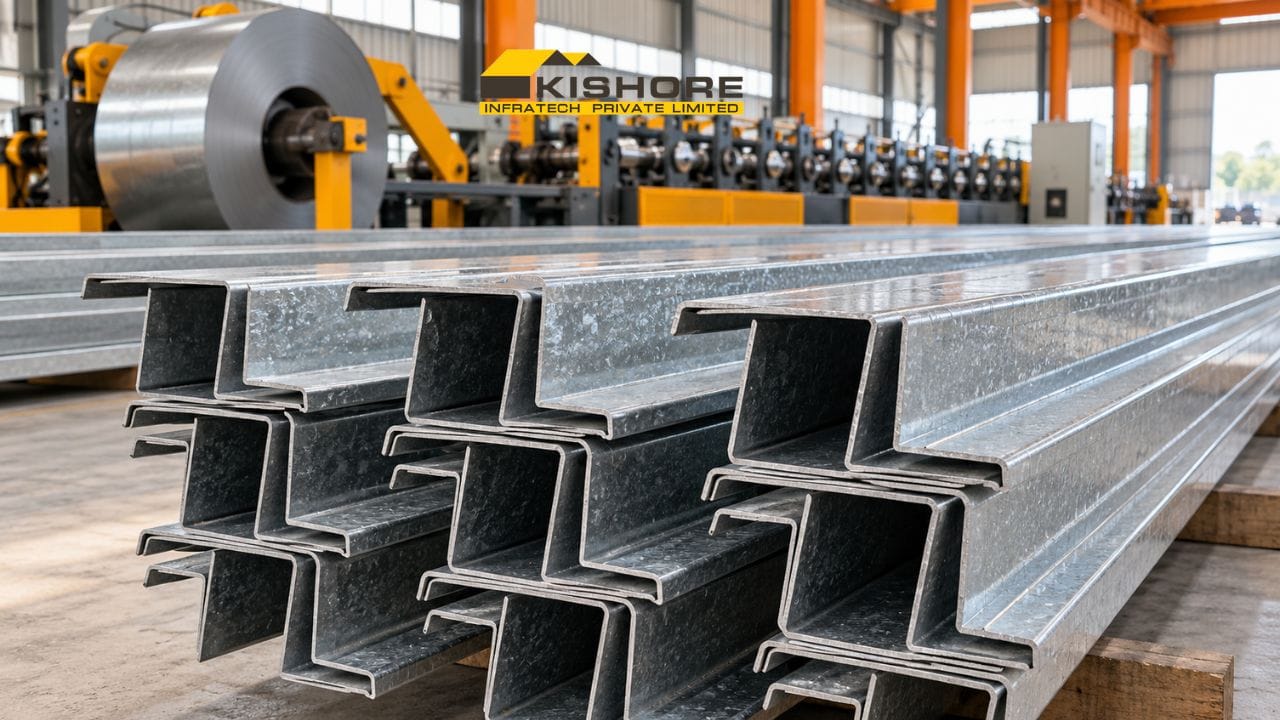
A Z purlin is a cold-formed, lipped Z-shaped section roll-formed from steel coil, used as the secondary member that carries roof sheeting between the rafters of a pre-engineered building. In India every Z purlin size is written as four numbers in millimetres: web depth D, flange width B, lip length C and thickness t. Z200×60×20×2.0 is therefore 200 mm deep, 60 mm wide at each flange, with 20 mm stiffening lips, rolled from 2.0 mm coil. The web depth sets stiffness, the thickness sets both weight and cost, and the lip stops the thin flange buckling before it reaches its yield strength.
The flanges of a Z section point in opposite directions, which is what lets one purlin nest inside the next at a rafter. That nesting is the whole reason Z purlins exist as a separate family from C purlins: lapped Z purlins behave as a continuous beam over several bays, so a smaller section does the job of a larger simply supported one.
Z Purlin Standard Sizes in India: Master Dimension Chart
Key takeaway: Indian manufacturers standardise on six Z purlin depths, 150 to 300 mm, in 1.5 to 3.0 mm thickness. Z200×60×20 is the default PEB roof purlin at 5.53 kg/m in 2.0 mm, Z250 is the step-up for 7.5 m bays at 6.47 kg/m, and Z300×2.5 at 9.03 kg/m is the heaviest standard cold-formed size before designers move to built-up sections.
| Section | Web depth D | Flange B | Lip C | Thickness t options | Weight range (kg/m) | Typical use |
|---|---|---|---|---|---|---|
| Z150 | 150 mm | 50 mm | 15 mm | 1.5 / 2.0 / 2.5 / 3.0 mm | 3.23 – 6.31 kg/m | Girts, canopies, light sheds; bays up to ~4.5 m |
| Z175 | 175 mm | 60 mm | 20 mm | 1.5 / 2.0 / 2.5 / 3.0 mm | 3.87 – 7.61 kg/m | Light industrial roofs; bays ~5 m |
| Z200 | 200 mm | 60 mm | 20 mm | 1.5 / 2.0 / 2.5 / 3.0 mm | 4.17 – 8.20 kg/m | Standard PEB roof purlin for 6 m bays |
| Z225 | 225 mm | 65 mm | 20 mm | 1.5 / 2.0 / 2.5 / 3.0 mm | 4.58 – 9.02 kg/m | 6–7 m bays, heavier sheeting/insulation |
| Z250 | 250 mm | 65 mm | 20 mm | 1.5 / 2.0 / 2.5 / 3.0 mm | 4.87 – 9.61 kg/m | 7.5 m bays; 6 m bays with PUF panels |
| Z300 | 300 mm | 65 mm | 20 mm | 1.5 / 2.0 / 2.5 / 3.0 mm | 5.46 – 10.79 kg/m | 9 m bays, high wind zones, rooftop solar |
Flange and lip dimensions vary slightly between manufacturers, with 40 to 65 mm flanges and 10 to 25 mm lips all in circulation, so always confirm the full designation rather than the depth alone. A “Z200” from one roll-former may be Z200×50×15×1.6 and from another Z200×65×20×2.5, a weight difference of roughly 74 percent on the same depth.
Z Purlin Weight Chart (kg per metre) by Size and Thickness
Key takeaway: Weight scales almost linearly with thickness: a Z200 goes from 4.17 kg/m at 1.5 mm to 8.20 kg/m at 3.0 mm. For tonnage estimates, a 6 m bay roof with Z200×2.0 purlins at 1.5 m spacing uses about 3.68 kg of purlin steel per square metre of roof.
| Section (D×B×C) | 1.5 mm | 2.0 mm | 2.5 mm | 3.0 mm |
|---|---|---|---|---|
| Z150×50×15 | 3.23 | 4.27 | 5.30 | 6.31 |
| Z175×60×20 | 3.87 | 5.13 | 6.38 | 7.61 |
| Z200×60×20 | 4.17 | 5.53 | 6.87 | 8.20 |
| Z225×65×20 | 4.58 | 6.08 | 7.56 | 9.02 |
| Z250×65×20 | 4.87 | 6.47 | 8.05 | 9.61 |
| Z300×65×20 | 5.46 | 7.25 | 9.03 | 10.79 |
Weights are gross-section values at a steel density of 7,850 kg/m³ using centre-line geometry. Rolled purlins typically come out 2 to 3 percent lighter because of corner radii, and coil thickness tolerance of ±0.1 mm can move the figure either way. Use the chart for budgeting tonnage and freight; use the manufacturer’s test certificate for billing.
Z Purlin Section Properties: Area, Ixx, Zxx and Iyy
Key takeaway: Moment of inertia grows with roughly the cube of depth, so moving from Z200 to Z250 at the same 2.0 mm thickness raises Ixx by about 77 percent for only 17 percent more weight. That is why increasing depth, not thickness, is the economical way to span a longer bay.
| Section | Area (mm²) | Weight (kg/m) | Ixx (cm⁴) | Zxx (cm³) | Iyy (cm⁴) |
|---|---|---|---|---|---|
| Z150×50×15×2.0 | 544 | 4.27 | 184 | 24.6 | 27.6 |
| Z150×50×15×2.5 | 675 | 5.30 | 227 | 30.3 | 33.4 |
| Z175×60×20×2.0 | 654 | 5.13 | 305 | 34.9 | 51.6 |
| Z175×60×20×2.5 | 813 | 6.38 | 376 | 43.0 | 62.7 |
| Z200×60×20×2.0 | 704 | 5.53 | 418 | 41.8 | 51.6 |
| Z200×60×20×2.5 | 875 | 6.87 | 516 | 51.6 | 62.7 |
| Z225×65×20×2.0 | 774 | 6.08 | 577 | 51.3 | 63.5 |
| Z225×65×20×2.5 | 963 | 7.56 | 714 | 63.5 | 77.3 |
| Z250×65×20×2.0 | 824 | 6.47 | 742 | 59.3 | 63.5 |
| Z250×65×20×2.5 | 1025 | 8.05 | 917 | 73.4 | 77.3 |
| Z300×65×20×2.0 | 924 | 7.25 | 1149 | 76.6 | 63.5 |
| Z300×65×20×2.5 | 1150 | 9.03 | 1422 | 94.8 | 77.3 |
These are gross-section properties about the geometric axes of the Z, calculated from centre-line dimensions. Cold-formed design to IS 801 uses effective section properties that are 10 to 20 percent lower for the thinner gauges once local buckling of the compression flange is accounted for, and Z sections also have inclined principal axes that the designer must address when sheeting restraint is incomplete. Treat this table as a preliminary comparison between sizes, not as design input.
Indicative Z Purlin Span Guide: Which Size for Which Bay
Key takeaway: Under a typical sheeted-roof service load of 0.90 kN/m² at 1.5 m purlin spacing, 345 MPa steel and an IS 800 deflection limit of L/150, a Z200×2.0 spans about 6.6 m simply supported and 7.4 m when lapped continuous. Z250×2.0 reaches about 7.9 m and Z300×2.5 about 9.9 m simply supported.
| Section | Simply supported span (m) | Lapped continuous span (m) | Governing check (SS, 345 MPa) | Simply supported, 250 MPa MS (m) |
|---|---|---|---|---|
| Z150×50×15×2.0 | 5.0 | 5.6 | Bending | 4.3 |
| Z150×50×15×2.5 | 5.5 | 6.3 | Deflection | 4.8 |
| Z150×50×15×3.0 | 5.8 | 6.8 | Deflection | 5.2 |
| Z175×60×20×2.0 | 6.0 | 6.7 | Bending | 5.1 |
| Z175×60×20×2.5 | 6.5 | 7.5 | Deflection | 5.7 |
| Z175×60×20×3.0 | 6.9 | 8.1 | Deflection | 6.2 |
| Z200×60×20×2.0 | 6.6 | 7.4 | Bending | 5.6 |
| Z200×60×20×2.5 | 7.3 | 8.2 | Deflection | 6.2 |
| Z200×60×20×3.0 | 7.7 | 8.9 | Deflection | 6.8 |
| Z225×65×20×2.0 | 7.3 | 8.2 | Bending | 6.2 |
| Z225×65×20×2.5 | 8.1 | 9.1 | Deflection | 6.9 |
| Z225×65×20×3.0 | 8.6 | 9.9 | Deflection | 7.5 |
| Z250×65×20×2.0 | 7.9 | 8.8 | Bending | 6.7 |
| Z250×65×20×2.5 | 8.7 | 9.8 | Bending | 7.4 |
| Z250×65×20×3.0 | 9.3 | 10.7 | Deflection | 8.1 |
| Z300×65×20×2.0 | 8.9 | 10.0 | Bending | 7.6 |
| Z300×65×20×2.5 | 9.9 | 11.1 | Bending | 8.5 |
| Z300×65×20×3.0 | 10.8 | 12.1 | Deflection | 9.2 |
Assumptions behind the table: dead load 0.15 kN/m² (sheeting plus purlin self-weight), imposed load 0.75 kN/m² per IS 875 Part 2 for an inaccessible roof below 10° slope, purlins at 1.5 m centres, limit-state load factor 1.5 on gravity loads, bending resistance taken as 0.85 × Zxx × fy / 1.10 to allow for local buckling in a simplified way, and deflection limited to span/150 for elastic cladding per IS 800:2007 Table 6. Continuous spans assume laps of 10 to 15 percent of span and use wL²/10 for moment and a deflection coefficient of roughly 1/185. Wind uplift is not included: in IS 875 Part 3 wind zones of 47 to 55 m/s (coastal Andhra Pradesh, Tamil Nadu and Odisha) uplift on the unrestrained bottom flange often governs, and purlin sizes go up one step or need extra sag rods and bridging.
Recommended Z Purlin Size by PEB Bay Spacing
Key takeaway: For the common 6 m PEB bay, Z200×60×20×2.0 is the lightest standard section that works simply supported and Z175×60×20×2.0 when lapped. At 7.5 m bays the lapped choice is Z250×65×20×2.0, and at 9 m it is Z300×65×20×2.0, with sag rods at third points.
| Bay spacing | Lightest size, simply supported (Est.) | Lightest size, lapped continuous (Est.) | Sag rods |
|---|---|---|---|
| 4.5 m | Z150×50×15×2.0 (4.27 kg/m) | Z150×50×15×2.0 (4.27 kg/m) | Optional |
| 5.0 m | Z175×60×20×2.0 (5.13 kg/m) | Z150×50×15×2.0 (4.27 kg/m) | 1 row at mid-span |
| 6.0 m | Z200×60×20×2.0 (5.53 kg/m) | Z175×60×20×2.0 (5.13 kg/m) | 1 row at mid-span |
| 7.5 m | Z300×65×20×2.0 (7.25 kg/m) | Z250×65×20×2.0 (6.47 kg/m) | 2 rows at third points |
| 9.0 m | Z300×65×20×2.5 (9.03 kg/m) | Z300×65×20×2.0 (7.25 kg/m) | 2 rows at third points |
| 10.5 m | Built-up / hot-rolled section, or reduce bay | Z300×65×20×3.0 (10.79 kg/m) | 2–3 rows + bridging |
| 12.0 m | Built-up / hot-rolled section, or reduce bay | Built-up / hot-rolled section, or reduce bay | 2–3 rows + bridging |
Picks are the lightest section of 2.0 mm or thicker whose indicative span exceeds the bay by at least 10 percent; 1.5 mm sections are excluded because their wide, thin flanges lose too much capacity to local buckling for roof purlin duty.
Indian PEB practice matches this table closely: Z200 in 2.0 or 2.5 mm on 6 m bays, Z250 on 7.5 m bays and Z300 on 9 m bays, with the thinner gauge used in dry interior zones and the thicker one on the coast or under PUF or rockwool sandwich panels. Beyond 9 m most designers either reduce the bay or switch to a built-up or hot-rolled purlin, because 350 mm and deeper cold-formed Z sections are not a stocked Indian size and the thin web starts to govern through shear and web crippling at the rafter cleat.
Steel Grade, Coil and Coating Specifications for Z Purlins
Key takeaway: Most Indian Z purlins are rolled from 345 MPa high-tensile coil, which spans 15 to 25 percent further than 250 MPa mild steel at the same weight. Corrosion protection is either pre-galvanized coil to IS 277 (120 or 275 GSM) or hot-dip galvanizing after forming to IS 4759 (about 610 g/m², roughly 85 microns).
| Parameter | Standard options in India | Governing standard | What it changes |
|---|---|---|---|
| Yield strength | 250 MPa (E250 / MS) or 345 MPa (E350 / Z350 high-tensile) | IS 2062, IS 1079 | Span capacity; weight per sq m |
| Coil type | Hot-rolled pickled & oiled (HRPO) or cold-rolled | IS 1079, IS 513 | Surface finish, thickness tolerance |
| Thickness tolerance | ±0.08 to ±0.12 mm | IS 1079 / IS 513 | Billed weight vs chart weight |
| Pre-galvanized (GI) coating | Z120 (120 GSM) or Z275 (275 GSM), total of both faces | IS 277 | Corrosion life 10–25 yrs in C2–C3 environments |
| Hot-dip galvanizing after forming | Min. 610 g/m² (≈85 µm) for ≥5 mm; 460–610 g/m² for thinner sections | IS 4759 | Cut edges and holes protected; 25–40+ yrs in C3–C4 |
| Bare / red-oxide primed | One coat red oxide zinc phosphate primer | IS 2074 (primer) | Lowest cost; needs site painting; indoor dry use |
| Length | Cut-to-length up to 12 m; laps added to bay length | Project drawings | Zero site cutting; bay-tagged bundles |
| Holes | 14 or 18 mm punched for M12 / M16 bolts at cleats and laps | Project drawings | Erection speed; bolt grade 4.6 or 8.8 |
The GSM versus microns confusion is the most common specification error on purlin tenders: 275 GSM is a pre-galvanized sheet class measured on both faces together and is not the same as 275 microns of hot-dip zinc. Our guide to hot-dip galvanizing: GSM vs microns sets out the conversion and the expected life in each ISO 9223 corrosivity category.
IS Codes That Govern Z Purlin Sizes and Design
Key takeaway: Six Indian Standards define a Z purlin from coil to roof: IS 811 for the section, IS 801 for cold-formed design, IS 800 for deflection limits, IS 875 Parts 2 and 3 for loads, and IS 277 or IS 4759 for the zinc coating.
| Standard | Title / scope | What it fixes for Z purlins |
|---|---|---|
| IS 811:1987 | Cold-formed light gauge structural steel sections | Standard Z and C section shapes, dimensions and tolerances |
| IS 801:1975 | Code of practice for use of cold-formed light gauge steel structural members | Effective width, local buckling, bending and web crippling checks |
| IS 800:2007 | General construction in steel, code of practice | Deflection limit L/150 (elastic cladding) or L/180 (brittle cladding), Table 6 |
| IS 875 Part 2 | Imposed loads | 0.75 kN/m² on inaccessible roofs ≤10°, reducing with slope |
| IS 875 Part 3 | Wind loads | Basic wind speed 33–55 m/s by zone; uplift pressure on purlins |
| IS 1079 / IS 2062 | Hot-rolled steel strip and structural steel | Coil grade E250 / E350, chemistry and mechanical properties |
| IS 277 | Galvanized steel sheets (plain and corrugated) | Pre-galvanized coating classes 120, 180, 275 GSM |
| IS 4759 | Hot-dip zinc coatings on structural steel | Minimum zinc mass per m² for post-forming galvanizing |
Z Purlin vs C Purlin Sizes: When Each Is Specified
Key takeaway: C purlins start at 80 mm web and stop at 300 mm; Z purlins start at 150 mm because they are meant to be lapped. For the same depth and thickness a lapped Z spans 10 to 30 percent further, while a C is simpler for single spans, wall girts and solar rails.
| Attribute | Z purlin | C purlin |
|---|---|---|
| Standard web depths (India) | 150, 175, 200, 225, 250, 300 mm | 80, 100, 125, 150, 175, 200, 250, 300 mm |
| Flange / lip | 40–65 mm / 10–25 mm | 40–65 mm / 10–25 mm |
| Nesting at supports | Yes, lapped continuous | No, butted or sleeved |
| Typical roof use | Multi-bay PEB roofs 6–9 m | Single bays, canopies, lean-tos |
| Typical wall use | Rarely | Wall girts, door and window framing |
| Solar mounting | Rails on long ground-mount tables | Rails, rafters and purlin-mount rooftop |
| Weight for equal span | Lower when lapped | Higher, or deeper section |
The full engineering comparison, including inclined principal axes and sheeting restraint, is in our pillar guide on C purlin vs Z purlin for solar and PEB structures. For sizes under 150 mm, see the cold-formed section range in our cold rolled purlins guide.
Lap Length, Sag Rods and Connection Details by Z Purlin Size
Key takeaway: A 6 m bay with Z200 purlins needs a 600 to 900 mm lap at each rafter, four M12 bolts per lap and one row of 12 mm sag rods at mid-span. Extending the lap towards 20 percent of span is a cheap way to push a borderline size through without going one depth up.
| Detail | Z150 / Z175 | Z200 / Z225 | Z250 / Z300 |
|---|---|---|---|
| Lap each side of rafter (10–15% span) | 450–700 mm | 600–900 mm | 750–1,350 mm |
| Lap bolts | 2 × M12 per side | 2 × M12 per side | 2 × M16 per side |
| Cleat bolts to rafter | 2 × M12 | 2 × M12 | 2 × M16 |
| Sag rods (bays ≤6 m) | 1 row, 12 mm | 1 row, 12 mm | 1 row, 12 mm |
| Sag rods (bays 7.5–9 m) | Not a recommended span | 2 rows, 12 mm | 2 rows, 12–16 mm |
| Hole diameter | 14 mm | 14 mm | 18 mm |
| Max purlin spacing (0.5 mm sheeting) | 1.2–1.5 m | 1.5 m | 1.5–1.8 m |
| Eave strut | Z150 + angle | Z200 + angle or box | Z250 box section |
Sag rods carry the component of roof load acting along the slope and brace the purlin against lateral movement; without them a Z purlin on a 1-in-10 roof can twist visibly even when the bending check passes. On bays above 6 m, two rows at third points are standard, and in high-wind coastal zones a bridging channel between purlins at the same points stops bottom-flange buckling under uplift.
Z Purlin Sizes for Solar Mounting Structures
Key takeaway: Ground-mount solar tables use Z150 to Z200 purlins in 1.6 to 2.5 mm galvanized steel as module rails; rooftop solar on an existing PEB adds 15 to 25 kg/m², which typically consumes the spare capacity of a Z200×2.0 on a 6 m bay and calls for a purlin check before installation.
For ground-mount versus rooftop solar structures the Z purlin acts as the long rail spanning between the table legs, usually 2.5 to 4 m, so Z150 and Z175 in 2.0 mm GI dominate and Z200 appears on wider tables. On rooftops, the critical question is not the new rail but the existing roof purlin: module dead load plus the wind uplift that modules attract is often the difference between a Z200×2.0 passing and failing, and our site checks on rooftop solar projects in Hyderabad routinely end in either Z250 replacement purlins or added intermediate purlins.
How to Specify and Order Z Purlins Correctly
Key takeaway: A complete purlin order lists the full D×B×C×t designation, steel grade, coating, cut length including laps, hole pattern and quantity per bay. Missing any one of these is the usual cause of site rework.
- Full designation: write Z200×60×20×2.0, never just “Z200”.
- Grade: state 345 MPa (E350) or 250 MPa; the span table changes by 15–25 percent between them.
- Coating: bare, GI 120 GSM, GI 275 GSM, or hot-dip galvanized to IS 4759; name the standard.
- Length: bay spacing plus lap on each side, so a 6 m bay with 15 percent laps is a 7.8 m purlin at interior rafters and a 6.9 m purlin at end bays.
- Holes: diameter, gauge and end distance from the cleat drawing; punched at the factory, not drilled on site.
- Quantity logic: (number of purlin lines × number of bays) + eave struts + ridge purlins + sag rods + bridging; add 2 percent for cut waste on non-standard lengths.
- Bundling: ask for bay-tagged, nested bundles so erection follows the drawing sequence.
- Documents: mill test certificate for coil, coating test report and a dimensional inspection sheet per lot.
Common Z Purlin Sizing Mistakes
- Sizing by depth alone and receiving 1.6 mm purlins where the design assumed 2.5 mm.
- Using the simply supported span for a lapped design, or the lapped span for end bays that are not continuous.
- Ignoring wind uplift in coastal Andhra Pradesh, Tamil Nadu and Odisha, where the bottom flange is unrestrained.
- Adding PUF or rockwool sandwich panels, or rooftop solar, without re-checking the purlin that was sized for 0.5 mm sheeting.
- Specifying “275 GSM hot-dip galvanized”, which mixes two standards and cannot be supplied as written.
- Omitting sag rods on bays above 4.5 m to save cost, then seeing purlin roll and sheet fastener leaks.
Need Z Purlins Cut to Your Bay Length?
Get a Factory-Direct Estimate.
Share your requirement — our team calls you back within 24 hours with an indicative estimate for your Z purlin sizes, quantities and a delivery schedule to your site.
- C purlins 80–300 mm, Z purlins 150–300 mm, 1.2–3 mm thick
- Cut-to-length, bay-tagged bundles — zero site wastage
- Bare, GI (IS 277) & hot-dip galvanized (IS 4759) options
- Direct dispatch from our Jeedimetla, Hyderabad plant across South India
- 45+ years steel fabrication, 700+ projects delivered
Prefer to speak directly? Call 9440407852
Thank You!
Our team will call you back shortly with an indicative Z purlin estimate and delivery schedule.
Want a faster response?
📱 Chat with us on WhatsAppWhy Buy Z Purlins from Kishore Infratech
Kishore Infratech Private Limited (KIPL), an ISO 9001:2015 certified PEB manufacturer headquartered in Hyderabad, Telangana, with 45+ years of steel fabrication experience and 700+ completed projects, roll-forms C and Z purlins at its Jeedimetla plant for its own pre-engineered buildings and for direct supply to contractors, EPC companies and solar installers across South India. Based on our experience supplying purlins for more than 45 lakh sq ft of PEB roofs, the sizes, laps and sag-rod patterns in this guide reflect what actually gets erected on 6, 7.5 and 9 m bays in Telangana, Andhra Pradesh, Karnataka, Tamil Nadu and Odisha.
- Z purlins 150–300 mm web, C purlins 80–300 mm web, 1.2–3 mm thickness, 40–65 mm flanges
- 250 MPa and 345 MPa coil with mill test certificates; bare, pre-galvanized IS 277 and hot-dip galvanized IS 4759 finishes
- Cut-to-length up to 12 m with factory-punched holes and bay-tagged, nested bundles
- In-house structural team to confirm purlin sizes against your rafter spacing, wind zone and sheeting
- Direct dispatch from Hyderabad; see our purlin manufacturing in Hyderabad, Nizamabad and Warangal supply pages
- Purlins supplied as part of a complete PEB shell: primary frames, purlins, girts, sheeting and accessories from one source
Frequently Asked Questions: Z Purlin Sizes in India
What are the standard Z purlin sizes in India?
Standard Z purlin sizes in India run from Z150 to Z300 web depth, with 50 to 65 mm flanges, 15 to 20 mm lips and 1.5 to 3.0 mm thickness. The most common roof purlin is Z200 x 60 x 20 in 2.0 mm, weighing about 5.53 kg per metre, used on 6 m PEB bays. Kishore Infratech roll-forms Z purlins from 150 to 300 mm web in 1.2 to 3 mm thickness.
How is a Z purlin size written?
A Z purlin is designated as Z D x B x C x t, where D is the web depth, B the flange width, C the lip length and t the thickness, all in millimetres. For example Z200 x 60 x 20 x 2.0 means a 200 mm deep section with 60 mm flanges, 20 mm lips and 2 mm thick steel. Always quote all four numbers when ordering because two purlins with the same depth can differ by 40 percent in weight.
What is the weight of a Z200 purlin per metre?
A Z200 x 60 x 20 purlin weighs approximately 4.17 kg/m in 1.5 mm, 5.53 kg/m in 2.0 mm, 6.87 kg/m in 2.5 mm and 8.20 kg/m in 3.0 mm thickness. These are calculated gross-section weights at 7,850 kg per cubic metre; actual rolled weights vary by about 2 to 3 percent with coil tolerance and corner radii.
Which Z purlin size is used for a 6 m bay?
For a 6 m bay with sheeting on 1.5 m purlin spacing, a Z200 x 60 x 20 x 2.0 in 345 MPa steel works as a simply supported purlin with one row of sag rods at mid-span. When purlins are lapped continuous over the rafters, a Z175 x 60 x 20 x 2.0 is usually adequate. In cyclone-prone coastal zones wind uplift governs and one size heavier is common; the final size must come from the structural designer.
Which Z purlin size is used for a 9 m bay?
For a 9 m bay, indicative sizing points to Z300 x 65 x 20 x 2.0 as a lapped continuous purlin or Z300 x 65 x 20 x 2.5 simply supported, with two rows of sag rods at third points. Many designers switch to built-up or hot-rolled sections beyond 9 m, or reduce the bay to 7.5 m, because cold-formed purlins above 300 mm web are not a standard Indian size.
What is the maximum span of a Z purlin?
Indicatively, Z150 spans about 5.0 m, Z200 about 6.6 m, Z250 about 7.9 m and Z300 about 8.9 m as simply supported purlins in 2.0 mm, 345 MPa steel at 1.5 m spacing under a 0.9 kN per square metre service load. Lapping purlins continuous over the rafters adds roughly 10 to 30 percent to these spans. Wind uplift, heavier insulated panels or rooftop solar reduce them.
Which IS code covers Z purlins?
IS 811:1987 specifies cold-formed light gauge structural steel sections including Z sections, and IS 801:1975 is the code of practice for their design. Loads come from IS 875 Part 2 (imposed) and Part 3 (wind), deflection limits from IS 800:2007 Table 6, coil from IS 1079 or IS 2062, pre-galvanized coating from IS 277 and hot-dip galvanizing from IS 4759.
What is the difference between Z purlin and C purlin sizes?
C purlins are available from 80 mm web upward and suit single-span girts, canopies and solar rails; Z purlins start at 150 mm because they are intended to be lapped over supports. The Z shape nests, so two purlins overlap at the rafter and act as a continuous beam, which a C section cannot do. For the same depth and thickness a Z section typically spans 10 to 30 percent further when lapped.
What steel grade is used for Z purlins in India?
Most Indian PEB purlins are roll-formed from 345 MPa yield high-tensile coil (often called Z350 or E350 grade per IS 2062 or IS 1079), with 250 MPa mild steel used for lighter work. The higher grade reduces purlin weight by 15 to 25 percent for the same span. Pre-galvanized coil to IS 277 at 120 or 275 GSM, or hot-dip galvanizing after forming to IS 4759, provides corrosion protection.
How much do Z purlins cost per kg in India?
Z purlin prices follow steel coil rates and change weekly, so any figure is an estimate and not a quotation. Indicatively, bare MS purlins trade at a modest premium over coil price per kg, high-tensile coil adds a few rupees per kg, and galvanized finishes add on top. Because rates move, Kishore Infratech issues an estimate against your size list and quantity on request.
What lap length is used for Z purlins?
Z purlins are typically lapped 10 to 15 percent of the span on each side of the rafter, so a 6 m bay gets about 600 to 900 mm of lap at each rafter with four bolts per lap. Longer laps increase continuity and reduce mid-span moment, which is how a Z200 can be used where a simply supported design would need a Z250.
Can Z purlins be used for solar mounting structures?
Yes. Z and C purlins in 1.6 to 2.5 mm galvanized steel are the standard rails and intermediate members in ground-mount and rooftop module mounting structures in India. Z150 to Z200 are common for module rails on ground mounts, while rooftop solar on an existing PEB often needs a purlin size check because the modules add 15 to 25 kg per square metre.
Data methodology: Section dimensions reflect Kishore Infratech Private Limited’s roll-forming range and common Indian manufacturer catalogues (2024–2026). Weights and section properties are computed from centre-line geometry at 7,850 kg/m³. Spans are computed for 0.15 + 0.75 kN/m² gravity load at 1.5 m purlin spacing, 345 MPa yield, a 0.85 effective-section factor, partial safety factor 1.10 and an L/150 deflection limit per IS 800:2007, without wind uplift. All figures are indicative estimates for preliminary sizing and budgeting, not a structural design or a quotation. Actual purlin sizes vary by project loads, wind zone and sheeting.
Conclusion: Choosing the Right Z Purlin Size
Z purlin standard sizes in India are a short list, six depths from Z150 to Z300 in four thicknesses, but choosing between them is where PEB roofs are won or lost. Z200×60×20×2.0 at 5.53 kg/m handles the standard 6 m bay, Z250 takes 7.5 m and Z300 takes 9 m, with laps of 10 to 15 percent and sag rods at mid-span or third points turning a borderline section into a comfortable one. Depth is cheaper than thickness for span, 345 MPa coil is cheaper than 250 MPa for weight, and the zinc specification must name IS 277 or IS 4759, never both.
Use the charts here for preliminary sizing and tonnage, then have the final size confirmed against your wind zone, sheeting and any rooftop solar by a structural engineer. If the building is a PEB, the purlin should come from the same manufacturer as the frames, so the laps, cleats and hole patterns match the drawings the first time.
Need Z purlins cut to your bay length, or a purlin size check for an existing roof? Call Kishore Infratech at 9440407852 or visit kishoreindustries.in for an indicative estimate within 24 hours.