
Understanding rice mill construction cost per square foot is crucial for entrepreneurs planning to enter India’s ₹2.5 lakh crore rice processing industry. With Pre-Engineered Buildings (PEB) revolutionizing agro-processing infrastructure, knowing the precise rice mill construction cost per square foot using modern PEB technology helps optimize investment and maximize returns in Telangana and Andhra Pradesh’s thriving rice belt.
Quick Answer: Rice mill construction cost per square foot in India runs an estimated ₹1,400–2,600 per sq ft for a pre-engineered shed against ₹1,800–3,200 per sq ft for RCC — roughly 25–35% lower. A 10 TPH mill typically needs about 13,500 sq ft of covered area. The per-square-foot figure is driven far more by clear height (bucket elevators and destoners set the eaves height), floor loading for paddy and rice storage, dust management and vibration-isolated machine foundations than by finish quality. Telangana and Andhra Pradesh remain the most cost-effective belts to build in. All figures are indicative estimates for planning, not quotations.
Why PEB Technology Transforms Rice Mill Construction Cost per Square Foot
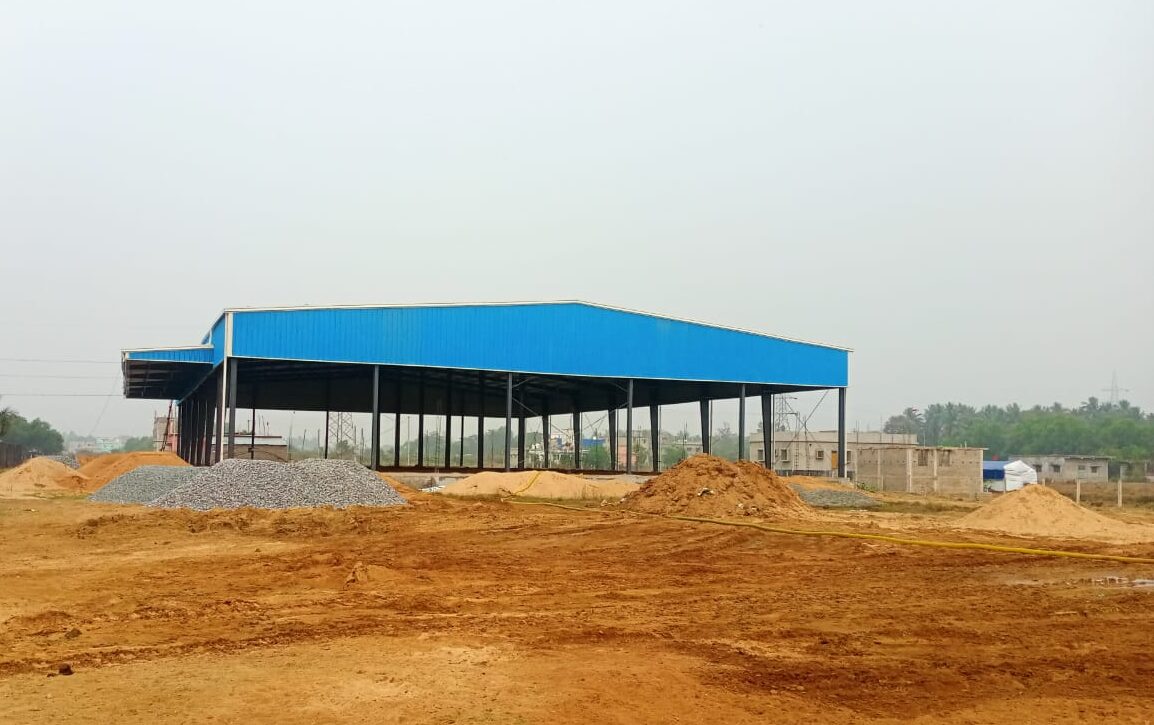
The rice mill construction cost per square foot with Pre-Engineered Buildings offers 25-30% savings compared to traditional construction while providing superior functionality. PEB technology has become the preferred choice for rice mill construction in Telangana and Andhra Pradesh due to:
- Cost Efficiency: PEB reduces rice mill construction cost per square foot by ₹400-600 compared to RCC
- Faster Construction: 40-50% faster completion enabling earlier revenue generation
- Superior Design: Clear-span structures ideal for rice milling machinery layout
- Dust Control: Better ventilation and dust extraction system integration
- Durability: 50+ year lifespan with minimal maintenance requirements
- Expansion Ready: Easy future capacity additions with modular PEB design
Understanding these PEB advantages helps optimize your rice mill construction cost per square foot investment while ensuring operational excellence.
Rice Mill Construction Cost per Square Foot: PEB vs Traditional Analysis
Comprehensive Cost Breakdown by Mill Capacity
| Mill Capacity | Required Area (Sq Ft) | PEB Cost/Sq Ft (₹) | RCC Cost/Sq Ft (₹) | PEB Savings | Construction Time |
|---|---|---|---|---|---|
| 5 TPH (Small) | 8,000-10,000 | ₹1,600-2,200 | ₹2,200-2,800 | ₹48-60 L | 3-4 months |
| 10 TPH (Medium) | 12,000-15,000 | ₹1,500-2,100 | ₹2,100-2,700 | ₹72-90 L | 4-5 months |
| 20 TPH (Large) | 18,000-25,000 | ₹1,400-2,000 | ₹2,000-2,600 | ₹1.08-1.50 Cr | 5-6 months |
| 30 TPH (Commercial) | 25,000-35,000 | ₹1,300-1,900 | ₹1,900-2,500 | ₹1.50-2.10 Cr | 6-7 months |
| 50 TPH (Industrial) | 35,000-50,000 | ₹1,200-1,800 | ₹1,800-2,400 | ₹2.10-3.00 Cr | 7-9 months |
Component-wise PEB Rice Mill Construction Cost per Square Foot
Detailed PEB Cost Breakdown for Standard 10 TPH Rice Mill:| Cost Component | PEB Cost (₹/Sq Ft) | % of Total | PEB Advantage |
|---|---|---|---|
| PEB Steel Structure | ₹650-950 | 40-45% | Clear span design, no columns |
| Roofing & Wall Cladding | ₹300-450 | 18-20% | Insulated panels, dust-proof |
| Foundation (Lighter) | ₹150-280 | 10-12% | 40% less concrete needed |
| Industrial Flooring | ₹120-200 | 7-9% | Heavy machinery support |
| Integrated Ventilation | ₹80-150 | 5-7% | Built-in turbo ventilators |
| Dust Control System | ₹70-130 | 4-6% | Integrated cyclone mounting |
| Electrical Infrastructure | ₹100-180 | 6-8% | Pre-planned cable routing |
| Doors, Shutters & Access | ₹80-140 | 5-6% | Large sliding doors, loading |
| Total PEB Cost/Sq Ft | ₹1,550-2,480 | 100% | 25-30% cost savings |
Why PEB is Ideal for Rice Mill Construction
Technical Advantages of PEB for Rice Processing
1. Clear Span Design Optimizes Rice Mill Layout
- No internal columns allowing flexible machinery placement
- Easy material flow from receiving to packaging
- Overhead crane installation for heavy equipment maintenance
- Unobstructed space for future capacity additions
2. Superior Dust Management
- Sealed roof and wall panels preventing dust accumulation
- Easy integration of cyclone separators and dust collectors
- Positive pressure ventilation systems
- Smooth internal surfaces for easy cleaning
3. Better Ventilation for Grain Quality
- Ridge ventilation maintaining optimal temperature
- Turbo ventilators preventing moisture buildup
- Cross-ventilation design protecting grain quality
- Natural cooling reducing energy costs
4. Heavy Equipment Support
- Structural steel frames supporting heavy machinery loads
- Pre-designed crane beam integration
- Vibration-resistant foundations
- Easy installation of mezzanine floors for storage
5. Faster Construction Timeline
- 40-50% faster than RCC construction
- Parallel foundation and fabrication work
- Weather-independent assembly
- Earlier mill commissioning and revenue generation
State-wise Rice Mill Construction Cost per Square Foot Analysis
Telangana: The Most Cost-Effective PEB Rice Mill Location
| State/Region | PEB Cost/Sq Ft (₹) | Labor Cost Index | Material Logistics | Government Support |
|---|---|---|---|---|
| Telangana | ₹1,400-2,000 | 100 (Base) | ⭐⭐⭐⭐⭐ | ⭐⭐⭐⭐⭐ |
| Andhra Pradesh | ₹1,450-2,100 | 105 | ⭐⭐⭐⭐⭐ | ⭐⭐⭐⭐ |
| Punjab | ₹1,600-2,300 | 120 | ⭐⭐⭐⭐ | ⭐⭐⭐ |
| West Bengal | ₹1,550-2,250 | 115 | ⭐⭐⭐ | ⭐⭐⭐ |
| Uttar Pradesh | ₹1,500-2,200 | 110 | ⭐⭐⭐⭐ | ⭐⭐⭐ |
Why Telangana Offers Best Rice Mill Construction Cost per Square Foot:
- TS-iPASS single-window clearance reducing approval time by 70%
- 15-20% lower PEB construction costs due to established supply chain
- Abundant skilled labor for PEB erection and installation
- Strategic location in India’s rice bowl with excellent connectivity
What Actually Moves Rice Mill Construction Cost per Square Foot
Rice mill buildings cost more per square foot than plain warehousing, and the difference comes from four specific requirements rather than from general finish quality.
- Clear height — bucket elevators, destoners and paddy separators drive eaves height well above a standard godown. Height is the single biggest structural cost lever.
- Floor loading — paddy and rice storage concentrates heavy load; the slab and footings must be designed for the stacked or silo load, not a general allowance.
- Dust management — milling is a dusty, explosive-risk environment. Ventilation, extraction routing and electrical fittings all follow from that, and all sit inside the building cost.
- Vibration — rotating milling machinery needs foundations designed for dynamic load, isolated from the main floor slab where the equipment supplier calls for it.
Key takeaway: Two rice mills of identical floor area can differ by 25-30% per square foot purely on clear height and floor loading. Fix both against the actual machinery layout before the frame is engineered, and the rest of the estimate becomes predictable.
Small Scale Dal Mill Setup Cost: Comparative Analysis
Dal Mill vs Rice Mill Construction Cost per Square Foot
| Parameter | Rice Mill (10 TPH) | Dal Mill (5 TPH) | Key Differences |
|---|---|---|---|
| Building Area Required | 12,000-15,000 sq ft | 8,000-10,000 sq ft | Rice mill needs 40% more space |
| PEB Cost per Sq Ft | ₹1,500-2,100 | ₹1,600-2,200 | Dal mill needs better dust control |
| Total Building Cost | ₹2.1-3.15 crores | ₹1.28-2.20 crores | 40-45% cost difference |
| Ventilation Requirements | Standard ridge vents | Enhanced dust extraction | Dal processing generates more dust |
| Floor Loading | Heavy duty 2-3 tons/sq m | Medium 1.5-2 tons/sq m | Rice machinery heavier |
| Construction Timeline | 4-5 months (PEB) | 3-4 months (PEB) | Smaller footprint, faster build |
Small Scale Dal Mill PEB Construction Advantages
Cost-Effective Entry:
- Lower initial investment: ₹1.3-2.2 crores for complete PEB facility
- Faster breakeven: 3-4 years due to lower capital requirement
- Better dust management with PEB sealed construction
- Easy expansion: Add capacity in 1 TPH increments with modular PEB
Ideal for Multi-Processing Units: Many entrepreneurs opt for combined rice + dal mill operations using PEB technology, optimizing building costs by sharing infrastructure:
- Shared receiving and storage areas
- Common dust extraction systems
- Integrated power distribution
- Single PEB structure reducing cost per square foot by 20-25%
Optimal Rice Mill Layout Design Using PEB Technology
Standard 10 TPH Rice Mill Layout (13,500 Sq Ft)
Zone-wise Area Distribution:| Functional Zone | Area (Sq Ft) | % of Total | PEB Design Features |
|---|---|---|---|
| Paddy Receiving & Storage | 3,500 | 26% | High roof for silo integration |
| Processing Area (Main) | 4,500 | 33% | Clear span for machinery layout |
| Rice Storage & Packaging | 3,000 | 22% | Loading dock integrated |
| By-products Storage | 1,200 | 9% | Separate bay with partition |
| Office & Lab | 800 | 6% | Mezzanine floor with AC |
| Electrical Room & Utilities | 500 | 4% | Fire-rated enclosure |
| Total Building Area | 13,500 | 100% | Single PEB structure |
PEB Design Features for Optimal Rice Mill Layout
1. Processing Flow Optimization:
- Single-level or multi-level gravity flow design
- Straight-line material movement reducing handling
- Overhead conveyors using PEB roof structure
- Mezzanine floors for storage and quality control
2. Dust Control Integration:
- Centralized cyclone separator on PEB roof
- Duct routing through structural members
- Sealed wall and roof panels preventing leaks
- Easy-clean smooth interior surfaces
3. Ventilation Strategy:
- Ridge ventilators at roof peak for hot air escape
- Turbo ventilators maintaining air circulation
- Louvers for fresh air intake at lower levels
- Controlled environment protecting grain quality
4. Expansion Capability:
- Modular PEB bays allowing future additions
- Pre-planned foundation for capacity increase
- Structural design for additional mezzanines
- Easy integration of new machinery
Kishore Infratech Private Limited: Leading PEB Rice Mill Construction
45+ Years of Agro-Processing Infrastructure Excellence
Kishore Infratech Private Limited stands as Telangana’s premier PEB construction partner for rice mills, dal mills, and food processing facilities. With facilities in Cherlapally and Nacharam, Hyderabad, the company has delivered over 100+ agro-processing PEB structures across Telangana and Andhra Pradesh since 1980.
Legacy in Food Processing Infrastructure:
- 1980s: Started serving rice mill industry with sheet metal fabrication
- 1990s: Expanded to complete rice mill shed construction
- 2000s: Pioneered PEB technology for modern rice mills in Telangana
- 2010s: Delivered large-scale rice processing complexes
- Present: South India’s most comprehensive PEB solution for agro-processing
Advanced PEB Manufacturing Capabilities for Rice Mills
17 State-of-the-Art Machines Ensuring Quality:| Equipment Category | Machine Details | Rice Mill Application |
|---|---|---|
| CNC Precision Cutting | Proarc Plasma + Oxy-fuel, 3m x 13m bed | Accurate structural steel cutting for precise fit |
| Beam Processing | Future Automation CTX1000 | Primary frames and rafters for clear spans |
| Heavy Lifting Systems | 12MT Hydra + 5MT EOT Cranes | Installation of heavy rice mill machinery |
| Welding Excellence | 6 MIG + 5 Arc Welding Stations | Quality joints ensuring structural integrity |
| Custom Purlin Manufacturing | Z & C Purlin Machine, 100-300mm | Roof purlins for panel mounting |
| Surface Treatment | Airless Painting Systems (7L/min) | Corrosion protection for 20+ year life |
Proven Rice Mill PEB Projects Portfolio
Major Agro-Processing Clients:
- Multiple 10-30 TPH rice mills across Nalgonda, Karimnagar, Warangal districts
- Dal mill and pulse processing facilities in Telangana
- Combined rice + dal processing units
- Rice mill modernization and capacity expansion projects
- Integrated paddy storage silos with processing facilities
Project Delivery Excellence:
- Average completion time: 4-5 months for 10 TPH rice mill PEB
- Cost optimization: 15-25% savings through integrated approach
- Quality assurance: Zero defect record in structural performance
- After-sales support: Maintenance and expansion services
Related rice mill guides: For the complete project budget including machinery, licensing, and working capital, see our rice mill project cost guide for 2026. For process flow and equipment placement, see the rice mill layout and plant design guide.
Planning a Rice Mill?
Get a Free PEB Design & Quotation.
Share your mill capacity — our engineers call you back within 24 hours with a machinery-coordinated shed design and transparent costing.
- Mill sheds with machinery-coordinated layouts & spans
- Hot-dip galvanized purlins for parboiling & dryer zones
- Godown, dryer & silo blocks integrated in one structure
- Faster erection than RCC — months, not years
- 45+ years steel fabrication, 700+ projects delivered
Prefer to speak directly? Call 9440407852
Thank You!
Our PEB engineers will call you back shortly with your free rice mill shed proposal and quotation.
Want a faster response?
📱 Chat with us on WhatsAppWhy Choose Kishore Infratech for Rice Mill PEB Construction
Cost Optimization Benefits:
- Single-vendor solution reducing costs by 15-25%
- Faster construction enabling earlier mill commissioning
- Quality materials reducing long-term maintenance
- Energy-efficient design lowering operational costs
- Expansion-ready structure protecting future investment
Technical Expertise:
- 45+ years experience in agro-processing infrastructure
- Understanding of rice mill operational requirements
- Dust management and ventilation expertise
- Heavy machinery support structure design
- Compliance with food processing regulations
Rice Mill Construction Timeline: PEB vs Traditional
Detailed Project Timeline Comparison
| Project Phase | PEB Timeline | Traditional RCC | Time Savings |
|---|---|---|---|
| Design & Approvals | 3-4 weeks | 6-8 weeks | 50% faster |
| Foundation Work | 3-4 weeks | 6-8 weeks | 40% less concrete |
| PEB Fabrication (Parallel) | 4-6 weeks | N/A | Parallel to foundation |
| Structural Construction | 4-6 weeks | 12-16 weeks | 60% faster erection |
| Roofing & Cladding | 2-3 weeks | 4-6 weeks | Weather independent |
| Finishing & Utilities | 3-4 weeks | 6-8 weeks | Simpler integration |
| Total Timeline | 16-20 weeks | 34-46 weeks | 4-6 months faster |
Revenue Impact of Faster Construction:
- PEB mill operational in 4-5 months vs 8-10 months for RCC
- 4-5 months additional revenue generation
- Earlier market entry during peak season
- Faster ROI realization by 30-40%
Frequently Asked Questions: Rice Mill Construction Cost
What is the rice mill construction cost per square foot in Telangana using PEB?
A pre-engineered rice mill shed in Telangana runs an estimated ₹1,400–2,000 per sq ft, against ₹2,100–2,700 per sq ft for comparable RCC construction. A standard 10 TPH mill needing about 13,500 sq ft therefore works out to roughly ₹2.1–2.8 crore for the building envelope. The figure covers structural steel, roofing and cladding, foundation, industrial flooring, ventilation and basic electrical routing. All figures are indicative planning estimates, not quotations.
Why does a PEB rice mill cost less per square foot than RCC?
The saving comes from four measurable places: roughly 40% less concrete in the foundations because the steel frame is lighter, about 50% less on-site labour because components arrive factory-fabricated, material wastage of around 5% against 15–20% in RCC, and no spend on formwork or scaffolding. Faster completion also cuts the indirect cost of supervision and financing by 30–40%. Clear-span framing, integrated ventilation and dust-control mountings come as part of the structure rather than as extras.
How does mill capacity change the cost per square foot?
Cost per square foot falls as capacity rises, because design, approvals, electrical rooms and offices are spread over more area. Indicative rates are ₹1,600–2,200 per sq ft at 5 TPH (8,000–10,000 sq ft), ₹1,500–2,100 at 10 TPH (12,000–15,000 sq ft), ₹1,400–2,000 at 20 TPH (18,000–25,000 sq ft) and ₹1,200–1,800 at 50 TPH (35,000–50,000 sq ft). Larger mills do need heavier machine foundations and more capable dust extraction, which offsets part of the scale benefit.
What does the per-square-foot cost actually break down into?
For a 10 TPH mill the PEB steel structure is the largest line at an estimated ₹650–950 per sq ft, or 40–45% of the building cost. Roofing and wall cladding follow at ₹300–450, foundation at ₹150–280, industrial flooring at ₹120–200 and electrical infrastructure at ₹100–180. Integrated ventilation (₹80–150), dust control mounting (₹70–130) and doors and shutters (₹80–140) complete the envelope, totalling roughly ₹1,550–2,480 per sq ft.
What should I budget beyond the building itself?
The building is usually about a third of the total project. Plan separately for land, site development such as levelling, approach roads and compound wall (an estimated ₹2–4 lakh), milling machinery (₹40–80 lakh for a 10 TPH line), electrical infrastructure including transformer and panels (₹8–15 lakh), water supply and drainage (₹3–6 lakh), the dust collection system (₹5–10 lakh) and a weighbridge (₹3–5 lakh). Bulk storage silos, if you integrate them, add materially on top.
What makes a rice mill structure different from an ordinary warehouse?
Four requirements drive the difference, and all of them are structural rather than cosmetic. Floor loading is 2–3 tonnes per sq m against 1–1.5 in a u003Ca class=u0022wpil_keyword_linku0022 href=u0022https://kishoreindustries.in/warehouse-construction-cost-india-2025-peb-traditional-analysis/u0022 target=u0022_blanku0022 rel=u0022noopeneru0022 title=u0022Warehouse Construction Cost in India 2026: Complete Pricing Guide with PEB vs Traditional Analysisu0022 data-wpil-keyword-link=u0022linkedu0022 data-wpil-replace=u0022u0022u003Ewarehouseu003C/au003E, so the slab and footings are designed for stacked grain, not a general allowance. Machinery vibration needs isolated foundations, the roof structure has to carry bucket elevators and pneumatic conveying, and clear height of 7–8 m is set by the elevators and destoners rather than by storage.
What clear height does a rice mill need, and why does it matter so much?
Plan for 7–8 m clear height in a rice mill against 4–5 m in a plain godown, because bucket elevators, destoners and paddy separators set the eaves. Height is the single biggest structural cost lever in the whole building — it drives column section, rafter depth, wind load and cladding area together. Fixing the machinery layout before the frame is engineered is what keeps the per-square-foot figure under control.
What is a sensible layout for a 10 TPH rice mill?
In a 13,500 sq ft clear-span shed, an indicative split is 3,500 sq ft for paddy receiving and storage with a drive-in unloading bay, 4,500 sq ft for the processing line in linear flow, and 3,000 sq ft for rice storage and packing. A further 1,200 sq ft serves by-products such as husk and bran with pneumatic evacuation, 800 sq ft goes to a mezzanine office and QC lab, and 500 sq ft to electrical and dust-collection equipment. Clear-span framing lets the machinery line be set by process flow instead of by column positions.
How does layout choice affect the cost per square foot?
A multi-level or gravity-flow layout uses 20–30% less ground area but adds an estimated ₹200–300 per sq ft for mezzanine framing and heavier foundations. Linear single-level flow needs 15–20% more area yet simplifies operation and cuts conveying equipment. Moving storage into external silos reduces the building footprint by 2,000–3,000 sq ft, and leaving 20–25% of the plot clear for a future bay is far cheaper than retrofitting one later.
How does a dal mill compare with a rice mill on construction cost?
A 5 TPH dal mill typically needs 8,000–10,000 sq ft against 12,000–15,000 sq ft for a 10 TPH rice mill, and costs slightly more per square foot — an estimated ₹1,600–2,200 against ₹1,500–2,100 — because dal processing generates 40–50% more dust and needs additional cyclone separators and extraction points. Against that, lighter machinery allows lighter foundations and the required height is 5–6 m rather than 7–8 m. Many operators build both in one clear-span structure and share the receiving, extraction, electrical and dispatch infrastructure.
How does the Telangana and Andhra Pradesh climate affect the design?
Summer temperatures of 40–45°C make insulated roof panels and 15–20 turbo ventilators worth specifying on a 10 TPH mill, at an estimated ₹100–150 per sq ft premium for insulation. Monsoon humidity between June and September calls for vapour barriers and properly sealed cladding to protect grain quality, adding around ₹50–80 per sq ft. In coastal Andhra the frame is designed for wind speeds up to 150 km/h, which affects anchoring and bracing rather than the cladding.
How does maintenance cost compare with RCC over the buildingu0027s life?
Annual maintenance on a PEB rice mill runs an estimated ₹25–40 per sq ft — repainting every 8–10 years, joint inspection and gutter cleaning — against ₹40–65 per sq ft for RCC, where seepage repair, crack filling and plaster work recur. RCC roofs also need complete re-waterproofing every 5–7 years. Over a 25-year life, PEB maintenance typically lands 30–40% lower, and damaged roof or wall panels can be replaced individually rather than repaired in place.
Does Kishore Infratech handle the approvals for a rice mill?
No. Kishore Infratech Private Limited is a PEB manufacturer, not an approval agency — we do not file applications or liaise with departments on your behalf. What we provide is the structural drawings, design calculations and stamped documentation your own architect, liaison consultant or licensed professional submits to the relevant authority. Approvals for a rice mill typically involve building plan permission, fire NOC, FSSAI registration and an industrial power connection, and the timeline is set by those authorities.
Conclusion: Optimizing Rice Mill Construction Cost per Square Foot with PEB Technology
Understanding rice mill construction cost per square foot is fundamental to successful agro-processing venture planning. Pre-Engineered Building technology has revolutionized rice mill construction in Telangana and Andhra Pradesh, offering 25-30% cost savings, 40-50% faster construction, and superior operational performance compared to traditional methods.
Key Takeaways for Rice Mill Entrepreneurs:
Technical Advantages of PEB: ✅ Clear-span design optimizing rice mill layout and machinery placement
✅ Superior dust management with sealed construction and integrated systems
✅ Better ventilation maintaining grain quality and reducing losses
✅ Heavy equipment support with pre-designed structural capabilities
✅ Faster construction enabling earlier commissioning and revenue generation
Kishore Infratech: Your Trusted PEB Rice Mill Construction Partner
With 45+ years of agro-processing infrastructure experience, Kishore Infratech Private Limited offers unmatched expertise in optimizing rice mill construction cost per square foot while ensuring operational excellence:
🏭 Complete Solutions: Design, manufacturing, installation, and commissioning
⚙️ Advanced Technology: 17 state-of-the-art machines for precision PEB fabrication
📈 Cost Savings: 15-25% reduction through integrated single-vendor approach
⏱️ Faster Delivery: 4-5 month completion enabling early mill operation
✅ Quality Assurance: 10-year structural warranty on PEB construction
🌾 Sector Expertise: 100+ agro-processing projects across Telangana and Andhra Pradesh
Ready to build your rice mill with optimized construction cost per square foot? Contact Kishore Infratech Private Limited for comprehensive consultation, detailed cost estimation, and turnkey PEB solutions that combine 45+ years of experience with modern technology for exceptional value.
Contact Kishore Infratech Private Limited:
🌐 Website: kishoreindustries.in
🏭 Facilities: Cherlapally & Nacharam, Hyderabad, Telangana
⚙️ Specialization: Complete PEB solutions for rice mills, dal mills, and food processing
📞 Service Area: Telangana, Andhra Pradesh, and across South India
Kishore Infratech Private Limited – Where 45+ years of agro-processing expertise meets modern PEB technology to deliver South India’s most cost-effective rice mill construction solutions.